


AI in drug development: a multidisciplinary perspective
- PMID: 34251580
- PMCID: PMC8342381
- DOI: 10.1007/s11030-021-10266-8
AI in drug development: a multidisciplinary perspective
Abstract
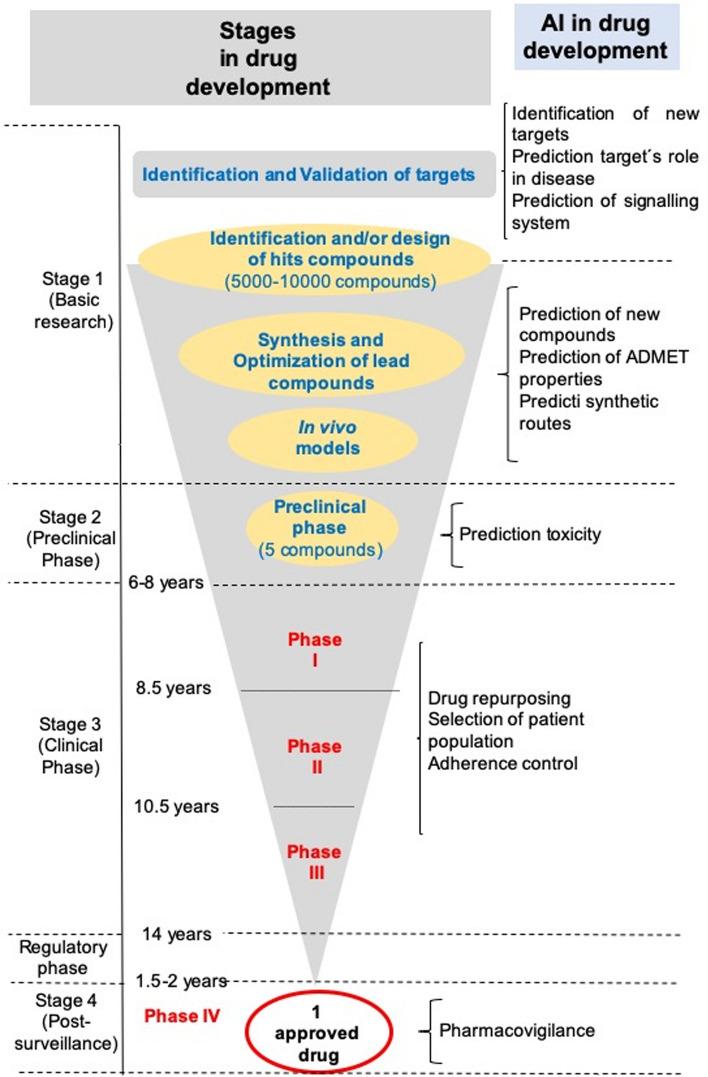
The introduction of a new drug to the commercial market follows a complex and long process that typically spans over several years and entails large monetary costs due to a high attrition rate. Because of this, there is an urgent need to improve this process using innovative technologies such as artificial intelligence (AI). Different AI tools are being applied to support all four steps of the drug development process (basic research for drug discovery; pre-clinical phase; clinical phase; and postmarketing). Some of the main tasks where AI has proven useful include identifying molecular targets, searching for hit and lead compounds, synthesising drug-like compounds and predicting ADME-Tox. This review, on the one hand, brings in a mathematical vision of some of the key AI methods used in drug development closer to medicinal chemists and, on the other hand, brings the drug development process and the use of different models closer to mathematicians. Emphasis is placed on two aspects not mentioned in similar surveys, namely, Bayesian approaches and their applications to molecular modelling and the eventual final use of the methods to actually support decisions. Promoting a perfect synergy.
Keywords: Artificial intelligence; Bayesian methods; Chemoinformatics; Decision support; Deep learning; Drug development; Machine learning.
© 2021. The Author(s).
Figures
References
-
- Kaul V, Enslin S, Gross SA (2020) The history of artificial intelligence in medicine. Gastrointest Endosc - PubMed
