. 2021 Aug 31;12(4):e0082421.
doi: 10.1128/mBio.00824-21. Epub 2021 Jul 13.

Drosophila Antimicrobial Peptides and Lysozymes Regulate Gut Microbiota Composition and Abundance

Affiliations

Drosophila Antimicrobial Peptides and Lysozymes Regulate Gut Microbiota Composition and Abundance

A Marra et al. mBio. .

Abstract

The gut microbiota affects the physiology and metabolism of animals and its alteration can lead to diseases such as gut dysplasia or metabolic disorders. Several reports have shown that the immune system plays an important role in shaping both bacterial community composition and abundance in Drosophila, and that immune deficit, especially during aging, negatively affects microbiota richness and diversity. However, there has been little study at the effector level to demonstrate how immune pathways regulate the microbiota. A key set of Drosophila immune effectors are the antimicrobial peptides (AMPs), which confer defense upon systemic infection. AMPs and lysozymes, a group of digestive enzymes with antimicrobial properties, are expressed in the gut and are good candidates for microbiota regulation. Here, we take advantage of the model organism Drosophila melanogaster to investigate the role of AMPs and lysozymes in regulation of gut microbiota structure and diversity. Using flies lacking AMPs and newly generated lysozyme mutants, we colonized gnotobiotic flies with a defined set of commensal bacteria and analyzed changes in microbiota composition and abundance in vertical transmission and aging contexts through 16S rRNA gene amplicon sequencing. Our study shows that AMPs and, to a lesser extent, lysozymes are necessary to regulate the total and relative abundance of bacteria in the gut microbiota. We also decouple the direct function of AMPs from the immune deficiency (IMD) signaling pathway that regulates AMPs but also many other processes, more narrowly defining the role of these effectors in the microbial dysbiosis observed in IMD-deficient flies upon aging. IMPORTANCE This study advances current knowledge in the field of host-microbe interactions by demonstrating that the two families of immune effectors, antimicrobial peptides and lysozymes, actively regulate the gut microbiota composition and abundance. Consequences of the loss of these antimicrobial peptides and lysozymes are exacerbated during aging, and their loss contributes to increased microbiota abundance and shifted composition in old flies. This work shows that immune effectors, typically associated with resistance to pathogenic infections, also help shape the beneficial gut community, consistent with the idea that host-symbiont interactions use the same "language" typically associated with pathogenesis.

Keywords: aging; gnotobiotic animals; gut; immune effectors; innate immunity; microbiota.


Figures
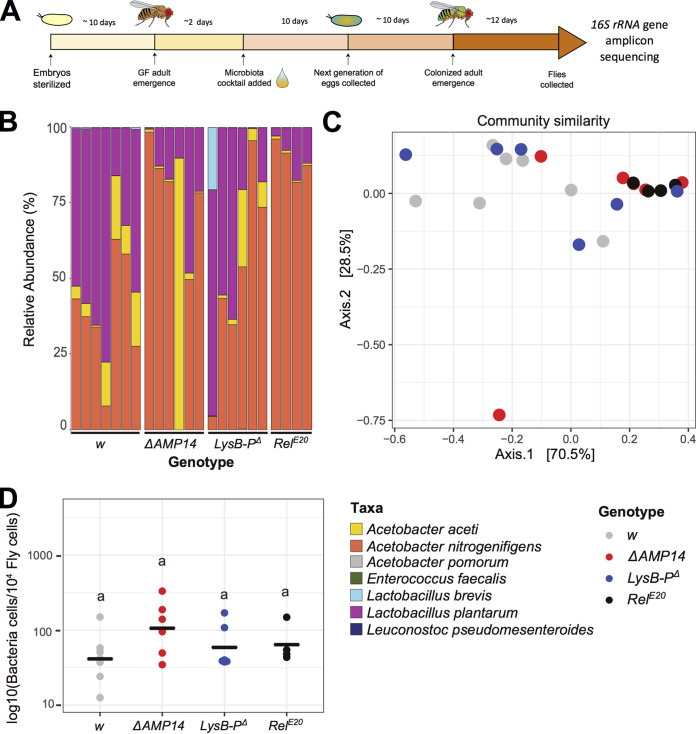
FIG 1
FIG 1
The role of AMPs and lysozymes on microbiota composition and abundance in a gnotobiotic vertical transmission setup. (A) Scheme of the experimental procedure for fly colonization and collection for 16S rRNA gene amplicon sequencing. Parental embryos were collected, sterilized in 3% bleach, and kept on antibiotic food until the adult stage. Emerging GF flies were then associated with a bacterial cocktail (microbiota cocktail) containing six representative microbiota members. Their eggs were collected over 3 days, allowed to develop to adulthood, and finally the microbiota of their adult female progeny was analyzed at ∼12 days after emergence. (B) Relative community composition of the gut microbiota in wild-type iso w1118 (w) wild-type flies, Relish (RelE20), antimicrobial peptide (ΔAMP14), and gut lysozyme (LysB-PΔ) mutants as determined by 16S rRNA gene amplicon sequencing. Each bar represents a biological replicate of multiple pooled flies (see Table S1 in the supplemental material for the numbers of flies included in each sample). (C) Principal coordinate analysis (PCoA) of gut communities in w wild-type flies, RelE20, ΔAMP14, and LysB-PΔ, as determined by 16S rRNA gene amplicon sequencing. Overall colocalization of ΔAMP14 (red dots) and RelE20 (black dots) samples and separation of these from wild-type (gray dots) samples shows that ΔAMP14 and RelE20 samples are similar to each other and differ from wild-type samples. Stochastic distribution of LysB-PΔ samples shows high variability in community structures between samples. (D) Absolute quantification by qPCR of the total number of bacterial cells normalized to the host gene Actin5C. Horizontal black bars show mean values. Details of the statistical outcomes are provided in Table S2.
FIG 2
FIG 2
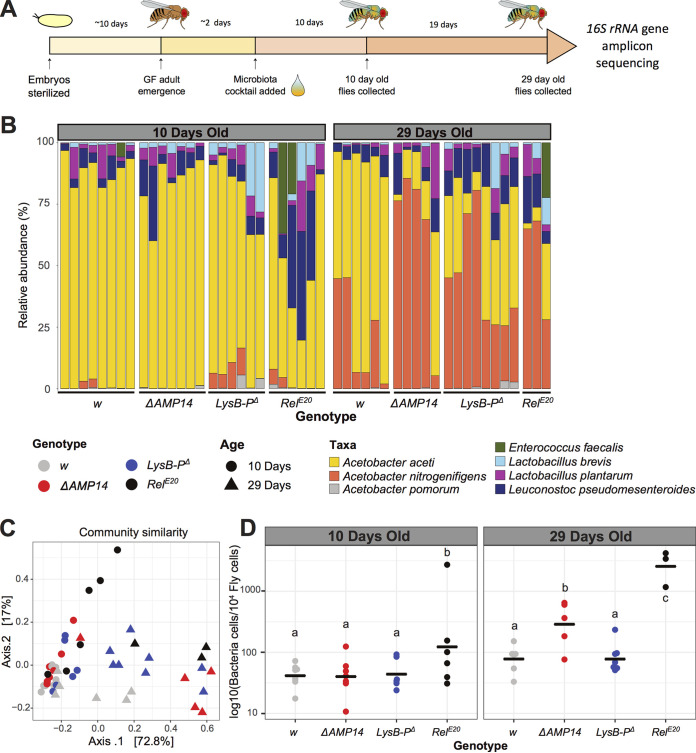
The role of AMPs and lysozymes in microbiota composition and abundance on adult microbiota in a gnotobiotic setup of young and aged flies. (A) Scheme of the experimental procedure for fly colonization and collection for 16S rRNA gene amplicon sequencing. Embryos were collected, sterilized in 3% bleach, and kept on antibiotic food until the adult stage. Emerging GF flies were associated with a bacterial cocktail containing six representative microbiota members. Females were collected for DNA extraction and 16S rRNA gene amplicon sequencing at 10 and 29 days after colonization. See Table S1 for the number of flies included in each sample. (B) Relative community composition of the gut microbiota in iso w1118 (w) wild-type flies and Relish (RelE20), antimicrobial peptide (ΔAMP14), and gut lysozyme (LysB-PΔ) mutants at 10 days (left panel) and 29 days (right panel) after colonization. Each bar in the plot represents a biological replicate with a pool of 5 flies each. (C) Principal coordinate analysis based on Bray-Curtis dissimilarities on the gut communities of w control flies, RelE20, ΔAMP14, and LysB-PΔ mutants at 10 and 29 days after colonization, based on 16S rRNA gene amplicon sequencing. Separation of the 10-day-old (dots) and 29-day-old clusters on the first axis indicates that aging is the major factor defining bacterial community composition in adults. Separation of ΔAMP14 and RelE20 (red and black triangles) from wild-type and LysB-PΔ (gray and blue triangles) on the same axis in the 29-day samples indicates that aging and loss of immune effectors act on microbiota composition in similar directions. (D) Absolute quantification of the total number of bacterial cells by qPCR, normalized to the host gene Actin5C. Horizontal black bars show mean values. Details of the statistical outcomes are provided in Table S2.
FIG 3
FIG 3
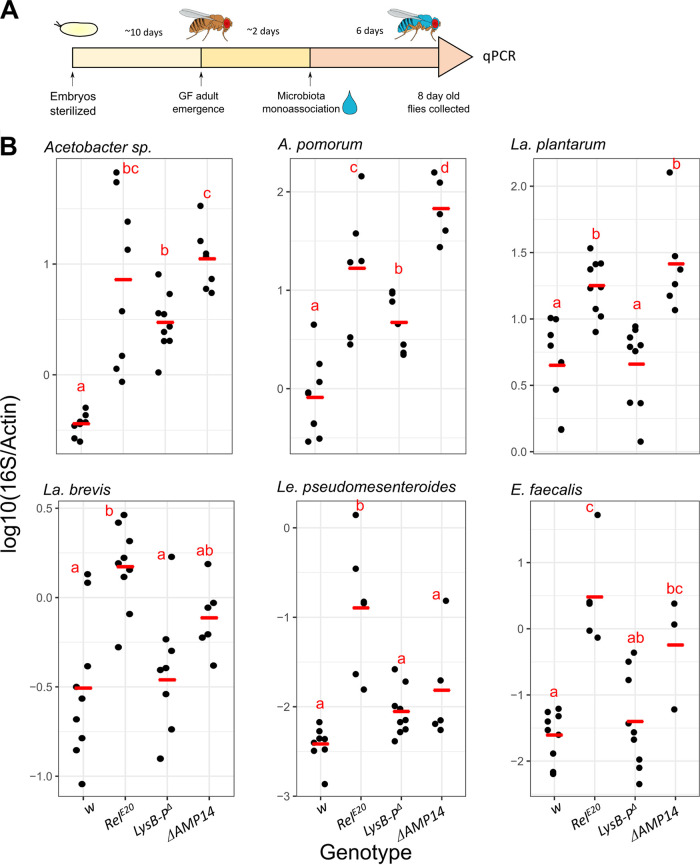
Regulation of individual microbiota members in mono-association. (A) Scheme of the experimental procedure of the mono-association experiment. Embryos were collected, sterilized in 3% bleach, and kept on antibiotic food until the adult stage. Newly emerged GF flies were then mono-associated with a single bacterial isolate. Six days after colonization, the host and bacterial DNA was extracted and qPCR analysis of the microbial load was performed. (B) Total microbial load was determined by quantitative PCR (qPCR) in female flies at 6 days after mono-association with iso w1118 (w) wild-type flies versus Relish (RelE20), antimicrobial peptide (ΔAMP14), and gut lysozyme (LysB-PΔ) mutant flies. Bacterial loads were assessed by qPCR with family/phylum-specific 16S rRNA gene primers and normalized to the host gene Actin5C. Red horizontal bars show mean values. Each dot represents a sample containing five individuals. Letters represent statistical significance (P < 0.05) of adjusted P values (FDR) from pairwise contrasts obtained from a main general linear mixed model; samples with shared letters are not statistically different from each other.
FIG 4
FIG 4
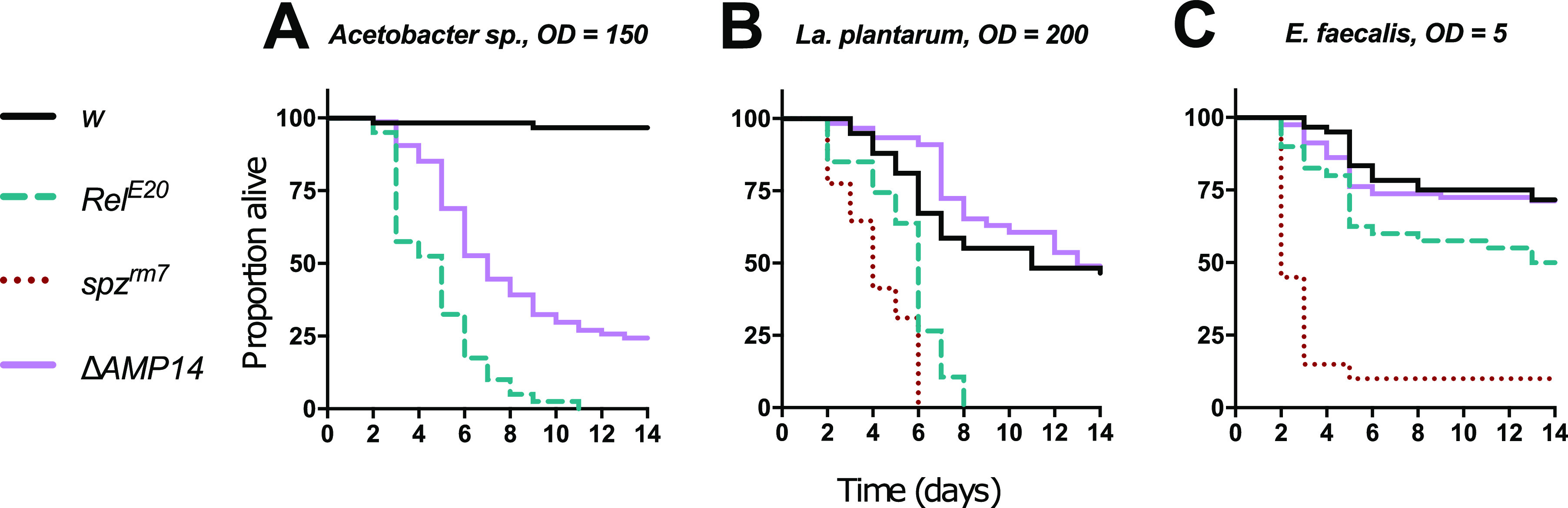
Survival upon systemic infection with microbiota bacteria. Female iso w1118 wild-type flies (w), and Relish (RelE20), antimicrobial peptide (ΔAMP14), and spaetzle (spzrm7) mutants were pricked in the thorax with three common microbiota bacteria: Gram-negative bacterium Acetobacter sp. (A) and two Gram-positive bacteria, La. plantarum (B) and E. faecalis (C). The ΔAMP14 mutants were significantly more susceptible than wild type only to Acetobacter sp. infection (P < 0.001), and otherwise resisted infection like wild type (P > 0.1). Pellet densities are reported for all systemic infections as the OD600 value.

References

    1. Belkaid Y, Harrison OJ. 2017. Homeostatic immunity and the microbiota. Immunity 46:562–576. doi: 10.1016/j.immuni.2017.04.008. - DOI - PMC - PubMed
    1. Kim S, Jazwinski SM. 2018. The gut microbiota and healthy aging: a mini-review. Gerontology 64:513–520. doi: 10.1159/000490615. - DOI - PMC - PubMed
    1. Fung TC, Olson CA, Hsiao EY. 2017. Interactions between the microbiota, immune and nervous systems in health and disease. Nat Neurosci 20:145–155. doi: 10.1038/nn.4476. - DOI - PMC - PubMed
    1. Boulangé CL, Neves AL, Chilloux J, Nicholson JK, Dumas ME. 2016. Impact of the gut microbiota on inflammation, obesity, and metabolic disease. Genome Med 8:42. doi: 10.1186/s13073-016-0303-2. - DOI - PMC - PubMed
    1. Zeng MY, Inohara N, Nuñez G. 2017. Mechanisms of inflammation-driven bacterial dysbiosis in the gut. Mucosal Immunol 10:18–26. doi: 10.1038/mi.2016.75. - DOI - PMC - PubMed

Publication types

MeSH terms

LinkOut - more resources