Co-produced capability framework for successful patient and staff partnerships in healthcare quality improvement: results of a scoping review
- PMID: 34253682
- PMCID: PMC8784995
- DOI: 10.1136/bmjqs-2020-012729
Co-produced capability framework for successful patient and staff partnerships in healthcare quality improvement: results of a scoping review
Abstract
Background: Internationally, patient and public involvement (PPI) is core policy for health service quality improvement (QI). However, authentic QI partnerships are not commonplace. A lack of patient and staff capability to deliver successful partnerships may be a barrier to meaningful QI collaboration.
Objectives: The research questions for this scoping review were: What is known regarding the capabilities required for healthcare staff and patients to effectively partner in QI at the service level?; and What is known regarding the best practice learning and development strategies required to build and support those capabilities?
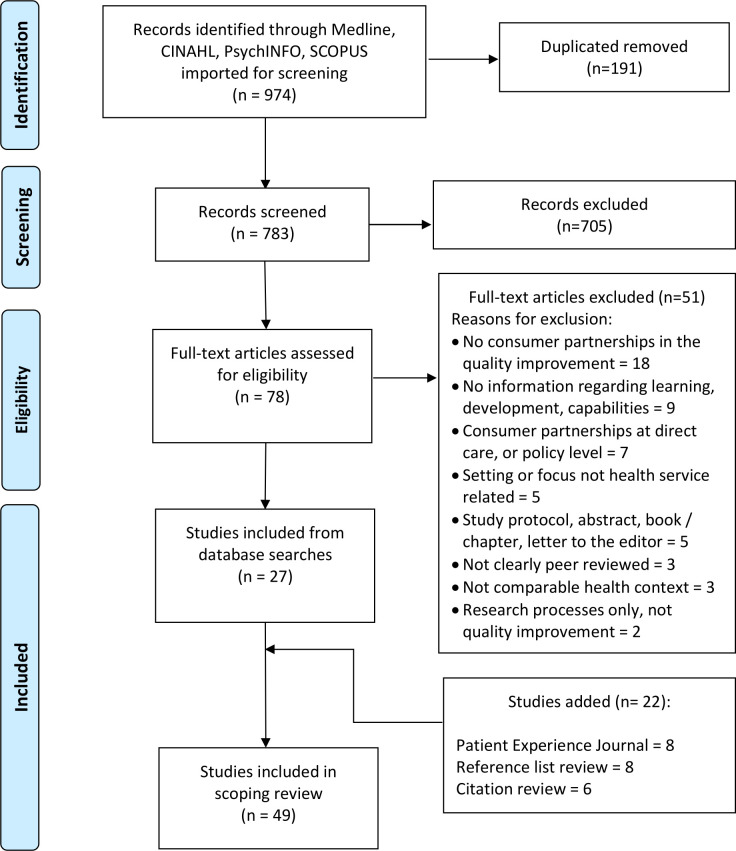
Methods: A six-stage scoping review was completed. Five electronic databases were searched for publications from January 2010 to February 2020. The database searches incorporated relevant terms for the following concepts: capabilities for PPI in healthcare QI; and best practice learning and development strategies to support those capabilities. Data were analysed using descriptive statistics and qualitative content analysis.
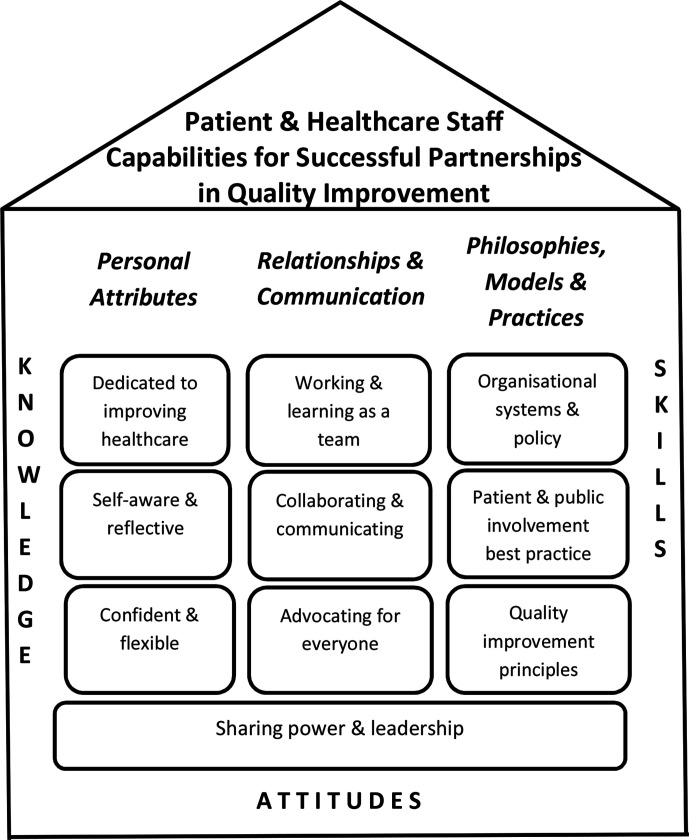
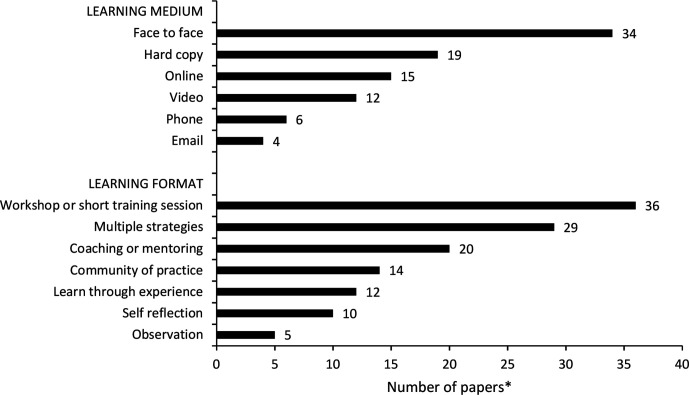
Results: Forty-nine papers were included. Very little peer-reviewed literature focused explicitly on capabilities for QI partnerships and thus implicit paper content was analysed. A Capability framework for successful partnerships in healthcare quality improvement was developed. It includes knowledge, skills and attitudes across three capability domains: Personal Attributes; Relationships and Communication; and Philosophies, Models and Practices, and incorporates 10 capabilities. Sharing power and leadership was discussed in many papers as fundamental and was positioned across all of the domains. Most papers discussed staff and patients' co-learning (n=28, 57.14%). Workshops or shorter structured training sessions (n=36, 73.47%), and face-to-face learning (n=34, 69.38%) were frequently reported.
Conclusion: The framework developed here could guide individualised development or learning plans for patient partners and staff, or could assist organisations to review learning topics and approaches such as training content, mentoring guidelines or community of practice agendas. Future directions include refining and evaluating the framework. Development approaches such as self-reflection, communities of practice, and remote learning need to be expanded and evaluated.
Keywords: attitudes; continuing education; continuing professional development; healthcare quality improvement; patient-centred care.
© Author(s) (or their employer(s)) 2022. Re-use permitted under CC BY-NC. No commercial re-use. See rights and permissions. Published by BMJ.
Conflict of interest statement
Competing interests: None declared.
Figures
References
-
- World Health Organization . Patients for patient safety: partnerships for safer health care. Geneva, Switzerland: WHO Press, 2013.
-
- Australian Commission on Safety and Quality in Health Care . Partnering with consumers standard. Sydney, NSW: Australian Commission on Safety and Quality in Health Care, 2019. http://nationalstandards.safetyandquality.gov.au/2.-partnering-consumers [Accessed 24 Oct 2020]
-
- Kuluski K, Kokorelias KM, Peckham A, et al. Twelve principles to support caregiver engagement in health care systems and health research. Patient Exp J 2019;6:141–8. 10.35680/2372-0247.1338 - DOI
Publication types
MeSH terms
LinkOut - more resources
Full Text Sources
Medical