TRP channels in health and disease at a glance
- PMID: 34254641
- PMCID: PMC8358089
- DOI: 10.1242/jcs.258372
TRP channels in health and disease at a glance
Abstract
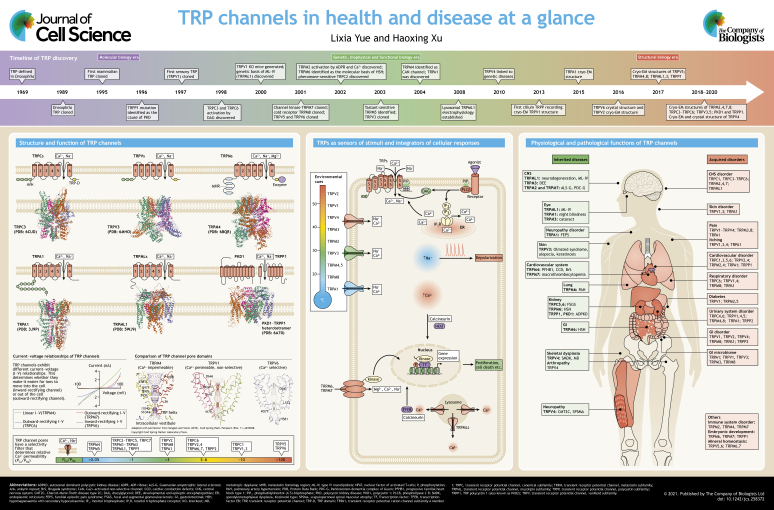
The transient receptor potential (TRP) channel superfamily consists of a large group of non-selective cation channels that serve as cellular sensors for a wide spectrum of physical and environmental stimuli. The 28 mammalian TRPs, categorized into six subfamilies, including TRPC (canonical), TRPV (vanilloid), TRPM (melastatin), TRPA (ankyrin), TRPML (mucolipin) and TRPP (polycystin), are widely expressed in different cells and tissues. TRPs exhibit a variety of unique features that not only distinguish them from other superfamilies of ion channels, but also confer diverse physiological functions. Located at the plasma membrane or in the membranes of intracellular organelles, TRPs are the cellular safeguards that sense various cell stresses and environmental stimuli and translate this information into responses at the organismal level. Loss- or gain-of-function mutations of TRPs cause inherited diseases and pathologies in different physiological systems, whereas up- or down-regulation of TRPs is associated with acquired human disorders. In this Cell Science at a Glance article and the accompanying poster, we briefly summarize the history of the discovery of TRPs, their unique features, recent advances in the understanding of TRP activation mechanisms, the structural basis of TRP Ca2+ selectivity and ligand binding, as well as potential roles in mammalian physiology and pathology.
Keywords: Inherited and acquired disorders; Physiological and pathological roles; Structure–function relationship; TRP channels; TRPA; TRPC; TRPM; TRPML; TRPP; TRPV.
© 2021. Published by The Company of Biologists Ltd.
Conflict of interest statement
Competing interests The authors declare no competing or financial interests.
References
-
- Alkhatib, O., da Costa, R., Gentry, C., Quallo, T., Bevan, S. and Andersson, D. A. (2019). Promiscuous G-Protein-Coupled Receptor Inhibition of Transient Receptor Potential Melastatin 3 Ion Channels by Gbetagamma Subunits. J. Neurosci. 39, 7840-7852. 10.1523/JNEUROSCI.0882-19.2019 - DOI - PMC - PubMed
-
- AlTalbishi, A., Zelinger, L., Zeitz, C., Hendler, K., Namburi, P., Audo, I., Sheffer, R., Yahalom, C., Khateb, S., Banin, E.et al. (2019). TRPM1 Mutations are the Most Common Cause of Autosomal Recessive Congenital Stationary Night Blindness (CSNB) in the Palestinian and Israeli Populations. Sci. Rep. 9, 12047. 10.1038/s41598-019-46811-7 - DOI - PMC - PubMed
Publication types
MeSH terms
Substances
Grants and funding
LinkOut - more resources
Full Text Sources
Molecular Biology Databases
Miscellaneous