


Longitudinal Changes in Cognitive Function in a Nationwide Cohort Study of Patients With Lymphoma Treated With Chemotherapy
- PMID: 34255086
- PMCID: PMC8755506
- DOI: 10.1093/jnci/djab133
Longitudinal Changes in Cognitive Function in a Nationwide Cohort Study of Patients With Lymphoma Treated With Chemotherapy
Abstract
Background: Cancer-related cognitive decline (CRCD) is an important clinical problem, but limited research exists on assessment of cognitive function in patients with lymphoma.
Methods: The overall objective of this nationwide, prospective, observational study conducted in the National Cancer Institute Community Clinical Oncology Research Program (NCORP) was to assess changes in memory, attention, and executive function in patients with lymphoma from pre- (A1) to postchemotherapy (A2) and to 6 months postchemotherapy (A3). Individuals without cancer served as noncancer controls, paired to patients by age and sex, and assessed at the same time-equivalent points. Longitudinal linear mixed models (LMM) including A1, A2, and A3 and adjusting for age, education, race, sex, cognitive reserve score, baseline anxiety, and depressive symptoms were fit. We assessed changes in patients compared with control participants without cancer and assessed differences in cognitive function in those patients with Hodgkin vs non-Hodgkin disease and by disease subtype. All statistical tests were 2-sided.
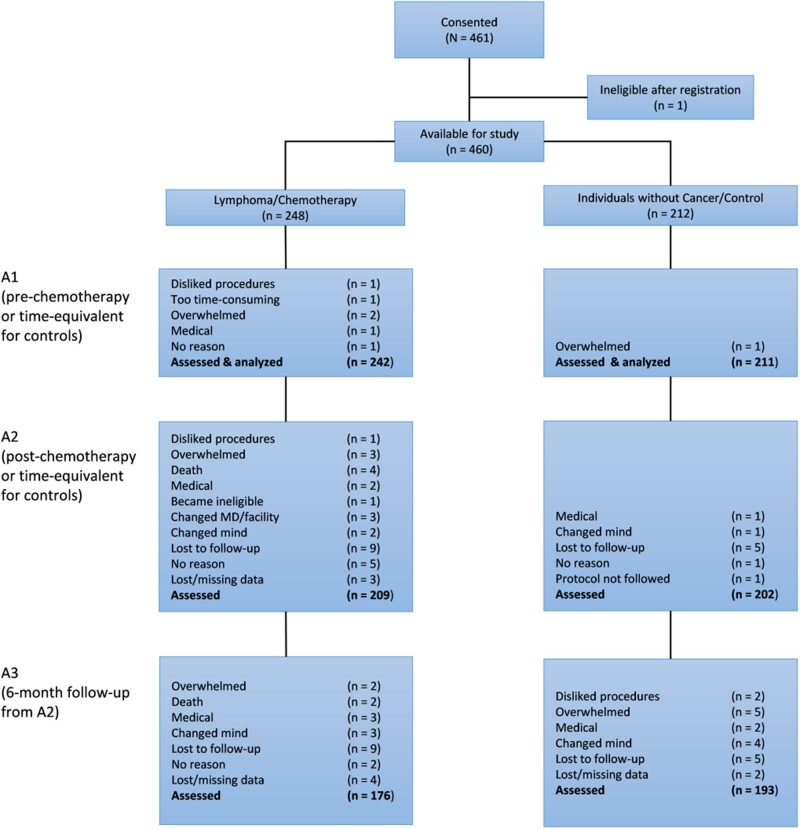
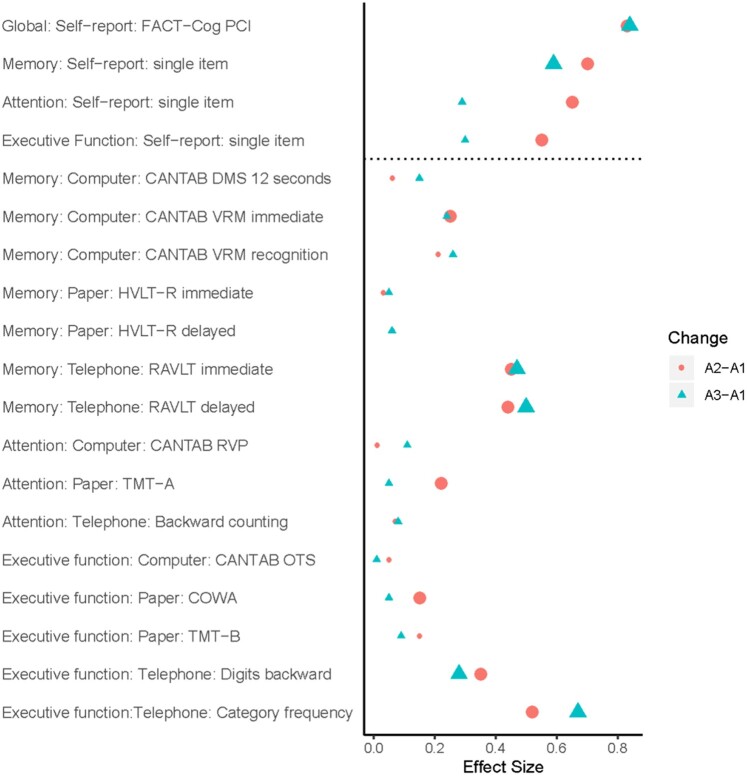
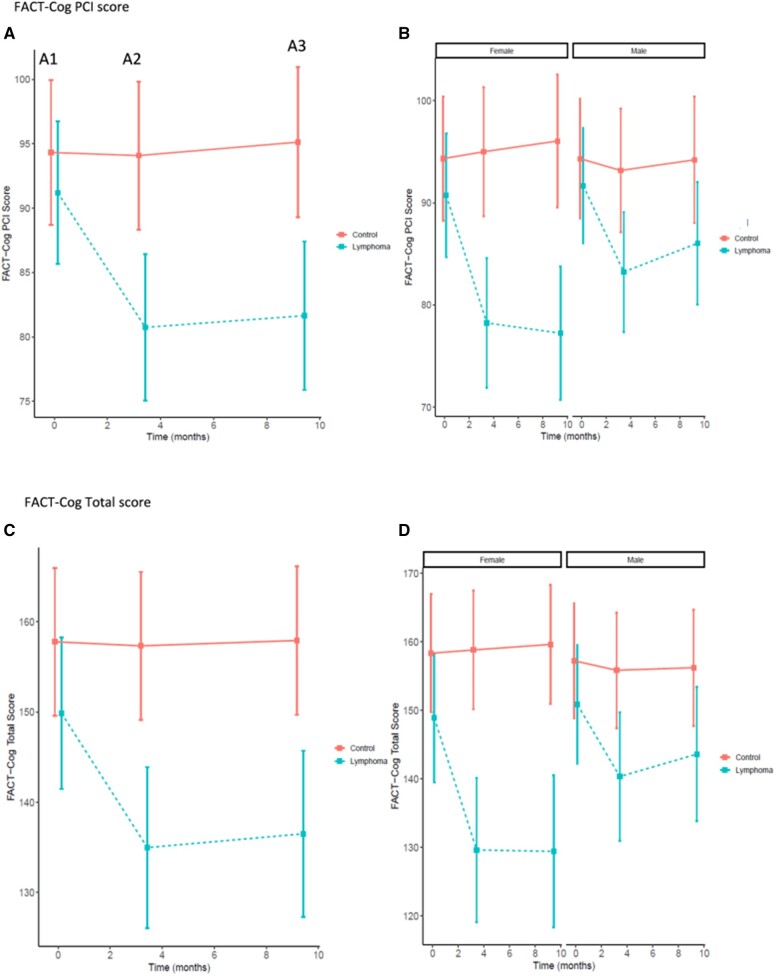
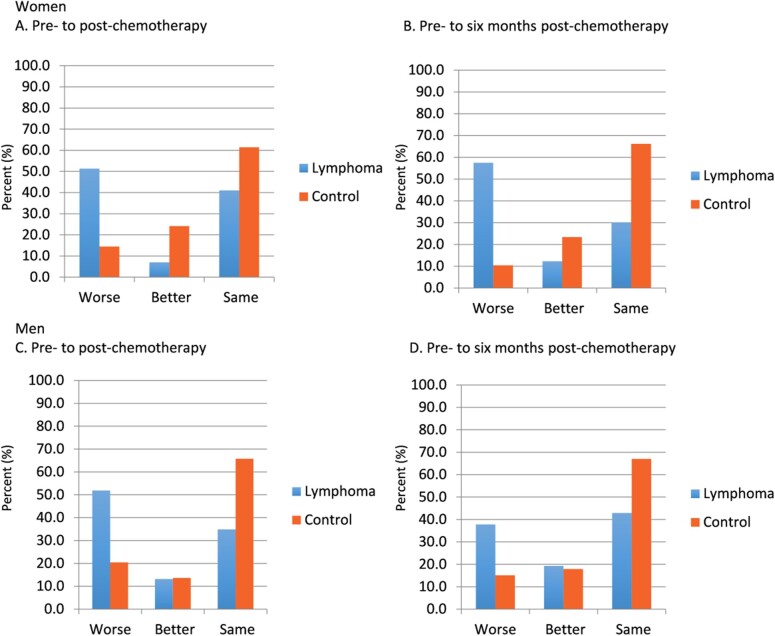
Results: Patients with lymphoma (n = 248) and participants without cancer serving as controls (n = 212) were recruited from 19 NCORP sites. From pre- to postchemotherapy and from prechemotherapy to 6 months follow-up, patients reported more cognitive problems over time compared with controls (Functional Assessment of Cancer-Therapy-Cognitive Function [FACT-Cog] perceived cognitive impairment effect size (ES) = 0.83 and 0.84 for A1 to A2 and A1 to A3, respectively; P < .001; single-item cognitive symptoms ES range = 0.55 to 0.70 inclusive of A1 to A2 and A1 to A3; P < .001); the complaints were more pronounced in women with lymphoma compared with men with lymphoma (FACT-Cog Perceived Cognitive Impairment (PCI) score group-by-time-by-sex interaction, P = .007). Patients with lymphoma also performed statistically significantly less well on tests of verbal memory and delayed recall, attention and executive function, and telephone-based category fluency.
Conclusion: Patients with lymphoma experience worse patient-reported and objectively assessed cognitive function from prechemotherapy to 6-month follow-up compared with age- and sex-paired controls without cancer assessed at similar time intervals.
© The Author(s) 2021. Published by Oxford University Press. All rights reserved. For permissions, please email: journals.permissions@oup.com.
Figures
Comment in
-
Understanding Longitudinal Changes in Cognitive Function in Lymphoma Patients: Where to Next?J Natl Cancer Inst. 2022 Jan 11;114(1):3-4. doi: 10.1093/jnci/djab134. J Natl Cancer Inst. 2022. PMID: 34255081 Free PMC article. No abstract available.
References
-
- Mayo SJ, Lustberg M, Dhillon HM, et al. Cancer-related cognitive impairment in patients with non-central nervous system malignancies: an overview for oncology providers from the MASCC Neurological Complications Study Group. Support Care Cancer 2021;29(6):2821–2840. - PubMed
-
- Wefel JS, Lenzi R, Theriault RL, et al. The cognitive sequelae of standard-dose adjuvant chemotherapy in women with breast carcinoma: results of a prospective, randomized, longitudinal trial. Cancer. 2004;100(11):2292–2299. - PubMed
-
- Bradley CJ, Neumark D, Bednarek HL, et al. Short-term effects of breast cancer on labor market attachment: results from a longitudinal study. J Health Econ. 2005;24(1):137–160. : - PubMed
-
- Hurria A, Zuckerman E, Panageas KS, et al. A prospective, longitudinal study of the functional status and quality of life of older patients with breast cancer receiving adjuvant chemotherapy. J Am Geriatr Soc. 2006;54(7):1119–1124. - PubMed
Publication types
MeSH terms
Grants and funding
LinkOut - more resources
Full Text Sources
Medical
Miscellaneous
