Review
. 2021 Sep 7;49(15):8419-8431.
doi: 10.1093/nar/gkab609.

DNA G-quadruplex structures: more than simple roadblocks to transcription?

Affiliations
Review

DNA G-quadruplex structures: more than simple roadblocks to transcription?

Jenna Robinson et al. Nucleic Acids Res. .

Abstract

It has been >20 years since the formation of G-quadruplex (G4) secondary structures in gene promoters was first linked to the regulation of gene expression. Since then, the development of small molecules to selectively target G4s and their cellular application have contributed to an improved understanding of how G4s regulate transcription. One model that arose from this work placed these non-canonical DNA structures as repressors of transcription by preventing polymerase processivity. Although a considerable number of studies have recently provided sufficient evidence to reconsider this simplistic model, there is still a misrepresentation of G4s as transcriptional roadblocks. In this review, we will challenge this model depicting G4s as simple 'off switches' for gene expression by articulating how their formation has the potential to alter gene expression at many different levels, acting as a key regulatory element perturbing the nature of epigenetic marks and chromatin architecture.


Figures

Graphical Abstract
Graphical Abstract
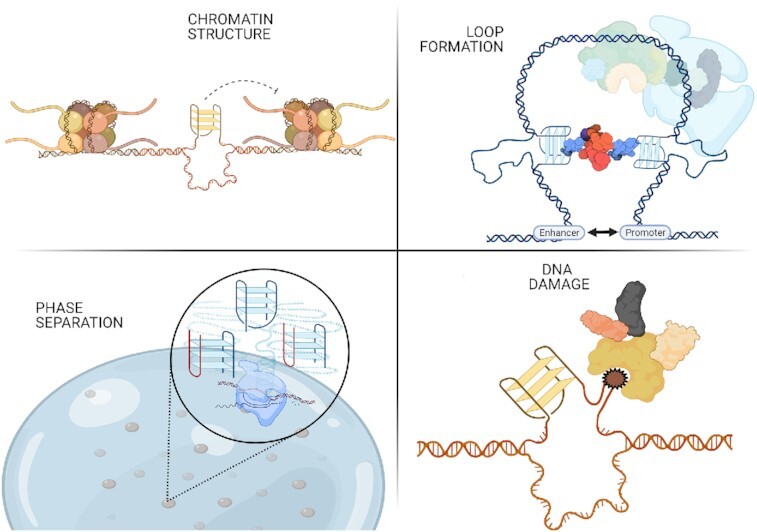
DNA G-quadruplexes act as transcriptional hubs by means of diverse mechanisms, including: modulation of chromatin structure, regulatory protein recruitment and formation of DNA loops, stimulation of liquid-liquid phase separation and eliciting DNA damage and repair.
Figure 1.
Figure 1.
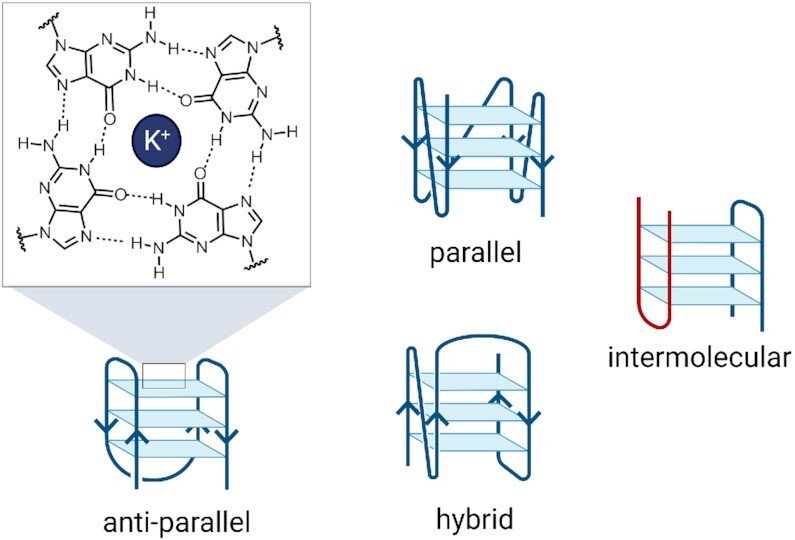
Schematic representation of G-quadruplex structures. G4s are constituted of four guanine bases arranged in a square planar conformation (G-tetrad) held together by Hoogsteen hydrogen bonding and further stabilized by alkali cation such as K+. Specific G4 topologies can be formed and include anti-parallel, parallel and hybrid structures, depending on the relative orientation of the DNA strand within the structure. Intermolecular G4 structures can also be formed when more than one DNA strand is used to generate the final structure (red and blue strands).
Figure 2.
Figure 2.
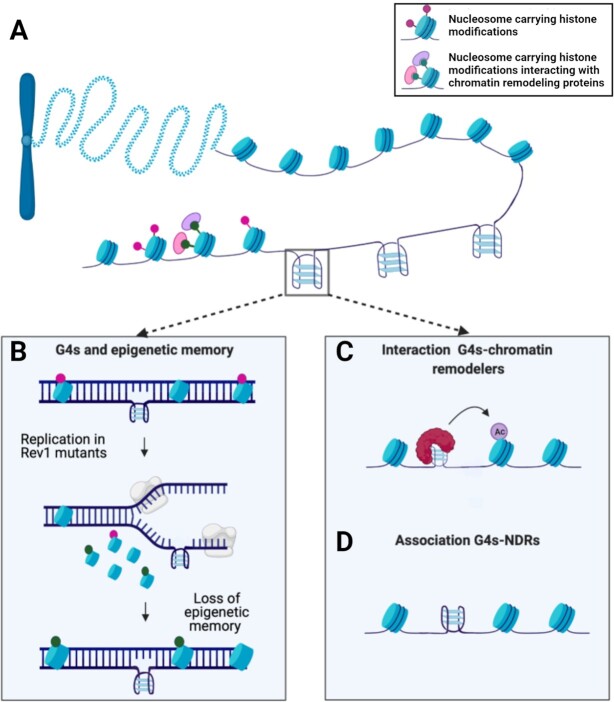
G4s and chromatin structure. (A) Structure of chromatin comprised of DNA wrapped around nucleosome complexes. (B) REV1 mutants unable to resolve G4s during DNA replication exhibit altered histones modifications in the newly synthesized strand and a consequent loss of epigenetic memory. (C) G4s can interact with a wide panel of proteins, including chromatin remodelers such as BRD3. (D) G4s are strongly associated with nucleosome depleted regions (NDRs) as confirmed by BG4-ChIP.
Figure 3.
Figure 3.
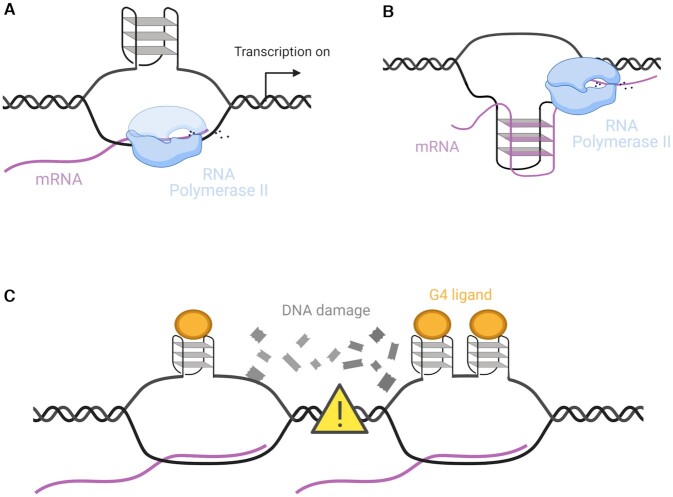
G4s and R-loops. (A) Intramolecular G4s formed on the non-template strand stabilize R-loops and increase transcriptional output in vitro. (B) Intermolecular DNA:RNA hybrid G4s may also form stabilizing R-loops on the template strand. (C) The use of G4-stabilizing small-molecules increases the prevalence of G4s and R-loops within cells. This can lead to the collision of nearby unscheduled R-loops, resulting in DNA-damage which hinders transcription.
Figure 4.
Figure 4.
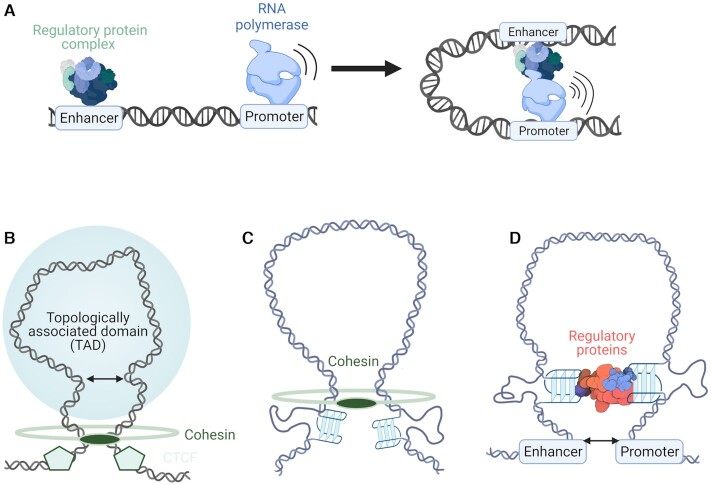
G4s in enhancer-promoter loop formation. (A) Schematic of how enhancers interact with their respective promoters to increase polymerase activity and transcription. (B) Cohesin and CTCF cooperate to form stable loops (topologically associated domains) in DNA. (C) G4 enrichment at loop boundaries possibly stalls cohesin. (D) G4s act as recruiters of regulatory proteins such as transcription factors that stabilize loops.
Figure 5.
Figure 5.
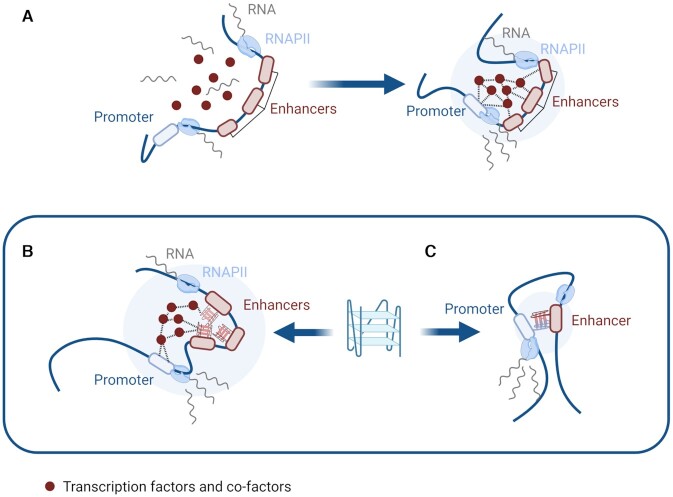
G4s and phase separation. (A) Super-enhancers interact with promoter regions via transcription factors, co-factors and chromatin remodelers triggering LLPS that enhances transcription. (B) G4s at super-enhancer sites may promote aggregation via intermolecular interactions such as π-stacking between quadruplexes. (C) ‘half-G4’ sequences can assemble intermolecularly to mediate enhancer-promoter interactions and phase separation.
Figure 6.
Figure 6.
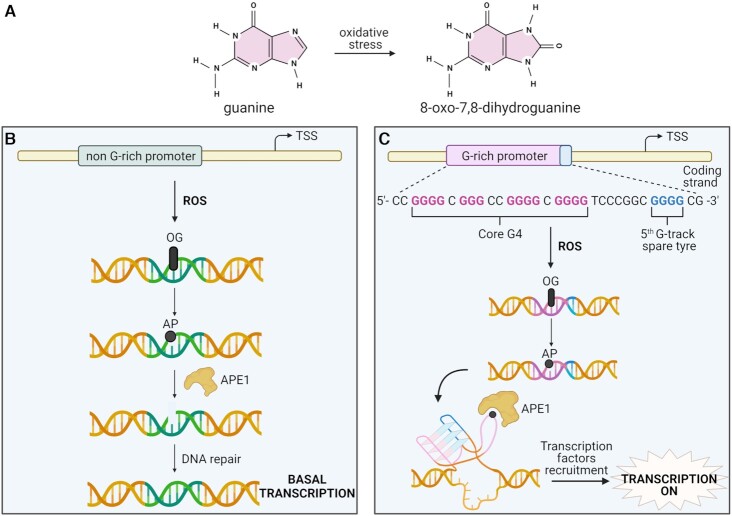
G4s and DNA damage. (A) Guanine is frequently oxidized by oxidative stress generating 8-oxo-7,8-dihydroguanine (OG). (B) OG formation upon ROS damage in a gene promoter without a G4 causes the formation of an apurinic (AP) site that is recognized and cleaved by APE1. This cleaved site is subsequently repaired without increasing the gene transcription level. (C) OG formation in a gene promoter containing a core G4 sequence (in pink) and a fifth G-track (spare tyre in blue) causes the formation of an alternative G4-structure and the extrusion of the AP site into a loop. The structure is recognized and bound by APE1 which reduces the cleaving ability of APE1 and stimulates the recruitment of transcription factors with consequent transcriptional activation.

References

    1. Raguseo F., Chowdhury S., Minard A., Di Antonio M.. Chemical-biology approaches to probe DNA and RNA G-quadruplex structures in the genome. Chem. Commun. 2020; 56:1317–1324. - PubMed
    1. Spiegel J., Adhikari S., Balasubramanian S.. The structure and function of DNA G-Quadruplexes. Trends Chem. 2020; 2:123–136. - PMC - PubMed
    1. Kwok C.K., Merrick C.J.. G-Quadruplexes: prediction, characterization, and biological application. Trends Biotechnol. 2017; 35:997–1013. - PubMed
    1. Mukherjee A.K., Sharma S., Chowdhury S.. Non-duplex G-Quadruplex structures emerge as mediators of epigenetic modifications. Trends Genet. 2019; 35:129–144. - PMC - PubMed
    1. Gellert M., Lipsett M.N., Davies D.R.. Helix formation by guanylic acid. Proc. Natl. Acad. Sci. U.S.A. 1962; 48:2013–2018. - PMC - PubMed

Publication types

MeSH terms

Grants and funding