


Development of the WHO STARS: A Tool for the Systematic Assessment of Rehabilitation Situation
- PMID: 34256023
- PMCID: PMC8769206
- DOI: 10.1016/j.apmr.2021.04.025
Development of the WHO STARS: A Tool for the Systematic Assessment of Rehabilitation Situation
Abstract
Objective: To present the development process of the World Health Organization (WHO) Systematic Assessment of Rehabilitation Situation (STARS).
Design: A conceptualization phase to establish its objective and identify the content for comprehensively describing rehabilitation in countries, a second phase to draft, and a third phase to refine the tool. Reviews of existing health system assessment (HSA) tools used in other areas of health as well as expert consultations occurred.
Setting: The WHO initiated the development of STARS because there is currently no comprehensive HSA tool for rehabilitation that supports stakeholders describing their country situation and identifying priority actions.
Participants: The WHO rehabilitation team, experts representing rehabilitation professions and from all WHO regions, and government and rehabilitation consumer groups.
Interventions: Conceptualizing, drafting, consulting, and reviewing of the WHO STARS.
Main outcomes measures: Development of a tool that is comprehensive and able to support countries to describe rehabilitation and identify priorities.
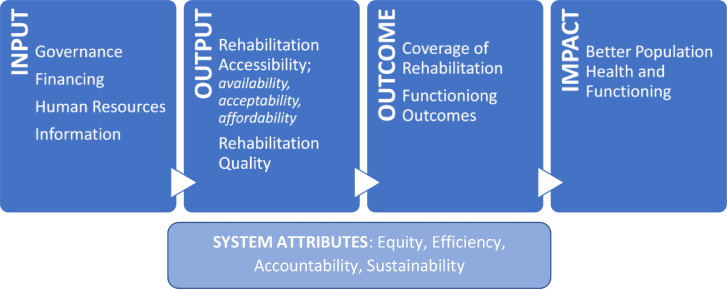
Results: STARS was developed in a participatory process, uses a logic model to structure the 50 components of rehabilitation selected for assessment, and assesses both capacity and performance.
Conclusions: STARS is the first HSA shaped to rehabilitation, has been developed by the WHO in a participatory process based on several expert consultations, and has the potential to meaningfully support governments to better understand the status of rehabilitation in their countries, define priorities for action to strengthen rehabilitation, and facilitate the monitoring of system level changes. Moreover, STARS information can be used in research to support evidence-informed policy and programs.
Keywords: Global health; Rehabilitation.
Copyright © 2021. Published by Elsevier Inc.
References
-
- Need to scale up rehabilitation . World Health Organization; Geneva, Switzerland: 2017. Background paper for the WHO Rehabilitation 2030 Meeting.
-
- World Health Organization . World Health Organization; Geneva, Switzerland: 2015. World report on ageing and health.
-
- Cieza A. Rehabilitation, the health strategy of the 21st century, really? Arch Phys Med Rehabil. 2019;100:2212–2214. - PubMed
-
- Kamenov K, Mills JA, Chatterji S, Cieza A. Needs and unmet needs for rehabilitation services: a scoping review. Disabil Rehabil. 2019;41:1227–1237. - PubMed
Publication types
MeSH terms
Grants and funding
LinkOut - more resources
Full Text Sources
Medical
