Optimizing Therapy to Prevent Avoidable Hospital Admissions in Multimorbid Older Adults (OPERAM): cluster randomised controlled trial
- PMID: 34257088
- PMCID: PMC8276068
- DOI: 10.1136/bmj.n1585
Optimizing Therapy to Prevent Avoidable Hospital Admissions in Multimorbid Older Adults (OPERAM): cluster randomised controlled trial
Erratum in
-
Correction for vol. 379, p.BMJ. 2022 Dec 1;379:o2859. doi: 10.1136/bmj.o2859. BMJ. 2022. PMID: 36455932 Free PMC article.
Abstract
Objective: To examine the effect of optimising drug treatment on drug related hospital admissions in older adults with multimorbidity and polypharmacy admitted to hospital.
Design: Cluster randomised controlled trial.
Setting: 110 clusters of inpatient wards within university based hospitals in four European countries (Switzerland, Netherlands, Belgium, and Republic of Ireland) defined by attending hospital doctors.
Participants: 2008 older adults (≥70 years) with multimorbidity (≥3 chronic conditions) and polypharmacy (≥5 drugs used long term).
Intervention: Clinical staff clusters were randomised to usual care or a structured pharmacotherapy optimisation intervention performed at the individual level jointly by a doctor and a pharmacist, with the support of a clinical decision software system deploying the screening tool of older person's prescriptions and screening tool to alert to the right treatment (STOPP/START) criteria to identify potentially inappropriate prescribing.
Main outcome measure: Primary outcome was first drug related hospital admission within 12 months.
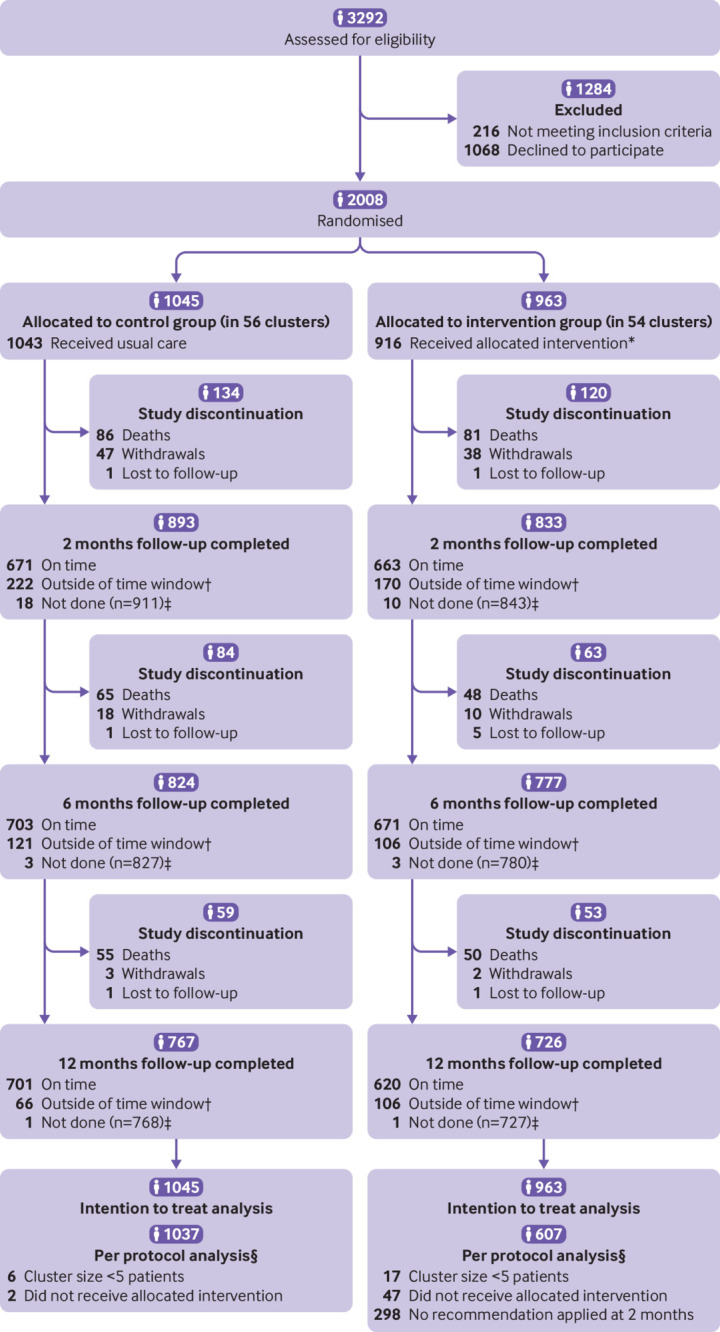
Results: 2008 older adults (median nine drugs) were randomised and enrolled in 54 intervention clusters (963 participants) and 56 control clusters (1045 participants) receiving usual care. In the intervention arm, 86.1% of participants (n=789) had inappropriate prescribing, with a mean of 2.75 (SD 2.24) STOPP/START recommendations for each participant. 62.2% (n=491) had ≥1 recommendation successfully implemented at two months, predominantly discontinuation of potentially inappropriate drugs. In the intervention group, 211 participants (21.9%) experienced a first drug related hospital admission compared with 234 (22.4%) in the control group. In the intention-to-treat analysis censored for death as competing event (n=375, 18.7%), the hazard ratio for first drug related hospital admission was 0.95 (95% confidence interval 0.77 to 1.17). In the per protocol analysis, the hazard ratio for a drug related hospital admission was 0.91 (0.69 to 1.19). The hazard ratio for first fall was 0.96 (0.79 to 1.15; 237 v 263 first falls) and for death was 0.90 (0.71 to 1.13; 172 v 203 deaths).
Conclusions: Inappropriate prescribing was common in older adults with multimorbidity and polypharmacy admitted to hospital and was reduced through an intervention to optimise pharmacotherapy, but without effect on drug related hospital admissions. Additional efforts are needed to identify pharmacotherapy optimisation interventions that reduce inappropriate prescribing and improve patient outcomes.
Trial registration: ClinicalTrials.gov NCT02986425.
© Author(s) (or their employer(s)) 2019. Re-use permitted under CC BY-NC. No commercial re-use. See rights and permissions. Published by BMJ.
Conflict of interest statement
Competing interests: All authors have completed the ICMJE uniform disclosure form at www.icmje.org/coi_disclosure.pdf and declare: financial support from grants from Swiss State Secretariat for Education, Research, and Innovation (NR, MSch), EU Horizon 2020 (LG), Gottfried and Julia Bangerter Rhyner Stiftung (LA), European Commission (ST, MR), during the conduct of the study. ST and MR are affiliated with CTU Bern, University of Bern, which has a staff policy of not accepting honorariums or consultancy fees. However, CTU Bern is involved in design, conduct, or analysis of clinical studies funded by not-for-profit and for profit organisations. In particular, pharmaceutical and medical device companies provide direct funding to some of these studies or an up-to-date list of CTU Bern’s conflicts of interest see https://www.ctu.unibe.ch/research/declaration_of_interest/index_eng.html. DOM has a patent A Prescription Decision Support System (based on screening tool of older person’s prescriptions and screening tool to alert to the right treatment (STOPP/START) prescribing rules) issued to European Patent Office (Munich). MS reports a 2011 grant and personal fees from Spru IT, before the conduct of the study; in addition, MS reports a settlement agreement between Spru IT and Utrecht University, in which all systematic tool to reduce inappropriate prescribing (STRIP) assistant IP is transferred to Utrecht University, in exchange for obtaining a free but non-exclusive right to provide STRIP assistant consultancy or support services, or both on a commercial basis, and to update the STRIP assistant, until June 2023.
Figures
References
-
- Menotti A, Mulder I, Nissinen A, Giampaoli S, Feskens EJ, Kromhout D. Prevalence of morbidity and multimorbidity in elderly male populations and their impact on 10-year all-cause mortality: The FINE study (Finland, Italy, Netherlands, Elderly). J Clin Epidemiol 2001;54:680-6. 10.1016/S0895-4356(00)00368-1 - DOI - PubMed