


Different Trends in Excess Mortality in a Central European Country Compared to Main European Regions in the Year of the COVID-19 Pandemic (2020): a Hungarian Analysis
- PMID: 34257618
- PMCID: PMC8262208
- DOI: 10.3389/pore.2021.1609774
Different Trends in Excess Mortality in a Central European Country Compared to Main European Regions in the Year of the COVID-19 Pandemic (2020): a Hungarian Analysis
Abstract
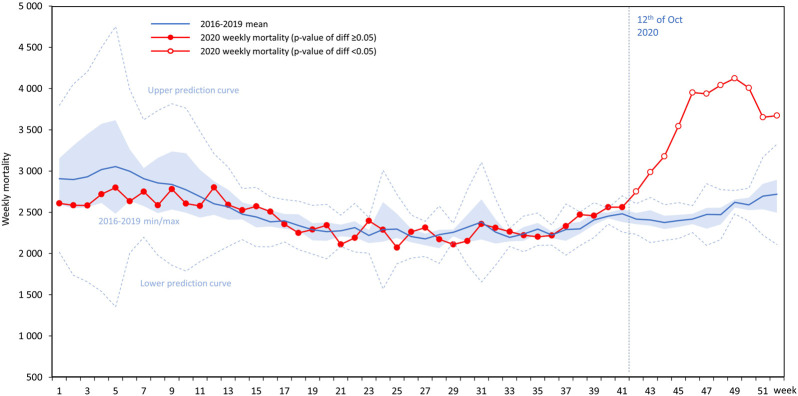
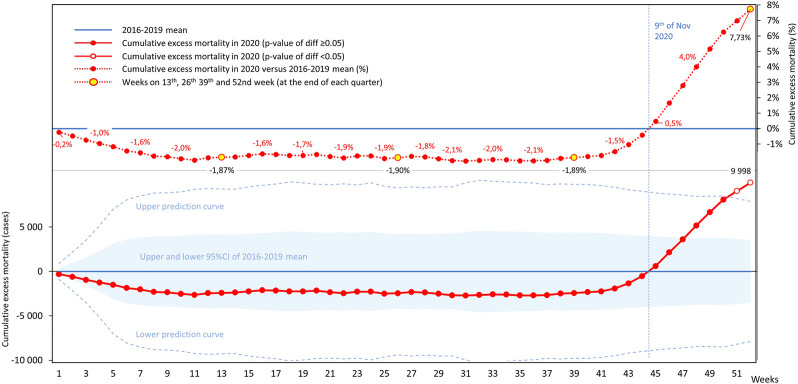
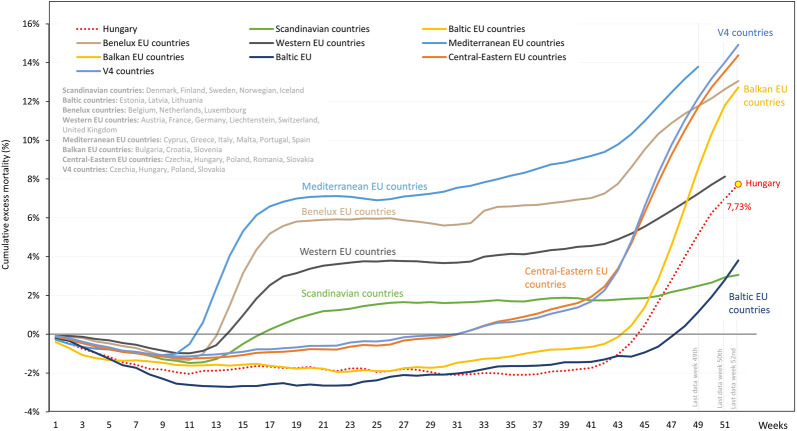
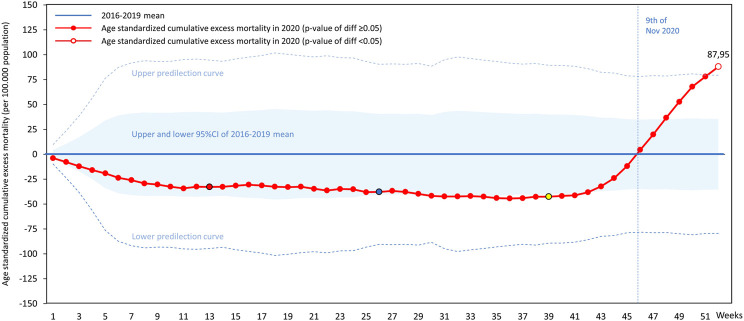
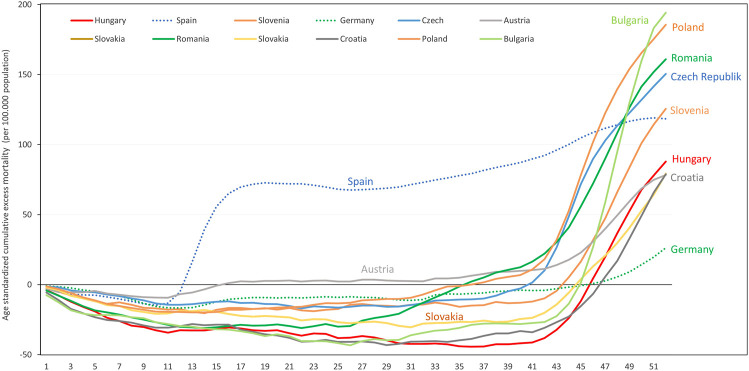
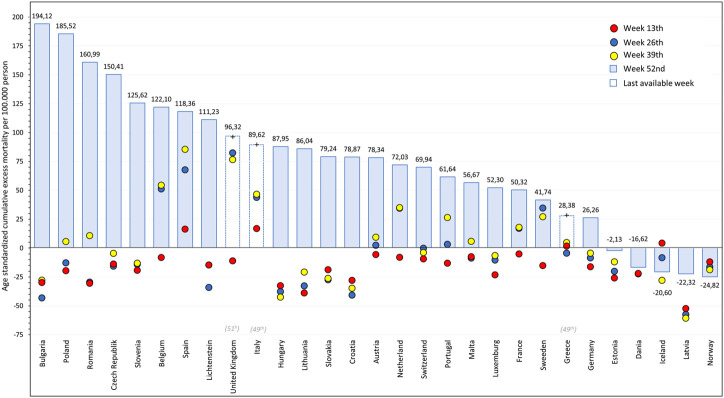
Objective: This study examined cumulative excess mortality in European countries in the year of the Covid-19 pandemic and characterized the dynamics of the pandemic in different countries, focusing on Hungary and the Central and Eastern European region. Methods: Age-standardized cumulative excess mortality was calculated based on weekly mortality data from the EUROSTAT database, and was compared between 2020 and the 2016-2019 reference period in European countries. Results: Cumulate weekly excess mortality in Hungary was in the negative range until week 44. By week 52, it reached 9,998 excess deaths, corresponding to 7.73% cumulative excess mortality vs. 2016-2019 (p-value = 0.030 vs. 2016-2019). In Q1, only Spain and Italy reported excess mortality compared to the reference period. Significant increases in excess mortality were detected between weeks 13 and 26 in Spain, United Kingdom, Belgium, Netherland and Sweden. Romania and Portugal showed the largest increases in age-standardized cumulative excess mortality in the Q3. The majority of Central and Eastern European countries experienced an outstandingly high impact of the pandemic in Q4 in terms of excess deaths. Hungary ranked 11th in cumulative excess mortality based on the latest available data of from the EUROSTAT database. Conclusion: Hungary experienced a mortality deficit in the first half of 2020 compared to previous years, which was followed by an increase in mortality during the second wave of the COVID-19 pandemic, reaching 7.7% cumulative excess mortality by the end of 2020. The excess was lower than in neighboring countries with similar dynamics of the pandemic.
Keywords: Hungary; age-standardized mortality rate; covid-19 pandemic; cumulative death; excess mortality.
Copyright © 2021 Bogos, Kiss, Kerpel Fronius, Temesi, Elek, Madurka, Cselkó, Csányi, Abonyi-Tóth, Rokszin, Barcza and Moldvay.
Conflict of interest statement
Krisztina Bogos, Anna Kerpel Fronius, Gabriella Temesi, Jenő Elek, Ildikó Madurka, Zsuzsanna Cselkó, Péter Csányi are employees of National Korányi Institute of Pulmonology. György Rokszin and Zsolt Abonyi‐Tóth are employees of RxTarget Ltd. Zsófia Barcza is employee of Syntesia Ltd. Zoltan Kiss is a PhD fellow in 2nd Department of Medicine and Nephrological Center of University of Pécs. Judit Moldvay was supported by the Hungarian Brain research Program (grant 2017‐1.2.1‐NKP‐2017‐00002), and the Hungarian NRDI Office (grant K‐129065).
Figures
References
-
- European Centre for Disease Prevention and Control (ECDC). Rapid Risk Assessment: outbreak of acute respiratory syndrome associated with a novel coronavirus, Wuhan, China; first update – 22 January 2020. Available from: https://www.ecdc.europa.eu/en/publications-data/risk-assessment-outbreak... (Accessed February 1, 2021). Stockholm: ECDC; (2020).
-
- European Center for Disease Prevention and Control (ECDC). Timeline of ECDC's response to COVID-19. Available from: https://www.ecdc.europa.eu/en/covid-19/timeline-ecdc-response (Accessed February 5, 2021).
-
- World Health Organization (WHO). Listings of WHO’s response to COVID-19. Available from: https://www.who.int/news/item/29-06-2020-covidtimeline (Accessed February 5, 2021).
-
- World Health Organization (WHO). A timeline of WHO’s response to COVID 19 in the WHO European Region. Available from: https://apps.who.int/iris/bitstream/handle/10665/334205/70id07e-COVID19-... (Accessed January 29, 2021).
-
- World Health Organization (WHO). WHO coronavirus disease (COVID-19) dashboard. Available from: https://covid19.who.int (Accessed January 26, 2021).
MeSH terms
LinkOut - more resources
Full Text Sources
