. 2021 Aug;22(2):902.
doi: 10.3892/etm.2021.10334. Epub 2021 Jun 24.

RUNX1 gene expression changes in the placentas of women smokers

Affiliations

RUNX1 gene expression changes in the placentas of women smokers

Litzy Gisella Bermudez et al. Exp Ther Med. 2021 Aug.

Abstract

The placenta can be affected by environmental factors, such as exposure to cigarette smoke. This exposure in the fetal context is considered a risk factor for the development of short-term postnatal diseases, such as asthma. Asthma is an inflammatory disease characterized by predominant acquisition of CD4 T lymphocytes (TLs) of the Th2 type. Transcription factors such as GATA binding protein 3 (GATA3) and STAT6 actively participate in the differentiation of virgin TLs towards the Th2 profile, while transcription factors such as STAT1, T-Box transcription factor 21 (T-BET), RUNX1 and RUNX3 participate in their differentiation towards the Th1 profile. The objective of the current study was to evaluate the impact of exposure to cigarette smoke on the gene expression of STAT1, T-BET, GATA3, IL-4, RUNX1 and RUNX3 during the gestation period, and to determine whether the expression levels of these genes are associated with changes in global methylation. STAT1, GATA3, RUNX1 and RUNX3 protein and mRNA expression levels in the placental tissue of women smokers and non-smoking women were determined via immunohistochemistry and quantitative PCR (qPCR) respectively. Additionally, T-BET and IL-4 mRNA expression levels were determined by qPCR. On the other hand, global methylation was determined via ELISA. In the present study, significant increases were observed in RUNX1 transcription factor expression in placentas from women smokers when compared with placentas of non-smoking women. Similarly, significant increases in the expression of GATA3, IL-4 and RUNX3 mRNA were observed. The changes in gene expression were not associated with changes in the global methylation levels. Finally, a higher frequency of low-birth-weight infants were identified in cases of exposure to cigarette smoke during pregnancy when compared with infants not exposed to cigarette smoke during pregnancy. Thus, the data of the present study contributed to the understanding of the genetic and clinical impacts of exposure to cigarette smoke during pregnancy and its importance in maternal and fetal health.

Keywords: GATA binding protein 3; RUNX1; cigarette smoking; maternal exposure; placenta; transcription factor.


Conflict of interest statement

The authors declare that they have no competing interests.

Figures

Figure 1
Figure 1
Analysis of the relative expression of GATA3 at the mRNA and protein levels in the placenta. (A) Expression levels of GATA3 relative to 18S in placentas from non-smoking women compared with placentas from women smokers. The horizontal bar represents the median of relative expression. (B) Intensity of positivity of GATA3 in placental samples from non-smoking women and women smokers. (C) Positive control biopsy slice of breast cancer and the nuclear staining pattern, with a strong intensity (magnification, x4). (D) Placental slice of a non-smoking woman displaying positive nuclear staining patterns in syncytiotrophoblasts, strong intensity, proportion between 30 and 60% of the total observed (magnification, x10). (E) Placental slice of a woman smoker, positive nuclear staining pattern in syncytiotrophoblasts, strong intensity, proportion <30% of total observed (magnification, x4). A Mann-Whitney U test was applied. ***P<0.001. GATA3, GATA binding protein 3; NS, not significant.
Figure 2
Figure 2
Analysis of the relative expression of STAT1 at the mRNA and protein levels in the placenta. (A) Expression levels of STAT1 relative to 18S in grouped samples of placentas from non-smoking women compared with placentas from women smokers. The horizontal bar represents the median of relative expression. (B) Level of intensity of STAT1 labeling via immunohistochemistry in samples from women smokers and non-smoking women. (C) Positive control thymus tissue slice, nuclear staining pattern, strong intensity (magnification, x10). (D) Placental slice of a non-smoking woman displaying positive nuclear staining pattern in extravillous trophoblasts and the decidua, strong intensity, proportion >60% of the total observed (magnification, x10). (E) Placental slice of a woman smoker, positive nuclear staining pattern in intravillous histiocytes, strong intensity (magnification, x10). A Mann-Whitney U statistical test was applied. NS, not significant.
Figure 3
Figure 3
Analysis of the relative expression of RUNX1 at the mRNA and protein levels in the placenta. (A) Expression levels of RUNX1 relative to 18S in placentas from non-smoking women compared with placentas of women smokers. The horizontal bar represents the median relative expression. (B) Level of intensity of RUNX1 labeling via immunohistochemistry in samples grouped by placentas from women smokers and non-smoking women. There was increased detection of RUNX1 protein in stromal cells of the chorion of placentas from women smokers compared with placentas from non-smoking women. (C) Positive control epiglottis tissue slice, nuclear staining pattern, medium intensity (magnification, x10). (D) Placental slice of a non-smoking woman, nuclear staining pattern positive in polymorphonuclear cells and negative in endothelial cells (magnification, x40). (E) Placental slice of a woman smoker, positive nuclear staining pattern for the decidua, strong intensity, proportion >60% of the total observed (magnification, x10). A Mann-Whitney U statistical test was applied. *P<0.05.
Figure 4
Figure 4
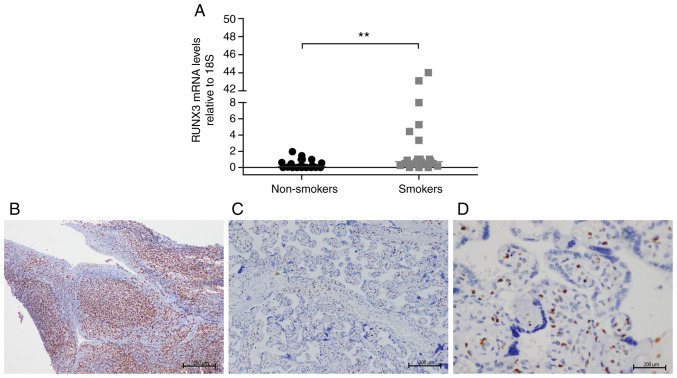
Analysis of the relative expression of RUNX3 at the mRNA and protein levels in the placenta. (A) Expression levels of RUNX3 relative to 18S in grouped samples of placentas from non-smoking women compared with placentas from women smokers. The horizontal bar represents the median of relative expression. (B) Positive control lymphoid tissue slice, nuclear staining pattern, strong intensity (magnification, x10). (C) Placental slice of a non-smoking woman, positive nuclear staining pattern in polymorphonuclear cells and negative nuclear staining pattern in placental cells (magnification, x40). (D) Placental slice of a woman smoker, negative pattern for all placental cells (magnification, x10). A Mann-Whitney U statistical test was applied. **P<0.01.
Figure 5
Figure 5
Analysis of the overall percentage of methylation in the placenta. Placental samples with methylation percentages <15% were analyzed regardless of exposure to cigarette smoke during pregnancy. The graph shows the percentage of the overall methylation of genomic DNA from the placentas of non-smoking women and women smokers, as well as the AGS human gastric adenocarcinoma cell line to allow the sensitivity of the test for identifying overall methylation markers to be validated.

References

    1. Maltepe E, Fisher SJ. Placenta: The forgotten organ. Annu Rev Cell Dev Biol. 2015;31:523–552. doi: 10.1146/annurev-cellbio-100814-125620. - DOI - PubMed
    1. Nugent BM, Bale TL. The omniscient placenta: Metabolic and epigenetic regulation of fetal programming. Front Neuroendocrinol. 2015;39:28–37. doi: 10.1016/j.yfrne.2015.09.001. - DOI - PMC - PubMed
    1. Luyten LJ, Saenen ND, Janssen BG, Vrijens K, Plusquin M, Roels HA, Debacq-Chainiaux F, Nawrot TS. Air pollution and the fetal origin of disease: A systematic review of the molecular signatures of air pollution exposure in human placenta. Environ Res. 2018;166:310–323. doi: 10.1016/j.envres.2018.03.025. - DOI - PubMed
    1. Marjonen H, Toivonen M, Lahti L, Kaminen-Ahola N. Early prenatal alcohol exposure alters imprinted gene expression in placenta and embryo in a mouse model. PLoS One. 2018;13(e0197461) doi: 10.1371/journal.pone.0197461. - DOI - PMC - PubMed
    1. Mikael LG, Pancer J, Jiang X, Wu Q, Caudill M, Rozen R. Low dietary folate and methylenetetrahydrofolate reductase deficiency may lead to pregnancy complications through modulation of ApoAI and IFN-γ in spleen and placenta, and through reduction of methylation potential. Mol Nutr Food Res. 2013;57:661–670. doi: 10.1002/mnfr.201200152. - DOI - PubMed