


Cross-ethnic comparison of the association between central sleep apnea and atrial fibrillation/flutter: The Kuakini Honolulu-Asia Aging Study and the Osteoporotic Fractures in Men (Mr.OS) study
- PMID: 34258384
- PMCID: PMC8256179
- DOI: 10.1016/j.ijcha.2021.100834
Cross-ethnic comparison of the association between central sleep apnea and atrial fibrillation/flutter: The Kuakini Honolulu-Asia Aging Study and the Osteoporotic Fractures in Men (Mr.OS) study
Abstract
Introduction: Few studies indicated the impact of ethnicity on an association between central sleep apnea (CSA) and atrial fibrillation/flutter (AF) in older populations. We assessed possible ethnic differences in the association among elderly Japanese-American and White-American men.
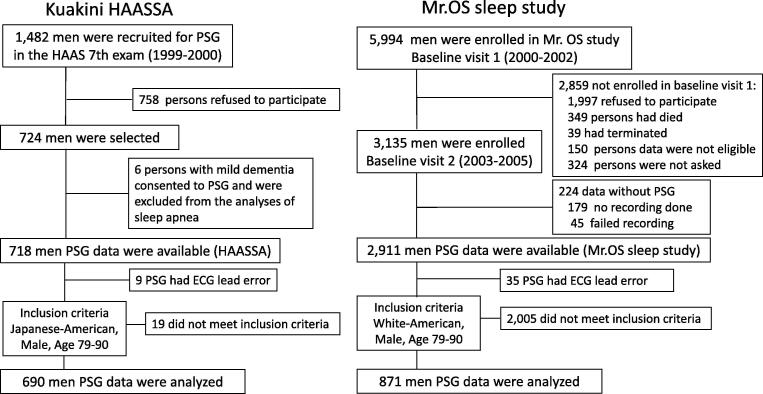
Methods: We performed a cross-sectional analysis using two population studies of Japanese-American and White-American men. The Kuakini Honolulu-Asia Aging Study is a longitudinal cohort study of Japanese-American men living in Hawaii. Sleep data were collected between 1999 and 2000. The Osteoporotic Fractures in Men (Mr.OS) Sleep Study was conducted between 2003 and 2005 on the continental U.S. The majority of Mr.OS participants were White-American. We selected 79-90 year old males, who had overnight polysomnography from both studies. Total participants were 690 Japanese-American and 871 White-American men. The central apnea index (CAI) was the measure of the number of central apneas. CSA was defined by CAI>=5. Cheyne-Stokes breathing (CSB) was defined as a minimum consecutive 5-10 min period of a crescendo-decrescendo respiratory pattern associated with CSA.
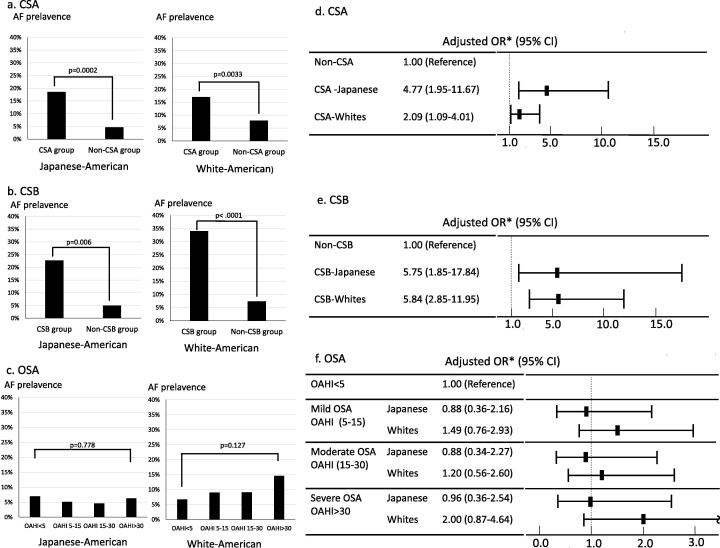
Results: The prevalence of AF was 5.7% in Japanese-American men and 9.0% in White-American men. The prevalence of CSA and CSB in White-Americans were higher than in Japanese-Americans (11.5% vs 6.5% and 5.7% vs 3.3%, respectively). In multivariable-adjusted logistic regression models, CSA was associated with higher odds of AF, and the association was stronger in Japanese-Americans [Odds Ratio (OR) = 4.77, 95% confidence interval (CI): 1.95-11.67] than in White-Americans (OR = 2.09, 95 %CI: 1.09-4.01). CSB showed similar trends as CSA.
Conclusions: After adjustment, CSA and CSB were significantly associated with AF in both Japanese-American and White-American men.
Keywords: Atrial fibrillation; Atrial flutter; Central sleep apnea; Ethnicity.
© 2021 The Authors.
Conflict of interest statement
The authors declare that they have no known competing financial interests or personal relationships that could have appeared to influence the work reported in this paper.
Figures
Comment in
-
Personalized management of sleep apnea in patients with atrial fibrillation: An interdisciplinary and translational challenge.Int J Cardiol Heart Vasc. 2021 Jul 21;35:100843. doi: 10.1016/j.ijcha.2021.100843. eCollection 2021 Aug. Int J Cardiol Heart Vasc. 2021. PMID: 34377764 Free PMC article. No abstract available.
References
-
- Menezes A.R., Lavie C.J., DiNicolantonio J.J. Atrial fibrillation in the 21st century: a current understanding of risk factors and primary prevention strategies. Mayo Clin. Proc. 2013;88(4):394–409. - PubMed
-
- Anzai T., Grandinetti A., Katz A.R., Hurwitz E.L., Wu Y.Y., Masaki K. Association between central sleep apnea and atrial fibrillation/flutter in Japanese-American men: The Kuakini Honolulu Heart Program (HHP) and Honolulu-Asia Aging Study (HAAS) J. Electrocardiol. 2020;61:10–17. - PubMed
LinkOut - more resources
Full Text Sources
