


The hemostatic and thrombotic complications of liver disease
- PMID: 34258797
- PMCID: PMC9009189
- DOI: 10.1111/ejh.13688
The hemostatic and thrombotic complications of liver disease
Abstract
Hepatic cirrhosis leads to numerous hematologic derangements resulting in a complex and tenuously rebalanced hemostatic milieu. The utility of common hematologic tests including the INR and aPTT in assessing hemostatic and thrombotic risk in patients with cirrhosis is limited, and consensus on transfusion thresholds and proper management of thrombotic complications continues to evolve. This review summarizes the pathophysiology of key derangements of hemostasis including those of platelets, von Willebrand factor, pro- and anticoagulation factors, and fibrin. Additionally, the pathogenesis, consequences, optimal management, and prevention of major thrombotic and bleeding complications in cirrhosis arte discussed.
Keywords: blood coagulation; hemostasis; humans; liver cirrhosis; thrombosis.
© 2021 John Wiley & Sons A/S. Published by John Wiley & Sons Ltd.
Conflict of interest statement
CONFLICT OF INTEREST
None.
Figures
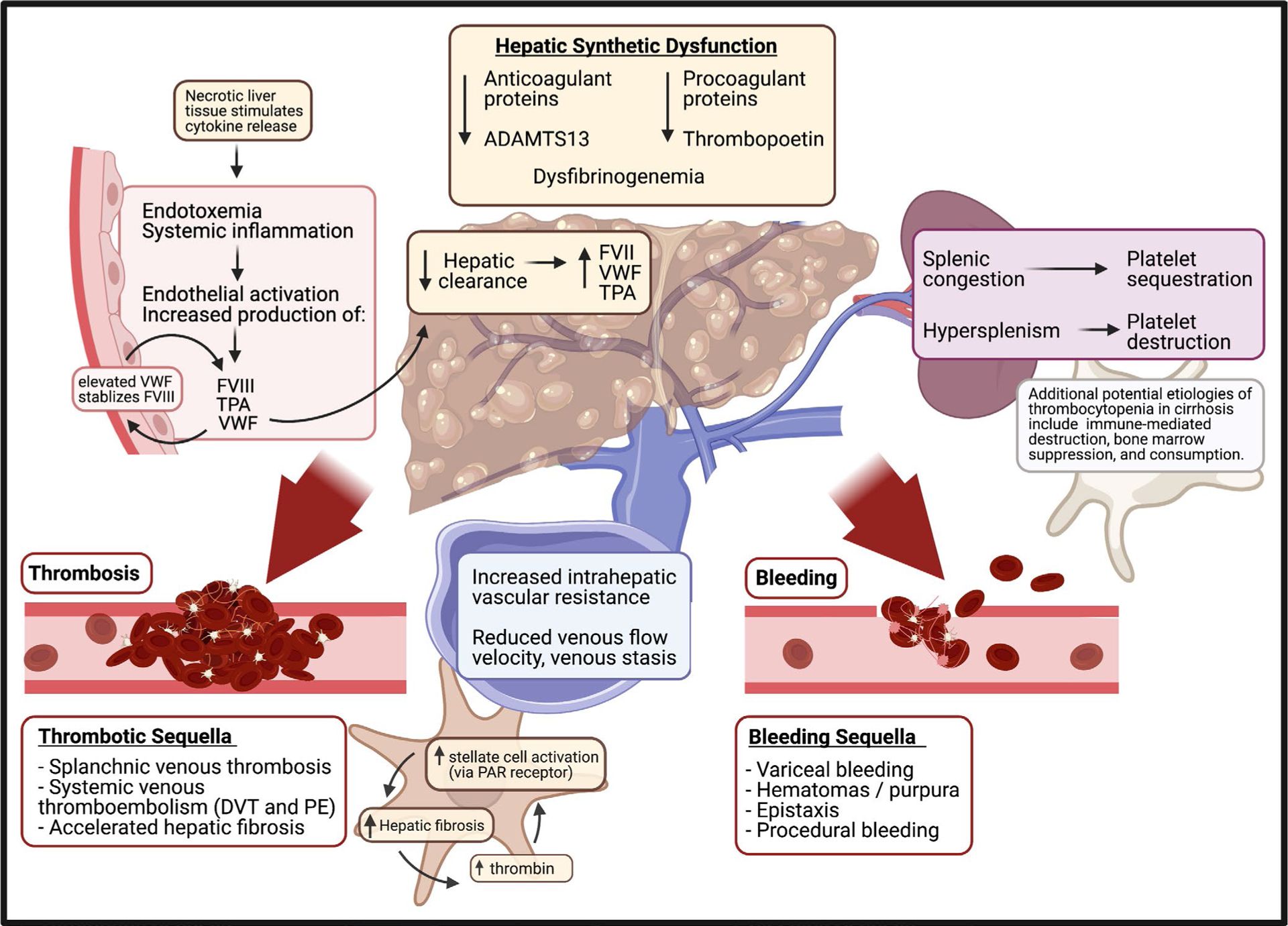
Similar articles
-
AGA Clinical Practice Update: Coagulation in Cirrhosis.Gastroenterology. 2019 Jul;157(1):34-43.e1. doi: 10.1053/j.gastro.2019.03.070. Epub 2019 Apr 12. Gastroenterology. 2019. PMID: 30986390 Review.
-
Anticoagulation in cirrhosis: a new paradigm?Clin Mol Hepatol. 2017 Mar;23(1):13-21. doi: 10.3350/cmh.2016.0110. Epub 2017 Mar 14. Clin Mol Hepatol. 2017. PMID: 28288507 Free PMC article. Review.
-
Primary Hemostasis in Chronic Liver Disease and Cirrhosis: What Did We Learn over the Past Decade?Int J Mol Sci. 2020 May 6;21(9):3294. doi: 10.3390/ijms21093294. Int J Mol Sci. 2020. PMID: 32384725 Free PMC article. Review.
-
Hemostasis in liver transplantation: Pathophysiology, monitoring, and treatment.World J Gastroenterol. 2016 Jan 28;22(4):1541-50. doi: 10.3748/wjg.v22.i4.1541. World J Gastroenterol. 2016. PMID: 26819521 Free PMC article. Review.
-
Hemostatic balance in patients with liver cirrhosis: Report of a consensus conference.Dig Liver Dis. 2016 May;48(5):455-467. doi: 10.1016/j.dld.2016.02.008. Epub 2016 Feb 27. Dig Liver Dis. 2016. PMID: 27012444
Cited by
-
Individualized Management of Coagulopathy in Patients with End-Stage Liver Disease.Diagnostics (Basel). 2022 Dec 15;12(12):3172. doi: 10.3390/diagnostics12123172. Diagnostics (Basel). 2022. PMID: 36553179 Free PMC article. Review.
-
Development and validation of an integrated model for the diagnosis of liver cirrhosis with portal vein thrombosis combined with endoscopic characters and blood biochemistry data: a retrospective propensity score matching (PSM) cohort study.Ann Med. 2025 Dec;57(1):2457521. doi: 10.1080/07853890.2025.2457521. Epub 2025 Jan 29. Ann Med. 2025. PMID: 39881530 Free PMC article.
-
Patient Blood Management in Liver Transplant-A Concise Review.Biomedicines. 2023 Apr 4;11(4):1093. doi: 10.3390/biomedicines11041093. Biomedicines. 2023. PMID: 37189710 Free PMC article. Review.
-
Enhanced venous thrombosis and hypercoagulability in murine and human metabolic dysfunction-associated steatohepatitis.J Thromb Haemost. 2024 Dec;22(12):3572-3580. doi: 10.1016/j.jtha.2024.08.023. Epub 2024 Sep 19. J Thromb Haemost. 2024. PMID: 39306095
-
Eryptosis in Liver Diseases: Contribution to Anemia and Hypercoagulation.Med Sci (Basel). 2025 Aug 12;13(3):125. doi: 10.3390/medsci13030125. Med Sci (Basel). 2025. PMID: 40843747 Free PMC article. Review.
References
-
- Kujovich JL. Coagulopathy in liver disease: a balancing act. Hematology. 2015;2015(1):243–249. - PubMed
-
- Tripodi A, Mannucci PM. The Coagulopathy of chronic liver disease. N Engl J Med. 2011;365(2):147–156. - PubMed
-
- Lisman T, Porte RJ. Rebalanced hemostasis in patients with liver disease: evidence and clinical consequences. Blood. 2010;116(6):878–885. - PubMed
Publication types
MeSH terms
Substances
Grants and funding
LinkOut - more resources
Full Text Sources
Medical
