


Annual home-based HIV testing in the Chókwè Health Demographic Surveillance System, Mozambique, 2014 to 2019: serial population-based survey evaluation
- PMID: 34259391
- PMCID: PMC8278856
- DOI: 10.1002/jia2.25762
Annual home-based HIV testing in the Chókwè Health Demographic Surveillance System, Mozambique, 2014 to 2019: serial population-based survey evaluation
Abstract
Introduction: WHO recommends implementing a mix of community and facility testing strategies to diagnose 95% of persons living with HIV (PLHIV). In Mozambique, a country with an estimated 506,000 undiagnosed PLHIV, use of home-based HIV testing services (HBHTS) to help achieve the 95% target has not been evaluated.
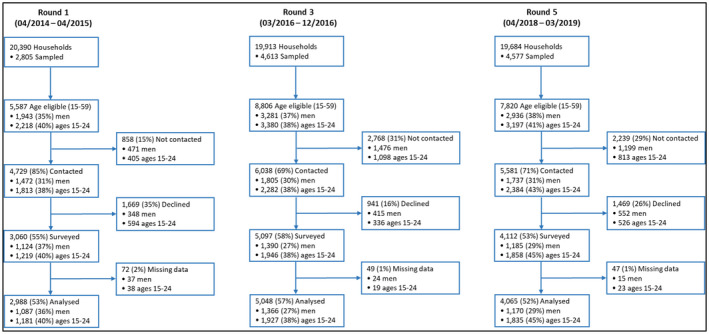
Methods: HBHTS was provided at 20,000 households in the Chókwè Health Demographic Surveillance System (CHDSS), Mozambique, in annual rounds (R) during 2014 to 2019. Trends in prevalence of HIV infection, prior HIV diagnosis among PLHIV (diagnostic coverage), and undiagnosed HIV infection were assessed with three population-based surveys conducted in R1 (04/2014 to 04/2015), R3 (03/2016 to 12/2016), and R5 (04/2018 to 03/2019) of residents aged 15 to 59 years. Counts of patients aged ≥15 years tested for HIV in CHDSS healthcare facilities were obtained from routine reports.
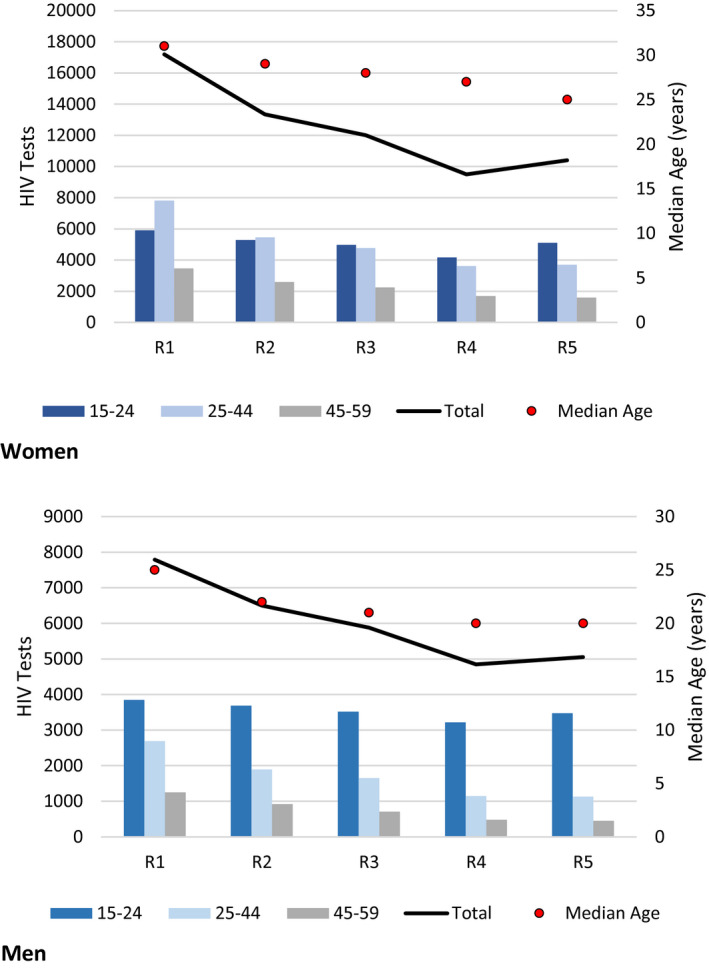
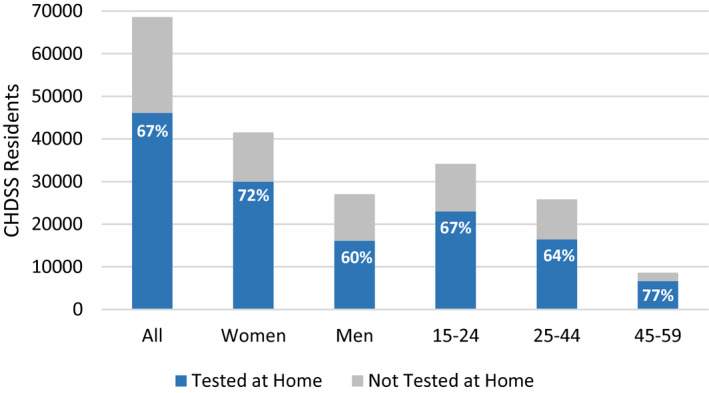
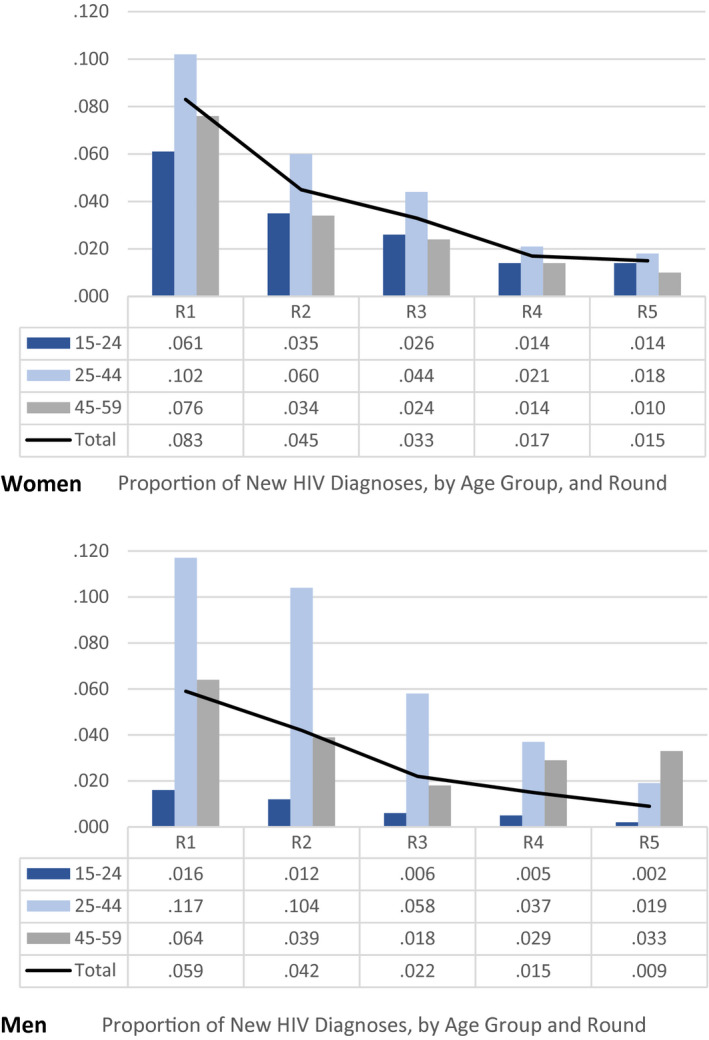
Results: During 2014 to 2019, counsellors conducted 92,512 home-based HIV tests and newly diagnosed 3711 residents aged 15 to 59 years. Prevalence of HIV infection was stable (R1, 25.1%; R3 23.6%; R5 22.9%; p-value, 0.19). After the first two rounds (44,825 home-based tests; 31,717 facility-based tests), diagnostic coverage increased from 73.8% (95% CI 70.3 to 77.2) in R1 to 93.0% (95% CI 91.3 to 94.7) in R3, and prevalence of undiagnosed HIV infection decreased from 6.6% (95% CI 5.6 to 7.5) in R1 to 1.7% (95% CI 1.2 to 2.1) in R3. After two more rounds (32,226 home-based tests; 46,003 facility-based tests), diagnostic coverage was 95.4% (95% CI 93.7 to 97.1) and prevalence of undiagnosed HIV infection was 1.1% (95% CI 0.7 to 1.5) in R5. Prevalence of having last tested at home was 12.7% (95% CI 11.3 to 14.0) in R1, 45.2% (95% CI 43.4 to 47.0) in R3, and 41.4% (95% CI 39.5 to 43.2) in R5, and prevalence of having last tested at a healthcare facility was 45.3% (95% CI 43.3 to 47.3) in R1, 40.1% (95% CI 38.4 to 41.8) in R3, and 45.2% (95% CI 43.3 to 47.0) in R5.
Conclusions: HBHTS successfully augmented facility-based testing to achieve HIV diagnostic coverage in a high-burden community of Mozambique. HBHTS should be considered in sub-Saharan Africa communities striving to diagnose 95% of persons living with HIV.
Keywords: HIV diagnostic coverage; Mozambique; home-based HIV testing and counselling; prevalence of undiagnosed HIV infection.
© 2021 The Authors. Journal of the International AIDS Society published by John Wiley & Sons Ltd on behalf of the International AIDS Society.
Figures
References
-
- Joint United Nations Programme on HIV/AIDS . Understanding Fast‐track. Accelerating action to end the AIDS epidemic by 2030. Geneva, Switzerland; 2015. [cited 2020 Nov 10]. Available from: https://www.unaids.org/sites/default/files/media_asset/201506_JC2743_Und...
-
- Joint United Nations Programme on HIV/AIDS . Global AIDS update. Geneva: Switzerland; 2019. [cited 2020 Nov 10]. Available from: https://www.unaids.org/sites/default/files/media_asset/2019‐global‐AIDS‐...
-
- The Joint United Nations Program on HIV/AIDS . UNAIDS Data 2020 (Mozambique Country Data, 2019). Geneva, Switzerland. UNAIDS data; 2020.
Publication types
MeSH terms
LinkOut - more resources
Full Text Sources
Medical
