Review
. 2021 Nov;125(10):1321-1332.
doi: 10.1038/s41416-021-01469-9. Epub 2021 Jul 14.

BRCA-mutant pancreatic ductal adenocarcinoma

Affiliations
Review

BRCA-mutant pancreatic ductal adenocarcinoma

Eleonora Lai et al. Br J Cancer. 2021 Nov.

Abstract

Despite continued research, pancreatic ductal adenocarcinoma (PDAC) remains one of the main causes of cancer death. Interest is growing in the role of the tumour suppressors breast cancer 1 (BRCA1) and BRCA2-typically associated with breast and ovarian cancer-in the pathogenesis of PDAC. Indeed, both germline and sporadic mutations in BRCA1/2 have been found to play a role in the development of PDAC. However, data regarding BRCA1/2-mutant PDAC are lacking. In this review, we aim to outline the specific landscape of BRCA-mutant PDAC, focusing on heritability, clinical features, differences between BRCA1 and 2 mutations and between germline and sporadic alterations, as well as established therapeutic strategies and those that are still under evaluation.


Conflict of interest statement

The authors declare no competing interests.

Figures
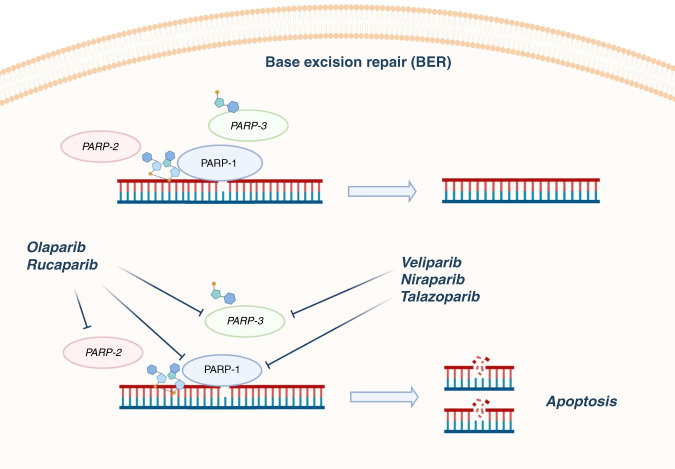
Fig. 1
Fig. 1. PARP inhibitors in BRCA1/2-mutant pancreatic cancer.
The figure shows the PARP inhibitors that have been evaluated in pancreatic ductal adenocarcinoma, together with their mechanism of action. PARP enzymes are crucial in the homologous recombination system, particularly in base-excision repair. By binding to the catalytic site of PARPs, PARP inhibitors block their activity and trap the enzymes inside the DNA. PARPi lead to a significant accumulation of DNA double-strand breaks, resulting in cell death through the phenomenon of synthetic lethality when BRCA1/2 is deficient. Olaparib and rucaparib target PARP-1, PARP-2 and PARP-3, whereas veliparib, niraparib and talazoparib target PARP-1 and PARP-3. PARP poly-ADP ribose polymerase.

References

    1. Bray F, Ferlay J, Soerjomataram I, Siegel RL, Torre LA, Jemal A. Global cancer statistics 2018: GLOBOCAN estimates of incidence and mortality worldwide for 36 cancers in 185 countries. CA Cancer J Clin. 2018;68:394–424. doi: 10.3322/caac.21492. - DOI - PubMed
    1. Lai E, Puzzoni M, Ziranu P, Pretta A, Impera V, Mariani S, et al. New therapeutic targets in pancreatic cancer. Cancer Treat Rev. 2019;81:101926. doi: 10.1016/j.ctrv.2019.101926. - DOI - PubMed
    1. Brunetti O, Luchini C, Argentiero A, Tommasi S, Mangia A, Aprile G, et al. The Italian rare pancreatic exocrine cancer initiative. Tumori. 2019;105:353–8. doi: 10.1177/0300891619839461. - DOI - PubMed
    1. Brunetti O, Aprile G, Marchetti P, Vasile E, Casadei Gardini A, Scartozzi M, et al. Systemic chemotherapy for advanced rare pancreatic histotype tumors: a retrospective multicenter analysis. Pancreas. 2018;47:759–71. doi: 10.1097/MPA.0000000000001063. - DOI - PubMed
    1. Aprile G, Negri FV, Giuliani F, DeCarlo E, Melisi D, Simionato F, et al. Second-line chemotherapy for advanced pancreatic cancer: which is the best option? Crit Rev Oncol Hematol. 2017;115:1–12. doi: 10.1016/j.critrevonc.2017.03.025. - DOI - PubMed
