Review
. 2021 Dec 6;13(9):611-621.
doi: 10.1093/jmcb/mjab041.

Multifaceted roles of centrosomes in development, health, and disease

Affiliations
Review

Multifaceted roles of centrosomes in development, health, and disease

Feifei Qi et al. J Mol Cell Biol. .

Abstract

The centrosome is a membrane-less organelle consisting of a pair of barrel-shaped centrioles and pericentriolar material and functions as the major microtubule-organizing center and signaling hub in animal cells. The past decades have witnessed the functional complexity and importance of centrosomes in various cellular processes such as cell shaping, division, and migration. In addition, centrosome abnormalities are linked to a wide range of human diseases and pathological states, such as cancer, reproductive disorder, brain disease, and ciliopathies. Herein, we discuss various functions of centrosomes in development and health, with an emphasis on their roles in germ cells, stem cells, and immune responses. We also discuss how centrosome dysfunctions are involved in diseases. A better understanding of the mechanisms regulating centrosome functions may lead the way to potential therapeutic targeting of this organelle in disease treatment.

Keywords: centrosome; ciliopathy; germ cell; immunity; stem cell.


Figures

Figure 1
Figure 1
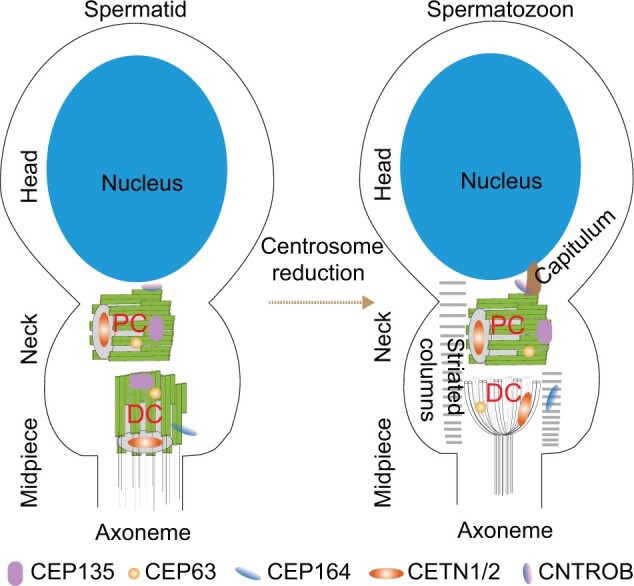
The sperm centrosome is remodeled during spermatogenesis. Initially, there are two centrioles located in the neck of spermatid cell. Both the PC, which articulates with the sperm nucleus, and the DC are composed of barrel-shaped microtubules. Later during spermatogenesis, the DC is remodeled through centrosome reduction into a structure consisting of splayed microtubules, and the PCM transforms into the capitulum and striated columns. The centriolar lumen protein CETN1/2 and the PCM protein CEP63 localize at the DC, while the centriole wall protein CEP135 and the appendage protein CEP164 are lost. The protein CEP164 instead localizes to the striated columns. The PC is slightly altered in mature spermatozoa. It maintains the typical centriole structure and the centriolar proteins CEP135 and CETN1/2, the PCM protein CEP63, and the appendage protein CEP164. The centriole wall protein CNTROB is missed from the centriole wall but localizes to the capitulum.
Figure 2
Figure 2
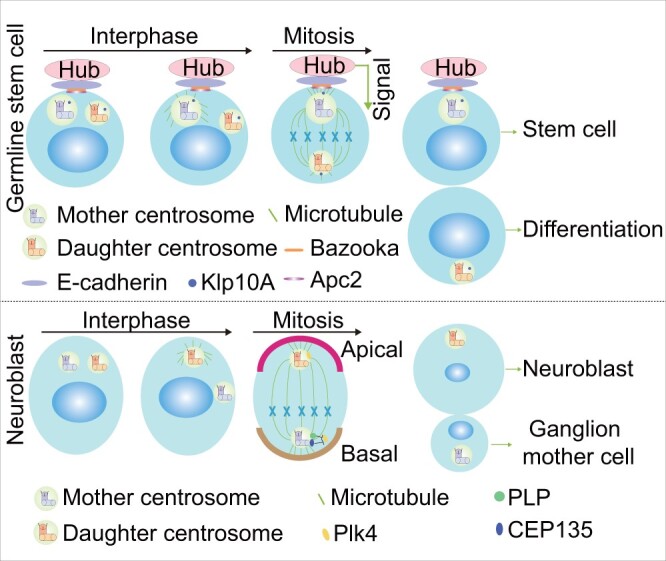
Centrosomes and asymmetric stem cell division. During asymmetric division of GSCs, the mother centrosome is connected to the hub via adherens junctions in conjunction with Apc2, Bazooka, and Klp10A. In response to signals from the hub, GSC inherits the mother centrosome and retains a stem cell identity, while the sibling cell inherits the daughter centrosome and undergoes differentiation. In contrast, during asymmetric division in neural stem cells, the neuroblast inherits the daughter centrosome, while the ganglion mother cell inherits the mother centrosome. This may involve inhibition of mother centrosome activity by PLP and CEP135, which block Plk4 recruitment.
Figure 3
Figure 3
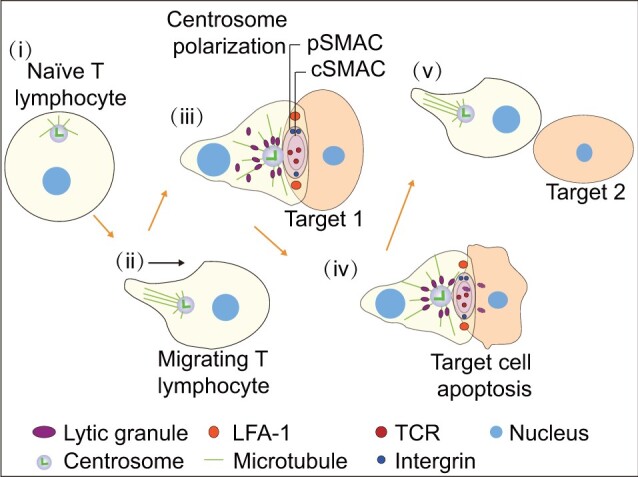
Centrosome functions in the immune response. (i) In naïve T lymphocytes, the centrosome is close to the nucleus and organizes microtubules toward the membrane. (ii) In migrating T lymphocytes, the centrosome is located at the back of nucleus. (iii) When T lymphocytes encounter a target cell, an IS, comprising a cSMAC and a pSMAC, is formed at the interface. The cSMAC contains accumulated TCRs. The activated TCR, along with lymphocyte function-associated antigen 1, triggers centrosome polarization to the IS. Microtubules emanating from the centrosome contribute to lytic granule delivery and target cell killing. (iv and v) Once the target is destroyed, the centrosome moves back into the cell body or polarizes to the next target.
Figure 4
Figure 4
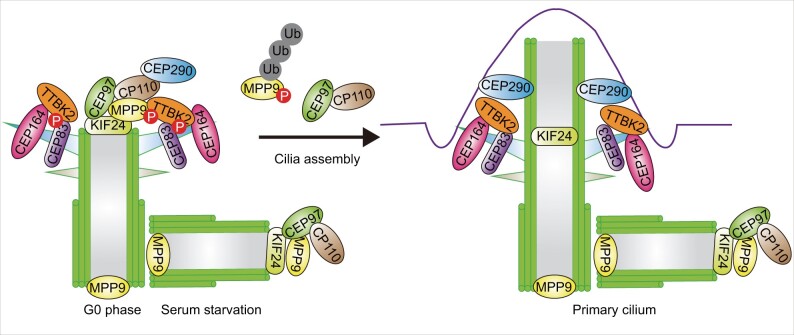
Regulation of centriole conversion to the basal body. In growing cells, CP110‒CEP97 complexes are recruited by KIF24 and MPP9 proteins to the distal ends of both centrioles, thereby inhibiting cilia assembly. In addition, CP110 antagonizes the function of CEP290, a positive regulator of ciliogenesis. When cells exit from the cell cycle and enter the G0 phase, TTBK2 is recruited by CEP164 to the mother centriole and phosphorylates MPP9 and CEP83 to promote the removal of CP110‒CEP97 complex from the mother centriole, thus initiating ciliogenesis.

References

    1. Ansley S.J., Badano J.L., Blacque O.E., et al. (2003). Basal body dysfunction is a likely cause of pleiotropic Bardet‒Biedl syndrome. Nature 425, 628–633. - PubMed
    1. Anvarian Z., Mykytyn K., Mukhopadhyay S., et al. (2019). Cellular signalling by primary cilia in development, organ function and disease. Nat. Rev. Nephrol. 15, 199–219. - PMC - PubMed
    1. Avasthi P., Scheel J.F., Ying G., et al. (2013). Germline deletion of Cetn1 causes infertility in male mice. J. Cell Sci. 126, 3204–3213. - PMC - PubMed
    1. Avidor-Reiss T., Carr A., Fishman E.L. (2020). The sperm centrioles. Mol. Cell. Endocrinol. 518, 110987. - PMC - PubMed
    1. Avidor-Reiss T., Fishman E.L. (2019). It takes two (centrioles) to tango. Reproduction 2, R33–R51. - PMC - PubMed

Publication types