Review
. 2021 Sep 1;33(5):419-430.
doi: 10.1097/BOR.0000000000000822.

Is severe COVID-19 a cytokine storm syndrome: a hyperinflammatory debate

Affiliations
Review

Is severe COVID-19 a cytokine storm syndrome: a hyperinflammatory debate

Puja Mehta et al. Curr Opin Rheumatol. .

Abstract

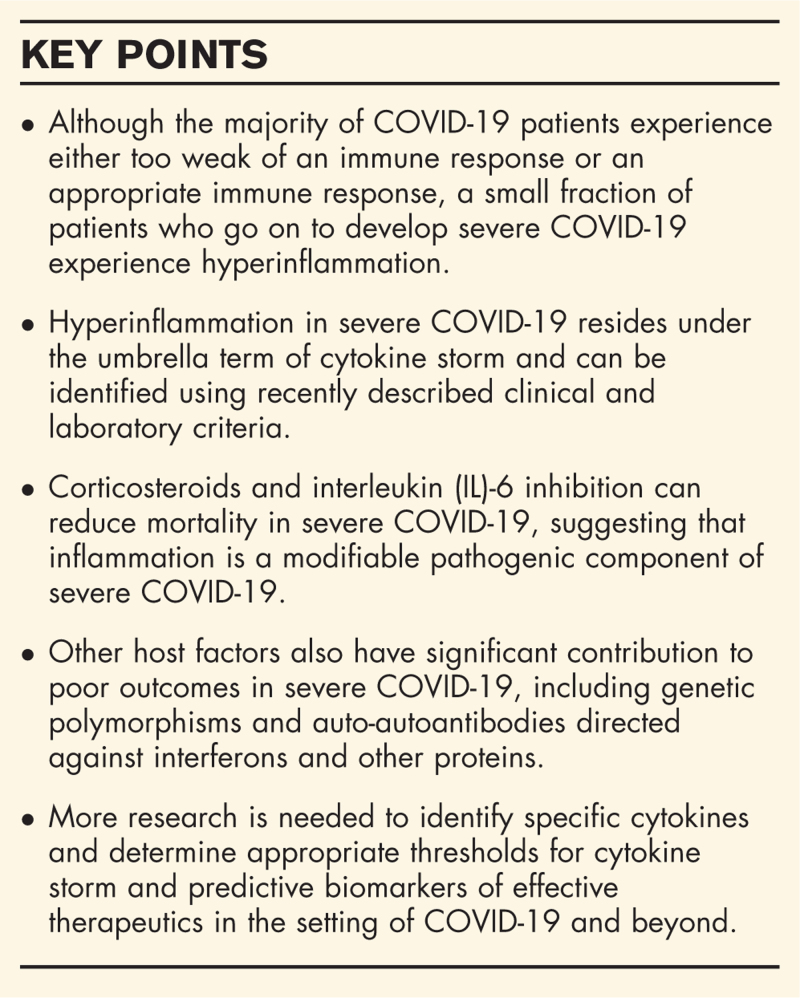
Purpose of review: The COVID-19 pandemic is a global public health crisis with considerable mortality and morbidity. A role for cytokine storm and therapeutic immunomodulation in a subgroup of patients with severe COVID-19 was proposed early in the pandemic. The concept of cytokine storm in COVID-19 has been criticised, given the lack of clear definition and relatively modest cytokinaemia (which may be necessary for viral clearance) compared with acute respiratory distress syndrome and bacterial sepsis. Here we consider the arguments for and against the concept of cytokine storm in COVID-19.

Recent findings: Several criteria have been proposed to identify the subgroup of COVID-19 patients exhibiting a cytokine storm. The beneficial effects of corticosteroids and interleukin-6 inhibition suggest that inflammation is a modifiable pathogenic component of severe COVID-19. The presence of genetic polymorphisms and pathogenic auto-autoantibodies in severe COVID-19 also suggests a significant contribution of immune dysregulation to poor outcomes.

Summary: Hyperinflammation is a key component of severe COVID-19, residing underneath the cytokine storm umbrella term, associated with poor outcomes. Better understanding of the aetiopathogenesis, with identification of biomarkers to predict treatment responses and prognosis, will hopefully enable a stratified and ultimately precision medicine approach.


Conflict of interest statement

P.M. is a Medical Research Council (MRC) – GlaxoSmithKline (GSK) Experimental Medicine Initiative to Explore New Therapies (EMINENT) clinical training fellow with project funding outside the submitted work. P.M. receives co-funding by the National Institute for Health Research (NIHR) University College London Hospitals Biomedical Research Centre (UCLH BRC). P.M. reports consultancy fees from Lily, SOBI, Pfizer and Abbvie, outside the submitted work. D.C.F. has received research funding from Janssen Pharmaceuticals and EUSA Pharma as well as study drug from Pfizer for a clinical trial in Castleman disease. D.C.F. has received research funding from the Parker Institute for Cancer Immunotherapy for COVID-19 therapeutic identification. D.C.F. holds two provisional pending patents for the diagnosis and treatment of Castleman disease.

Figures

Box 1
Box 1
no caption available
FIGURE 1
FIGURE 1
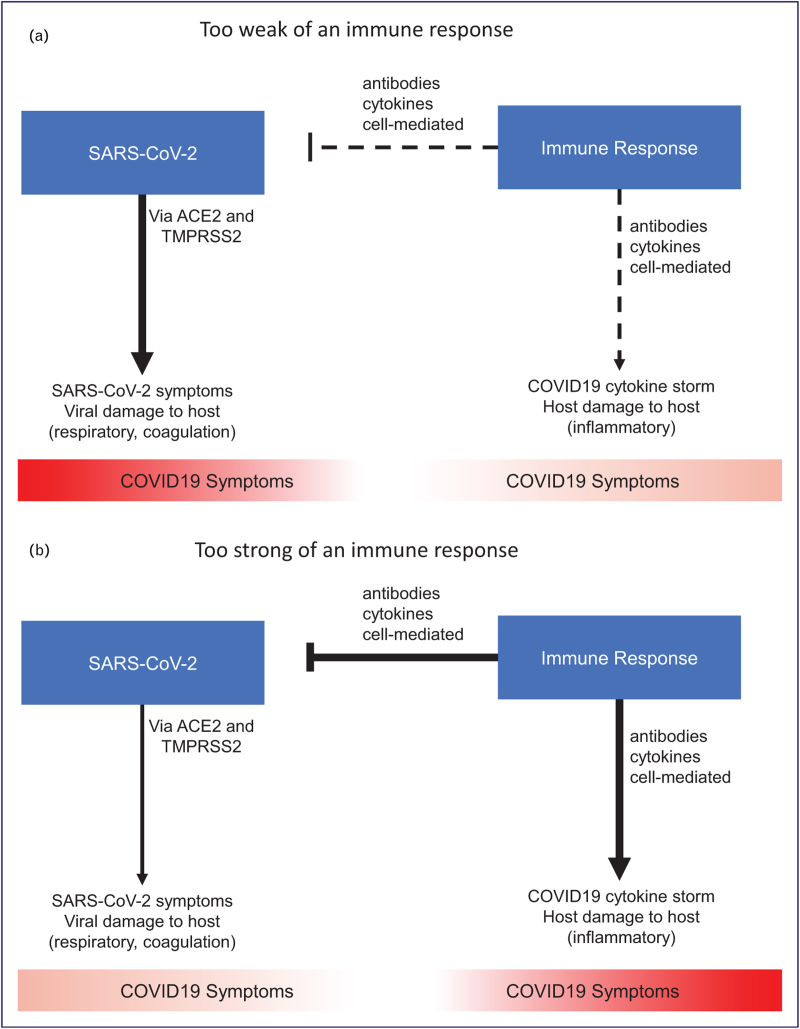
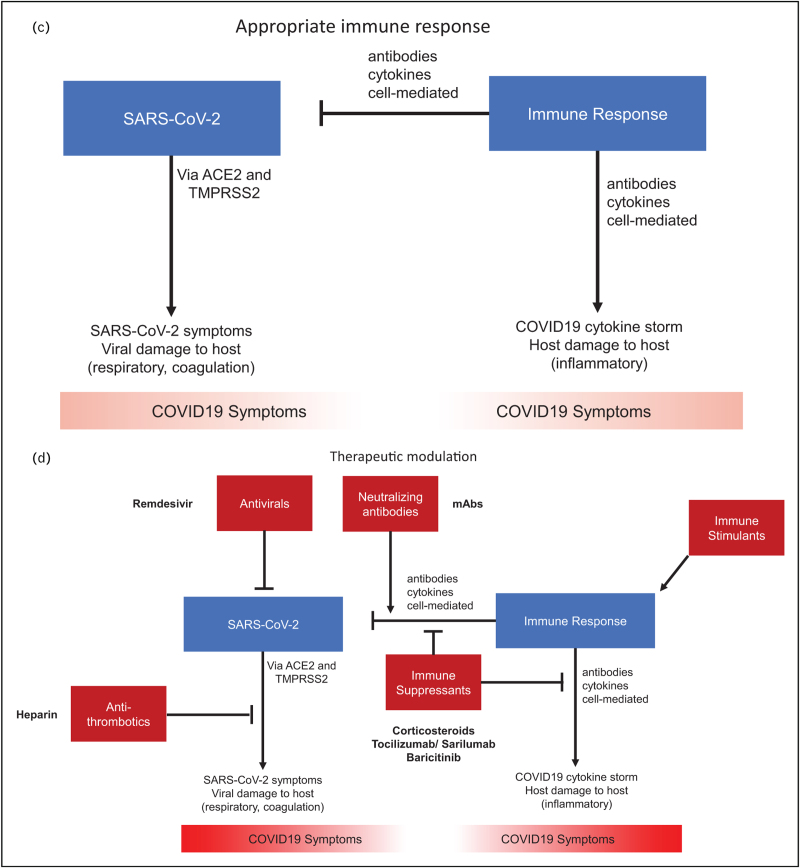
A framework for the heterogeneous host immune response in COVID-19. (A) In patients with too weak of an immune response, poorly controlled viral infection leads to direct SARS-CoV-2 related symptoms. (B) In patients with too strong of an immune response, viral damage is mitigated but antibodies, cytokines, and cell-mediated factors contribute to inflammatory symptoms. (C, D) The optimal response can require antivirals, neutralizing antibodies, and immune stimulants early in the disease course when patients may be mounting too weak of an immune response due to genetic factors or auto-antibodies against interferons. Alternatively, the optimal response may require antithrombotics and immunosuppressants late in the disease course when patients are mounting too strong of an immune response involving hyperinflammation and hypercoagulation. SARS-CoV-2, severe acute respiratory coronavirus 2.
FIGURE 1 (Continued)
A framework for the heterogeneous host immune response in COVID-19. (A) In patients with too weak of an immune response, poorly controlled viral infection leads to direct SARS-CoV-2 related symptoms. (B) In patients with too strong of an immune response, viral damage is mitigated but antibodies, cytokines, and cell-mediated factors contribute to inflammatory symptoms. (C, D) The optimal response can require antivirals, neutralizing antibodies, and immune stimulants early in the disease course when patients may be mounting too weak of an immune response due to genetic factors or auto-antibodies against interferons. Alternatively, the optimal response may require antithrombotics and immunosuppressants late in the disease course when patients are mounting too strong of an immune response involving hyperinflammation and hypercoagulation. SARS-CoV-2, severe acute respiratory coronavirus 2.

References

    1. Lescure FX, Bouadma L, Nguyen D, et al. Clinical and virological data of the first cases of COVID-19 in Europe: a case series. Lancet Infect Dis 2020; 20:697–706. - PMC - PubMed
    1. Mehta P, McAuley DF, Brown M, et al. COVID-19: consider cytokine storm syndromes and immunosuppression. Lancet 2020. - PMC - PubMed
    2. To our knowledge the first proposals for considering cytokine storm in COVID-19.

    1. Siddiqi HK, Mehra MR. COVID-19 illness in native and immunosuppressed states: a clinical-therapeutic staging proposal. J Heart Lung Transplant. - PMC - PubMed
    1. Ruan Q, Yang K, Wang W, et al. Clinical predictors of mortality due to COVID-19 based on an analysis of data of 150 patients from Wuhan, China. Intensive Care Med 2020. - PMC - PubMed
    1. Fajgenbaum DC, Khor JS, Gorzewski A, et al. Treatments administered to the first 9152 reported cases of COVID-19: a systematic review. Infect Dis Ther 2020; 9:435–449. - PMC - PubMed
    2. A good summary of treatments administered early in the pandemic.

Publication types