


Transitioning to telegenetics in the COVID-19 era: Patient satisfaction with remote genetic counseling in adult neurology
- PMID: 34265143
- PMCID: PMC8427091
- DOI: 10.1002/jgc4.1470
Transitioning to telegenetics in the COVID-19 era: Patient satisfaction with remote genetic counseling in adult neurology
Abstract
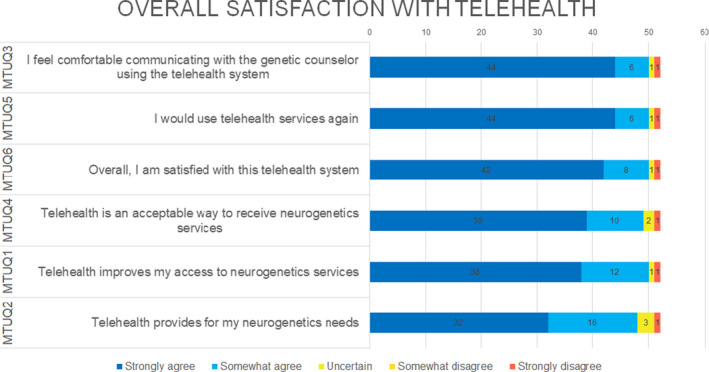
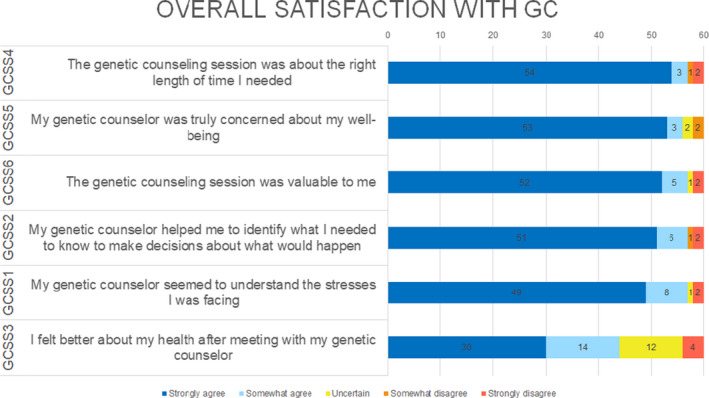
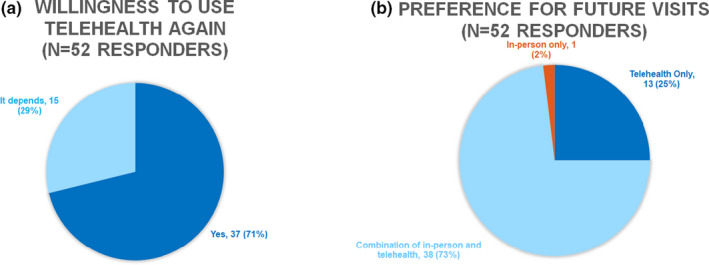
The COVID-19 pandemic rapidly changed genetic counseling services across the United States. At the University of Pennsylvania (UPenn), a large academic hospital in an urban setting, nearly all genetic counseling (GC) visits for adult-onset disorders within the Department of Neurology were conducted via secure videoconferencing (telegenetics) or telephone between March and December 2020. Although telemedicine services have been steadily emerging, many clinical programs, including the neurogenetics program at UPenn, had not built infrastructure or widely utilized these services prior to the pandemic. Thus, little is known about patient attitudes toward receiving clinical GC services remotely. From May 18 to October 18, 2020, all individuals seen remotely for GC in adult neurology via telephone or telegenetics were surveyed about their satisfaction with telehealth GC (N = 142), with a response rate of 42% (N = 60/142). Telephone and telegenetics services were referred to as 'telehealth' in the surveys to capture patient perspectives on all remote GC services, though the majority (N = 49/60) of these visits were completed via telegenetics. Surveys included the modified telehealth usability questionnaire (MTUQ), genetic counseling satisfaction scale (GCSS), and novel questions about future telehealth use. Preliminary results suggest that patients were satisfied with receiving remote GC services in adult neurology, with most participants strongly agreeing to all items about satisfaction with telehealth. Just 2% of participants preferred only in-person visits in the future, but every participant was willing to consider using telehealth for future visits if their genetic counselor felt it was appropriate. Most participants preferred a hybrid model (73%), and some (25%) preferred only telehealth for future visits. Additionally, we found no differences in satisfaction with remote services based on visit type (initial vs. results disclosure) nor age. We conclude that remote GC is an acceptable method for the provision of services in adult neurology that is well-received by patients.
Keywords: COVID-19; genetic counseling; neurogenetics; telegenetics; telehealth; telemedicine.
© 2021 National Society of Genetic Counselors.
Conflict of interest statement
TB receives consulting fees from Genome Medical, Inc., a telehealth company. PGA has received consulting fees unrelated to this work from Spark Therapeutics, Eisai Therapeutics and NeuExcell, research funding from the NIH and funds from clinical trial execution from BioHaven. TT reports no disclosures specific to this study. He has received grants from the NIH/NINDS (K23‐NS11416‐01A1), and research support from the Parkinson Foundation (PDGENEration Site Investigator) and The Michael J Fox Foundation. He has received consulting fees and honoraria from the Parkinson Foundation and Sanofi Genzyme. RP reports no financial disclosures for this study; she provides telegenetics counseling for the Parkinson Foundation's PDGENEration study. AR, LD, AB, and MB declare no conflicts of interest.
Figures
References
-
- Achey, M., Aldred, J. L., Aljehani, N., Bloem, B. R., Biglan, K. M., Chan, P., Cubo, E., Ray Dorsey, E., Goetz, C. G., Guttman, M., Hassan, A., Khandhar, S. M., Mari, Z., Spindler, M., Tanner, C. M., van den Haak, P., Walker, R., Wilkinson, J. R., & International Parkinson and Movement Disorder Society Telemedicine Task Force (2014). The past, present, and future of telemedicine for Parkinson's disease. Movement Disorders, 29(7), 871–883. 10.1002/mds.25903 - DOI - PubMed
-
- Alani, J. (2020). Telemedicine: An opportunity to bring better care to all. https://www.neurologylive.com/view/telemedicine‐an‐opportunity‐to‐bring‐...
-
- Alcalay, R. N., Kehoe, C., Shorr, E., Battista, R., Hall, A., Simuni, T., Marder, K., Wills, A.‐M., Naito, A., Beck, J. C., Schwarzschild, M. A., & Nance, M. (2020). Genetic testing for Parkinson disease: Current practice, knowledge, and attitudes among US and Canadian movement disorders specialists. Genetics in Medicine, 22(3), 574–580. - PMC - PubMed
-
- Armstrong, J., Toscano, M., Kotchko, N., Friedman, S., Schwartz, M. D., Virgo, K. S., & Sutphen, R. (2015). Utilization and outcomes of BRCA genetic testing and counseling in a national commercially insured population: The ABOUT study. JAMA Oncology, 1(9), 1251–1260. - PubMed
MeSH terms
LinkOut - more resources
Full Text Sources
Medical
Miscellaneous
