


Temporal Trends and Evolving Outcomes After Simultaneous Liver-Kidney Transplantation: Results from the US SLKT Consortium
- PMID: 34265161
- PMCID: PMC8982673
- DOI: 10.1002/lt.26232
Temporal Trends and Evolving Outcomes After Simultaneous Liver-Kidney Transplantation: Results from the US SLKT Consortium
Abstract
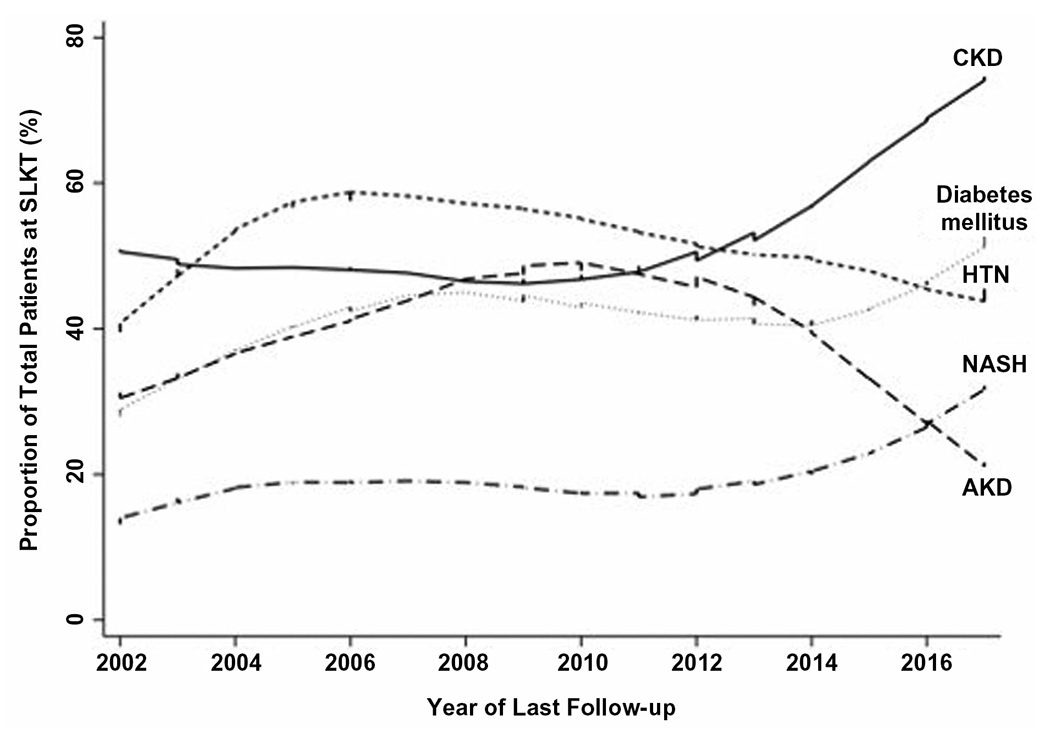
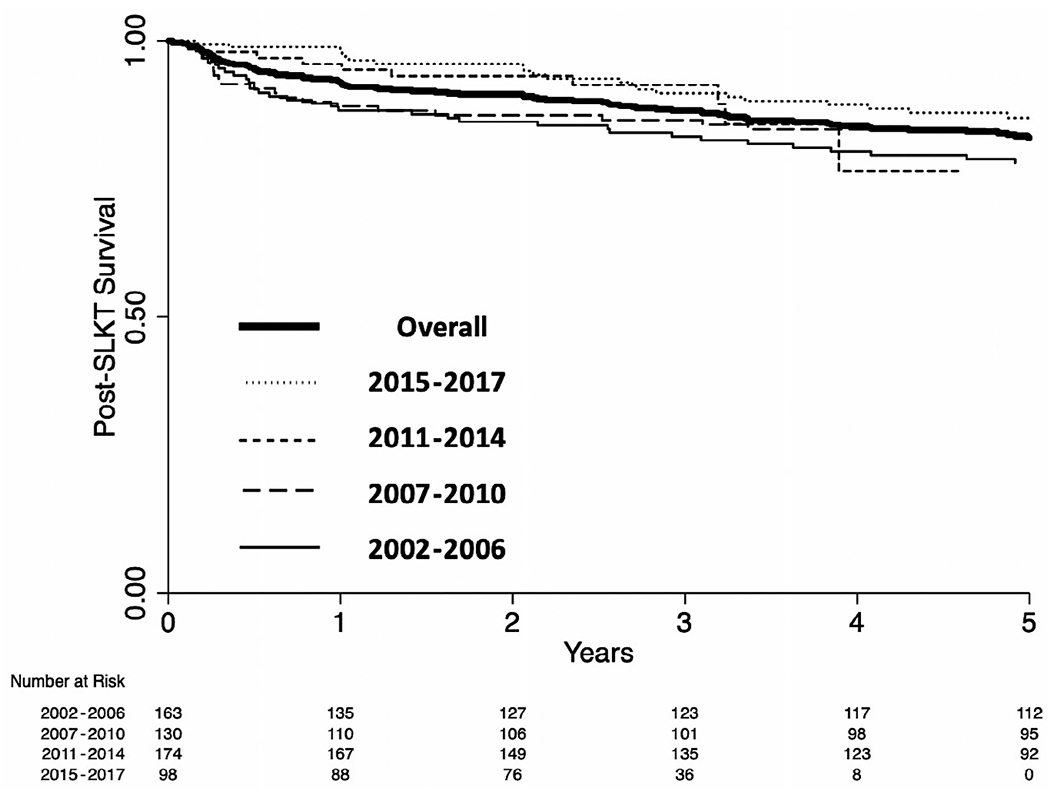
We aimed to understand the contemporary changes in the characteristics and the determinants of outcomes among simultaneous liver-kidney transplantation (SLKT) recipients at 6 liver transplantation centers in the United States. We retrospectively enrolled SLKT recipients between 2002 and 2017 in the US Multicenter SLKT Consortium. We analyzed time-related trends in recipient characteristics and outcomes with linear regression and nonparametric methods. Clustered Cox regression determined the factors associated with 1-year and overall survival. We enrolled 572 patients. We found significant changes in the clinical characteristics of SLKT recipients: as compared with 2002, recipients in 2017 were older (59 versus 52 years; P < 0.001) and more likely to have chronic kidney disease (71% versus 33%; P < 0.001). There was a marked improvement in 1-year survival during the study period: 89% in 2002 versus 96% in 2017 (P < 0.001). We found that the drivers of 1-year mortality were SLKT year, hemodialysis at listing, donor distance, and delayed kidney allograft function. The drivers of overall mortality were an indication of acute kidney dysfunction, body mass index, hypertension, creatinine at SLKT, ventilation at SLKT, and donor quality. In this contemporary cohort of SLKT recipients, we highlight changes in the clinical characteristics of recipients. Further, we identify the determinants of 1-year and overall survival to highlight the variables that require the greatest attention to optimize outcomes.
Copyright © 2021 by the American Association for the Study of Liver Diseases.
Figures
References
-
- Sharma P, Welch K, Eikstadt R, Marrero JA, Fontana RJ, Lok AS. Renal outcomes after liver transplantation in the model for end-stage liver disease era. Liver Transpl 2009;15:1142–1148. - PubMed
-
- Formica RN, Aeder M, Boyle G, Kucheryavaya A, Stewart D, Hirose R, et al. Simultaneous liver-kidney allocation policy: a proposal to optimize appropriate utilization of scarce resources. Am J Transplant 2016;16:758–766. - PubMed
-
- Northup PG, Argo CK, Bakhru MR, Schmitt TM, Berg CL, Rosner MH. Pretransplant predictors of recovery of renal function after liver transplantation. Liver Transpl 2010;16:440–446. - PubMed
