


Local government funding and life expectancy in England: a longitudinal ecological study
- PMID: 34265265
- PMCID: PMC8390384
- DOI: 10.1016/S2468-2667(21)00110-9
Local government funding and life expectancy in England: a longitudinal ecological study
Abstract
Background: Since 2010, large reductions in funding for local government services have been introduced in England. These reductions in funding have potentially led to reduced provision of health-promoting public services. We aimed to investigate whether areas that showed a greater decline in funding also had more adverse trends in life expectancy and premature mortality.
Methods: In this longitudinal ecological study, we linked annual data from the Ministry of Housing, Communities, and Local Government on local government revenue expenditure and financing to 147 upper-tier local authorities in England between 2013 and 2017 with data from Public Health England, on male and female life expectancy at birth, male and female life expectancy at age 65 years, and premature (younger than 75 years) all-cause mortality rate for male and female individuals. Local authorities were excluded if their populations were too small or if changes in boundaries meant consistent data were not available. Using multivariable fixed-effects panel regression models, and controlling for local socioeconomic conditions, we estimated whether changes in local funding from 2013 were associated with changes in life expectancy and premature mortality. We included a set of alternative model specifications to test the robustness of our findings.
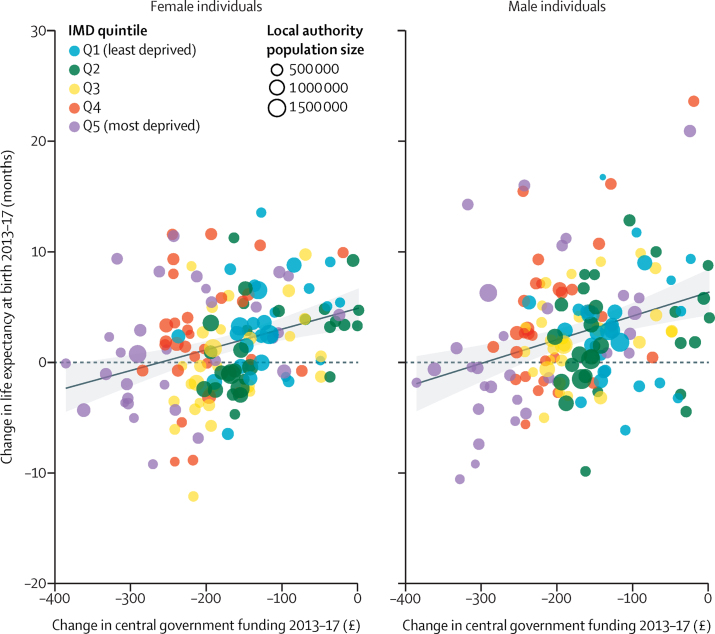
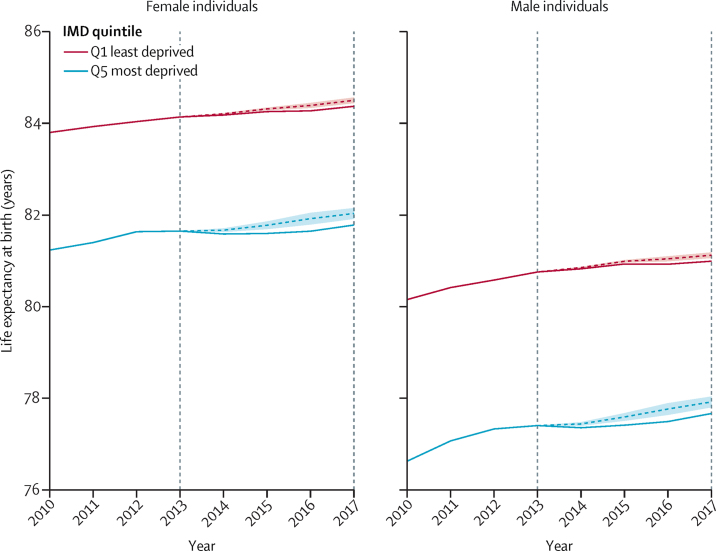
Findings: Between 2013 and 2017, mean per-capita central funding to local governments decreased by 33% or £168 per person (range -£385 to £1). Each £100 reduction in annual per person funding was associated over the study period 2013-17 with an average decrease in life expectancy at birth of 1·3 months (95% CI 0·7-1·9) for male individuals and 1·2 months (0·7-1·7) for female individuals; for life expectancy at age 65 years, the results show a decrease of 0·8 months (0·3-1·3) for male individuals and 1·1 months (0·7-1·5) for female individuals. Funding reductions were greater in more deprived areas and these areas had the worst changes in life expectancy. We estimated that cuts in funding were associated with an increase in the gap in life expectancy between the most and least deprived quintiles by 3% for men and 4% for women. Overall reductions in funding during this period were associated with an additional 9600 deaths in people younger than 75 years in England (3800-15 400), an increase of 1·25%.
Interpretation: Our findings indicate that cuts in funding for local government might in part explain adverse trends in life expectancy. Given that more deprived areas showed greater reductions in funding, our analysis suggests that inequalities have widened. Since the pandemic, strategies to address these adverse trends in life expectancy and reduce health inequalities could prioritise reinvestment in funding for local government services, particularly within the most deprived areas of England.
Funding: National Institute for Health Research (NIHR) School for Public Health Research, NIHR Applied Research Collaboration North East and North Cumbria, NIHR Applied Research Collaboration North West Coast and Medical Research Council.
Copyright © 2021 The Author(s). Published by Elsevier Ltd. This is an Open Access article under the CC BY 4.0 license. Published by Elsevier Ltd.. All rights reserved.
Conflict of interest statement
Declaration of interests We declare no competing interests.
Figures
Comment in
-
Cuts to local government funding and stalling life expectancy.Lancet Public Health. 2021 Sep;6(9):e623-e624. doi: 10.1016/S2468-2667(21)00136-5. Epub 2021 Jul 12. Lancet Public Health. 2021. PMID: 34265264 No abstract available.
References
-
- Leon DA, Jdanov DA, Shkolnikov VM. Trends in life expectancy and age-specific mortality in England and Wales, 1970–2016, in comparison with a set of 22 high-income countries: an analysis of vital statistics data. Lancet Public Health. 2019;4:e575–e582. - PubMed
-
- Marmot M. Social causes of the slowdown in health improvement. J Epidemiol Community Health. 2018;72:359–360. - PubMed
-
- Marshall L, Finch D, Cairncross L, Bibby J. Health Foundation; London: 2019. Mortality and life expectancy trends in the UK: stalling progress.
-
- Public Health England . Public Health England; London: 2018. A review of recent trends in mortality in England.
Publication types
MeSH terms
Grants and funding
LinkOut - more resources
Full Text Sources
Miscellaneous
