Human papillomavirus distribution and cervical cancer epidemiological characteristics in rural population of Xinjiang, China
- PMID: 34267066
- PMCID: PMC8367023
- DOI: 10.1097/CM9.0000000000001441
Human papillomavirus distribution and cervical cancer epidemiological characteristics in rural population of Xinjiang, China
Abstract
Background: Cervical cancer remains a major public health issue for the Uyghur women and other women living mainly in rural areas of Xinjiang. This study aims to investigate the distribution of human papillomavirus (HPV) infection and cervical cancer in rural areas of Xinjiang, China.
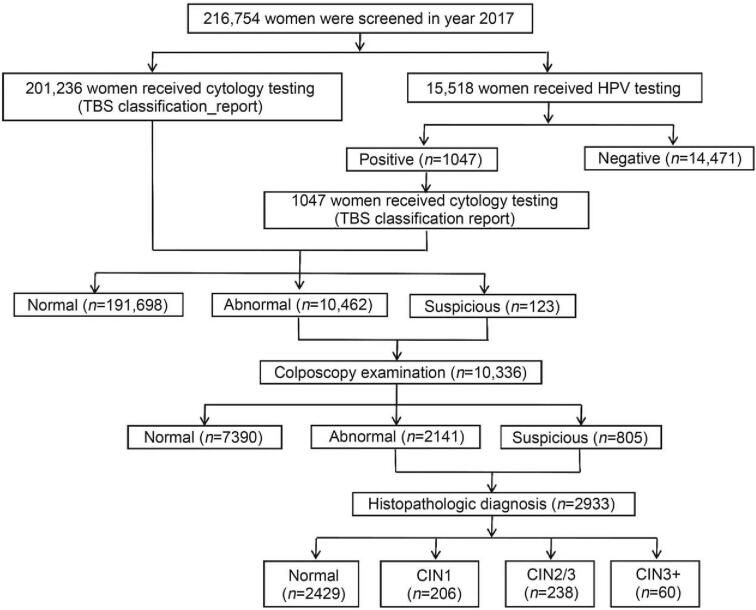
Methods: Cervical cancer screening was performed on rural women aged 35 to 64 years from Xinjiang, China in 2017 through gynecological examination, vaginal discharge smear microscopy, cytology, and HPV testing. If necessary, colposcopy and biopsy were performed on women with suspicious or abnormal screening results.
Results: Of the 216,754 women screened, 15,518 received HPV testing. The HPV-positive rate was 6.75% (1047/15,518). Compared with the age 35-44 years group, the odds ratios (ORs) of HPV positivity in the age 45-54 years and 55-64 years groups were 1.18 (95% confidence interval [CI]: 1.02-1.37) and 1.84 (95% CI: 1.53-2.21), respectively. Compared with women with primary or lower education level, the ORs for HPV infection rates of women with high school and college education or above were 1.37 (95% CI: 1.09-1.72) and 1.62 (95% CI: 1.23-2.12), respectively. Uyghur women were less likely to have HPV infection than Han women, with an OR (95% CI) of 0.78 (0.61-0.99). The most prevalent HPV types among Xinjiang women were HPV 16 (24.00%), HPV 33 (12.70%), and HPV 52 (11.80%). The detection rate of cervical intraepithelial neoplasia (CIN)2+ was 0.14% and the early diagnosis rate of cervical cancer was 85.91%. The detection rates of vaginitis and cervicitis were 19.28% and 21.32%, respectively.
Conclusions: The HPV infection rate in Xinjiang is low, but the detection rate of cervical cancer and precancerous lesions is higher than the national average level. Cervical cancer is a prominent public health problem in Xinjiang, especially in southern Xinjiang.
Copyright © 2021 The Chinese Medical Association, produced by Wolters Kluwer, Inc. under the CC-BY-NC-ND license.
Conflict of interest statement
None.
Figures
References
-
- Zheng RS, Sun KX, Zhang SW, Zeng HM, Zou XN, Chen R, et al. Report of cancer epidemiology in China, 2015 (in Chinese). Chin J Oncol 2019; 41:19–28. doi: 10.3760/cma.j.issn.0253-3766.2019.01.005. - PubMed
-
- Chen W, Zheng R, Baade PD, Zhang S, Zeng H, Bray F, et al. Cancer statistics in China, 2015. CA Cancer J Clin 2016; 66:115–132. doi: 10.3322/caac.21338. - PubMed
-
- Zur Hausen H. Papillomaviruses in human cancers. Proc Assoc Am Physicians 1999; 111:581–587. doi: 10.1046/j.1525-1381.1999.99723.x. - PubMed