Review
. 2021 Sep;28(34):46999-47023.
doi: 10.1007/s11356-021-14941-z. Epub 2021 Jul 16.

The contribution of bovines to human health against viral infections

Affiliations
Review

The contribution of bovines to human health against viral infections

AbdulRahman A Saied et al. Environ Sci Pollut Res Int. 2021 Sep.

Abstract

In the last 40 years, novel viruses have evolved at a much faster pace than other pathogens. Viral diseases pose a significant threat to public health around the world. Bovines have a longstanding history of significant contributions to human nutrition, agricultural, industrial purposes, medical research, drug and vaccine development, and livelihood. The life cycle, genomic structures, viral proteins, and pathophysiology of bovine viruses studied in vitro paved the way for understanding the human counterparts. Calf model has been used for testing vaccines against RSV, papillomavirus vaccines and anti-HCV agents were principally developed after using the BPV and BVDV model, respectively. Some bovine viruses-based vaccines (BPIV-3 and bovine rotaviruses) were successfully developed, clinically tried, and commercially produced. Cows, immunized with HIV envelope glycoprotein, produced effective broadly neutralizing antibodies in their serum and colostrum against HIV. Here, we have summarized a few examples of human viral infections for which the use of bovines has contributed to the acquisition of new knowledge to improve human health against viral infections covering the convergence between some human and bovine viruses and using bovines as disease models. Additionally, the production of vaccines and drugs, bovine-based products were covered, and the precautions in dealing with bovines and bovine-based materials.

Keywords: Bovine-based products; Bovines; COVID-19; Contribution; Human viruses; One medicine; Transchromosomic bovines.


Conflict of interest statement

This article has the consent of all the authors and authors have no conflicts of interest.

The authors declare no competing interests.

Figures
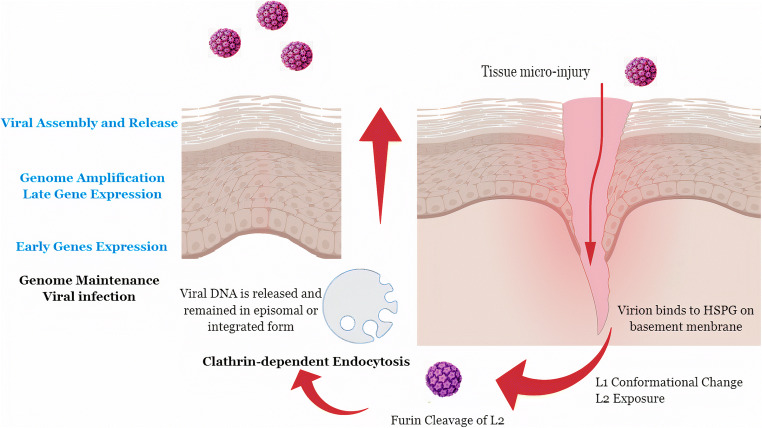
Fig. 1
Fig. 1
Papillomavirus life cycle. Viral lodgment starts from tissue micro-injury (because these viruses cannot actively penetrate the skin of their host), but other routes were reported as infected lymphocytes (viral hematogenous infection to the skin or urinary bladder), infected semen, and infected milk. After tissue micro-injury, heparin sulfate proteoglycan (HSPG) receptors that present on the basement membrane (BM) provides access to the basal keratinocytes, are exposed to L1 binding leading to conformational changes in capsid icosahedral structure, exposing the L2 N-terminal to be cleaved by extracellular furin protein that presents in the cell membrane inducing a second capsid conformational change, allowing L2 to bind to different receptors, such as integrin 24. Viral entry; virions internalization by clathrin-dependent endocytosis mechanism, resulting in cytoplasmic vesicles that associate to lysosomes, the lysosomal acid content release promotes pH alterations in capsid proteins, resulting in viral DNA release. BPV genome is found in episomal form and HPV genome can integrate into fragile sites of the host genome. Differentiation triggers the production of the PV early proteins that force the suprabasal cell to reenter the S-phase of the cell cycle resulting in cell cycle continuation. Amplification process: PVs induce the S-phase entry because they do not codify polymerase, stimulating cell proliferation, and inducing mitotic stress. As a result, many cell cycle checkpoints are abrogated. Consequently, an accumulation of mutations resulting in cytogenetic aberrations and progression into cancer occurs in cells that are persistently infected by these viruses. The productive infection occurs within the terminal differentiation and keratinization of an infected cell. PV late genes expression and viral assembly occur close to the cell surface and viral particles are released only after the epithelial cell sloughing from the epithelial surface and not by causing cell lysis. Thus, the viral life cycle is completed without directly causing cell death and without systemic viremia
Fig. 2
Fig. 2
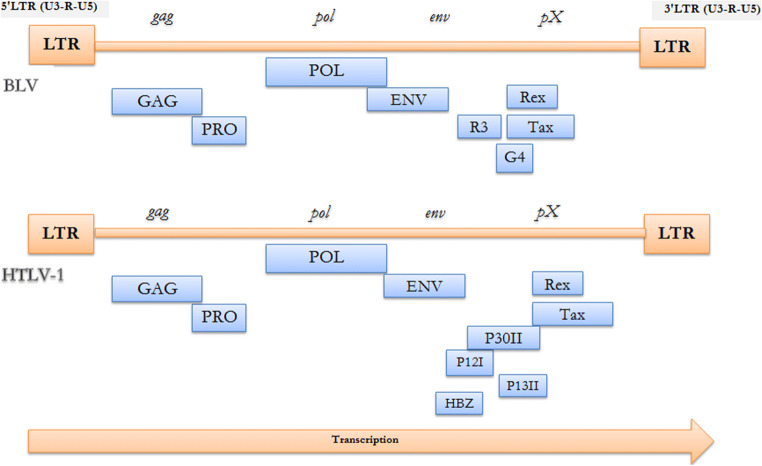
Summary of BLV and HTLV-1 genes and their precursors and proteins produced (structural and enzymatic). Gene: Gag, Precursor: Pr44gag, Proteins: P15/MA (bind the genomic viral RNA - interact with the lipid bilayer of the viral membrane - proteolytically processed to generate three fragments: p10, a seven amino acids product, and p4) - P12/NC (Tightly bind to the packaged genomic RNA) - P24/CA (The major constituent of the capsid (CA) of BLV virions - The major target for the host immune response). Gene: Pro (Prt), Precursor: pr66gag-prt, Proteins: p14/Prt (Protease). Gene: Pol, Precursor: Pr145, Proteins: P80/RT+IN (contains all of the tryptic peptides of the gag-protease precursor - encodes reverse transcriptase (RT), (RNA dependent DNA polymerase). Gene: Env, Precursor: Pr72env, Proteins: Gp51/SU (The extracellular SU is very immunogenic, a useful tool for diagnostics and vaccine development) - Gp30/TM (The TM transmembrane protein is a key factor in cell fusion during transmission and is involved in signal transduction via immunoreceptor tyrosine-based activation motifs (ITAM) present in the cytoplasmic tail). Gene: pX, Precursor: Tax ORF, Proteins: Tax (p34) (Transcriptional activator of viral expression - target of the host immune response with T and B epitopes - Oncogenic potential - Activation of NF-kappa B (NF-κB) pathway - Inhibition of DNA repair of oxidative damage, increase accumulation of mutations in cellular DNA - Induction of DNA damage, cellular senescence and apoptosis - directly binds to tristetraprolin (TTP), a post-transcriptional modulator of TNFα expression – regulate many cellular proteins by direct binding) - Rex (p18) (Nuclear export of viral mRNAs - post-transcriptional regulation) - R3 (p5) (The maintenance of high viral load) - p12I (Maintenance of viral infectivity - Activation of nuclear factor of activated T cells (NFAT) pathway) - G4 (p11) like p13II (The maintenance of high viral load - Oncogenic potential) - p13II (Suppression of viral replication - Interaction with farnesyl pyrophosphate synthetase - Activation of Ras-mediated apoptosis) - p30II (Suppression of viral replication - Regulation of gene transcription by binding with p300 - Enhancement of Myc transforming potential) - HBZ (Inhibition of HTLV-1 transcription - suppression of the classical pathway of NF-κB - Enhancement of TGF-β signaling - Oncogenic potential)
Fig. 3
Fig. 3
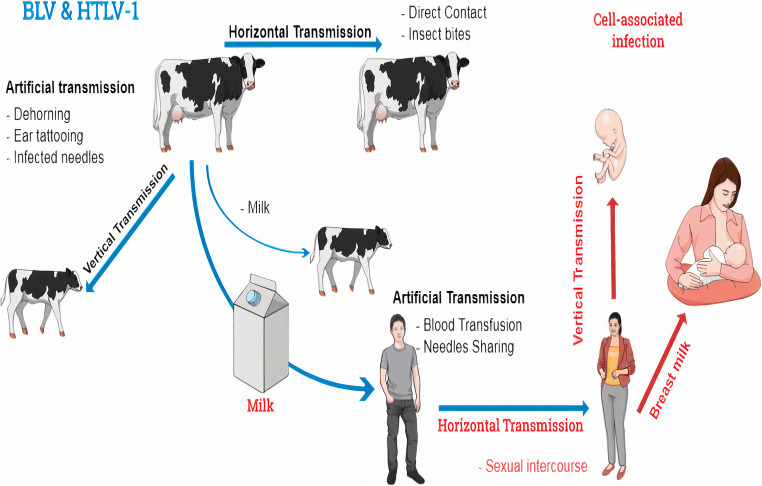
BLV life cycle. BLV can be transmitted between bovines via horizontal and vertical transmission. Milk and insects play a role in BLV transmission. As well, HTLV-1 could be transmitted via horizontal and vertical transmission. Milk, sexual intercourse, and blood transfusion are routes of HTLV-1 transmission. Transfer of infected maternal lymphocytes to offspring is a natural transmission route of both BLV and HTLV-1. So, efficient transmission for both BLV and HTLV-1 requires cell-associated infection. The anti-BLV antibodies were clearly identified in the human serum. That is awakened the idea of a possible zoonotic disease. BLV might be transmitted to humans through unpasteurized milk or undercooked meat when bovine products were uncontrolled. Then, BLV had transmitted from person to person, like HTLV in body fluids once the virus was integrated into the human host genome. Both BLV and HTLV-1 infections are prevalent throughout the world. BLV was isolated from breast tissues. Designing eradication plans and improving preventive strategies are mandatory when the link between BLV and breast cancer is confirmed
Fig. 4
Fig. 4
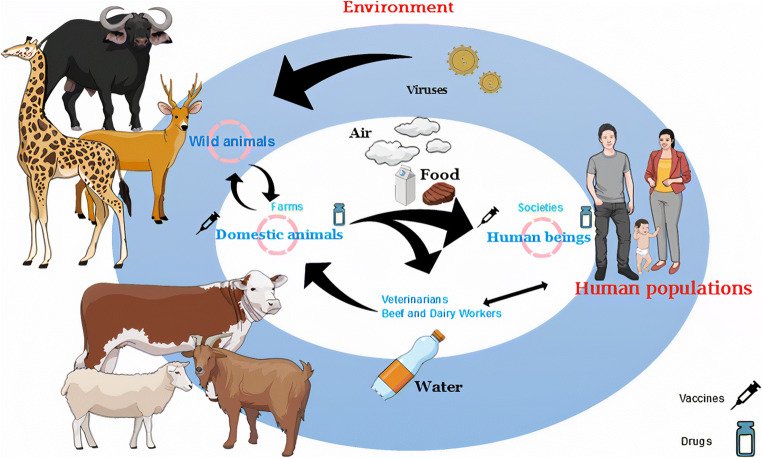
The possible ways of transmission of viruses. Viruses are present around in the environment as inactive microbes where the life cycle of viruses begins after entering the living body. Wild animals are reservoir hosts for many emerging viruses, and bovines play an important role in the spread of viruses from wildlife to a human directly or indirectly. Furthermore, the air, water, and food are other routes of transmission of viruses besides the anthropogenic activities leading to pathogen spillover. Vaccination of farm animals, including bovines, is the strategy for improving animal health and protecting human health, and medicines are valuable and urgent against diseases that do not possess vaccines until now

References

    1. Abed Y, St-Laurent G, Zhang H, et al. Development of a western blot assay for detection of bovine immunodeficiency-like virus using capsid and transmembrane envelope proteins expressed from recombinant baculovirus. Clin Diagn Lab Immunol. 1999;6:168–172. doi: 10.1128/cdli.6.2.168-172.1999. - DOI - PMC - PubMed
    1. Achachi A, Florins A, Gillet N, et al. Valproate activates bovine leukemia virus gene expression, triggers apoptosis, and induces leukemia/lymphoma regression in vivo. Proc Natl Acad Sci. 2005;102:10309–10314. doi: 10.1073/pnas.0504248102. - DOI - PMC - PubMed
    1. Adams MJ, Lefkowitz EJ, King AMQ, et al. Ratification vote on taxonomic proposals to the International Committee on Taxonomy of Viruses (2016) Arch Virol. 2016;161:2921–2949. doi: 10.1007/s00705-016-2977-6. - DOI - PMC - PubMed
    1. Aida Y, Murakami H, Takagashi M, Takeshima S-N. Mechanisms of pathogenesis induced by bovine leukemia virus as a model for human T-cell leukemia virus. Front Microbiol. 2013;4:328. doi: 10.3389/fmicb.2013.00328. - DOI - PMC - PubMed
    1. Alberti A, Pirino S, Pintore F, et al. Ovis aries Papillomavirus 3: a prototype of a novel genus in the family Papillomaviridae associated with ovine squamous cell carcinoma. Virology. 2010;407:352–359. doi: 10.1016/j.virol.2010.08.034. - DOI - PubMed

Substances