Review
. 2022 Jul;27(4):1119-1136.
doi: 10.1007/s10741-021-10137-2. Epub 2021 Jul 17.

Current and emerging drug targets in heart failure treatment

Affiliations
Review

Current and emerging drug targets in heart failure treatment

Nicolò Ghionzoli et al. Heart Fail Rev. 2022 Jul.

Abstract

After initial strategies targeting inotropism and congestion, the neurohormonal interpretative model of heart failure (HF) pathophysiology has set the basis for current pharmacological management of HF, as most of guideline recommended drug classes, including beta-blockers, angiotensin-converting enzyme inhibitors, angiotensin receptor blockers, and mineralocorticoid receptor antagonists, blunt the activation of detrimental neurohormonal axes, namely sympathetic and renin-angiotensin-aldosterone (RAAS) systems. More recently, sacubitril/valsartan, a first-in-class angiotensin receptor neprilysin inhibitor, combining inhibition of RAAS and potentiation of the counter-regulatory natriuretic peptide system, has been consistently demonstrated to reduce mortality and HF-related hospitalization. A number of novel pharmacological approaches have been tested during the latest years, leading to mixed results. Among them, drugs acting directly at a second messenger level, such as the soluble guanylate cyclase stimulator vericiguat, or other addressing myocardial energetics and mitochondrial function, such as elamipretide or omecamtiv-mecarbil, will likely change the therapeutic management of patients with HF. Sodium glucose cotransporter 2 inhibitors, initially designed for the management of type 2 diabetes mellitus, have been recently demonstrated to improve outcome in HF, although mechanisms of their action on cardiovascular system are yet to be elucidated. Most of these emerging approaches have shifted the therapeutic target from neurohormonal systems to the heart, by improving cardiac contractility, metabolism, fibrosis, inflammation, and remodeling. In the present paper, we review from a pathophysiological perspective current and novel therapeutic strategies in chronic HF.

Keywords: Emerging targets; Heart failure; Neurohormonal antagonism; Pharmacodynamics; Pharmacotherapy; SGLT2 inhibitors.


Conflict of interest statement

The authors declare no competing interests.

Figures
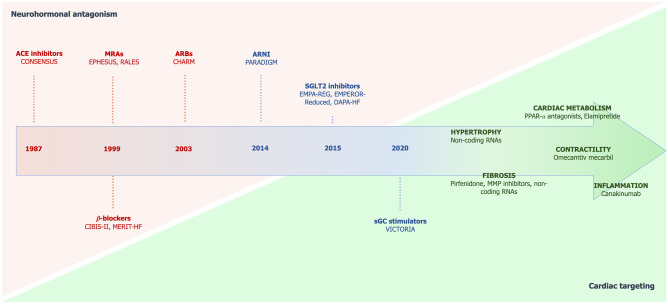
Fig. 1
Fig. 1
Chronologic development of drugs in heart failure, highlighting the shift from neurohormonal antagonism to specific cardiac targeting. Current guideline recommended drugs classes are represented in bold red; drug classes with existing evidence on an outcome benefit in heart failure are represented in bold blue; novel possible targets are represented in green. ACE angiotensin-converting enzyme; ARBs angiotensin receptor blockers; ARNI angiotensin receptor neprilysin inhibitor; MRAs mineralocorticoid receptor antagonists; sGC soluble guanylate cyclase; SGLT2 sodium-glucose cotransporter 2
Fig. 2
Fig. 2
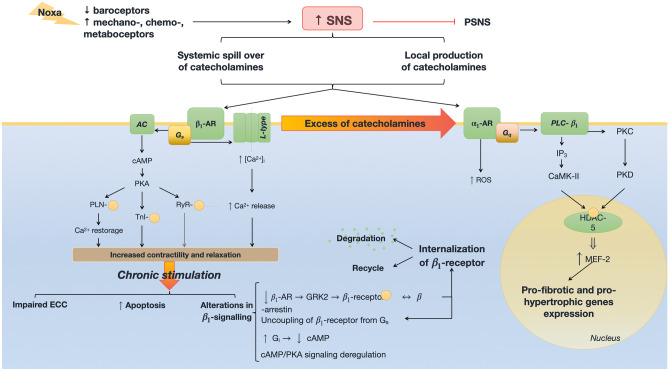
Molecular signaling of sympathetic nervous system (SNS) activation in the cardiomyocyte in heart failure. α1-AR α1 adrenergic receptor; AC adenylate cyclase; AR adrenergic receptor; CaMK-II calcium-calmodulin kinase type 2; cAMP cyclic adenosine monophosphate; Gi G-protein “i” associated with trans-membrane receptor; Gq G-protein “q” associated with trans-membrane receptor; GRK2 complex G protein-coupled receptor kinase type 2; Gs G-protein “s” associated with trans-membrane receptor; HDAC-5 histone deacetylase type 5; IP3 inositol trisphosphate; L-type L-type calcium channel; MEF-2 myocyte enhancer factor type 2; PKA protein-kinase A; PKC protein-kinase C; PKD protein-kinase D; PLC-β1 phospholipase C-β1; PLN phospholamban; PSNS parasympathetic nervous system; ROS reactive oxygen species; RyR ryanodine receptor; SR sarcoplasmic reticulum; TnI troponin-I
Fig. 3
Fig. 3
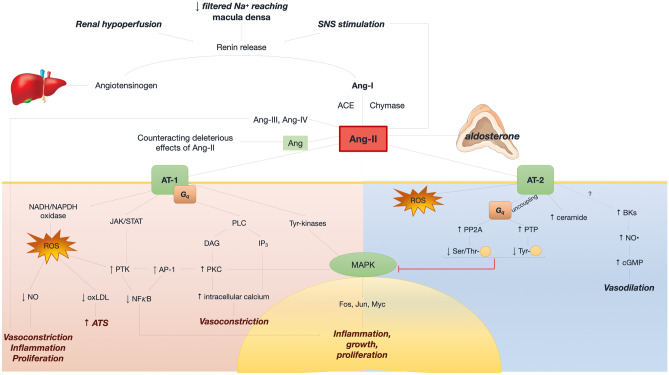
Molecular signaling of the renin–angiotensin–aldosterone system in heart failure. Angiotensin receptor 1 (AT-1) as well as many angiotensins (II, III, IV) are responsible for vasoconstriction, inflammation, proliferation and atherosclerosis. AT-2 counteracts these detrimental responses mainly via vasodilation. Ang angiotensin; AP-1 activator protein 1; ATS atherosclerosis, BK bradykinin; cGMP cyclic guanosine monophosphate; DAG diacyl-glycerol; IP3 inositol-triphosphate; JAK/STAT Janus kinase/signal transducer and activator transcription factor; NAD(P)H nicotinamide-adenine dinucleotide (phosphate); NFkB nuclear factor kappa-B; NO nitric oxide; oxLDL oxidized low-density lipoprotein; PKC protein kinase C; PLC phospholipase; PP2A protein phosphatase 2A; PTK phosphotyrosine kinase; PTP phosphotyrosine phosphatase; Ser/Thr serine/threonine; Tyr tyrosine
Fig. 4
Fig. 4
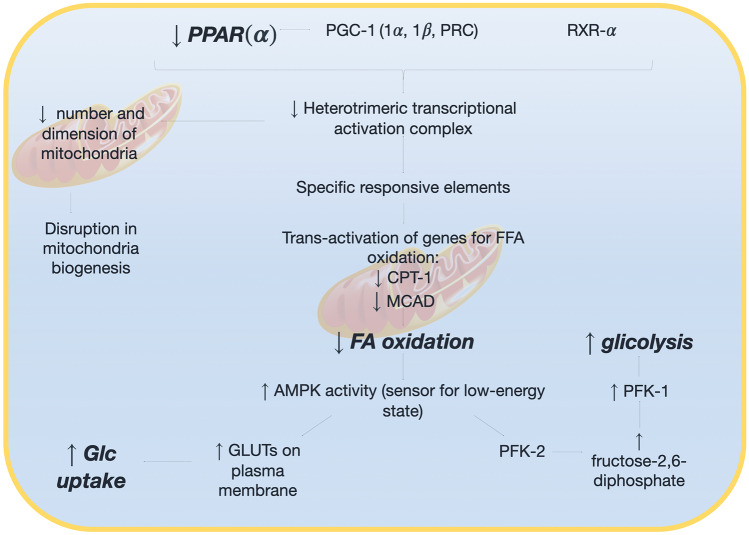
Metabolic phenotype of heart failure. The reduction in peroxisome proliferator-activated receptor alpha (PPAR-α) leads to a decreased expression of enzymes for fatty acid oxidation. This in turn stimulates glycolysis and glucose uptake via the increase of adenosine monophosphate kinase. AMPK adenosine monophosphate kinase; CPT carnitine palmitoyl transferase; FA fatty acid; Glc glucose; GLUT glucose transporter; MCAD medium-chain acyl-CoA dehydrogenase; PFK phosphofructokinase; PGC peroxisome proliferator-activated receptor gamma coactivator 1-alpha; PPAR peroxisome proliferator-activated receptor; RXR retinoid-X receptor
Fig. 5
Fig. 5
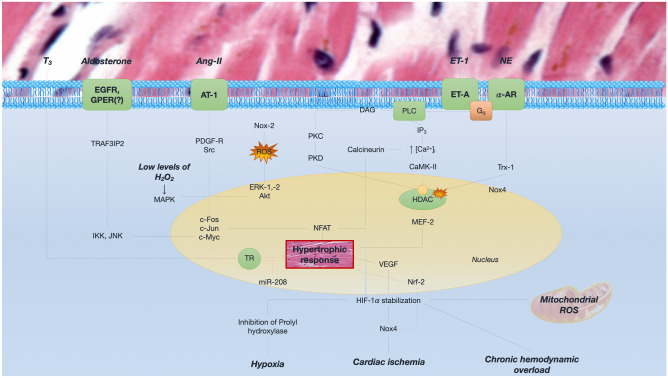
Main molecular pathways for cardiac hypertrophy. Hypertrophy may be the consequence of both hemodynamic (chronic overload) and non-hemodynamic factors, namely neuroendocrine systems derangement and reduction in oxygen myocardial delivery. Ang angiotensin; AR adrenergic receptor; AT angiotensin receptor; DAG diacyl-glycerol; EGFR epidermal growth factor receptor; ERK extracellular signal-regulated kinase; ET endothelin; ET-A endothelin receptor A; H2O2 hydrogen peroxide; HDAC histone deacetylase; HIF hypoxia inducible factor; IKK inhibitor of nuclear factor kappa-B kinase; IP3 inositol triphosphate; JNK c-Jun N-terminal kinase; MEF myocyte enhancer factor; NE norepinephrine; NFAT nuclear factor of activated T-cell; Nox NADPH oxidase; PDGF-R receptor of platelet-derived growth factor; PKC protein kinase C; PKD protein kinase D; PLC phospholipase C; Src Rous sarcoma protooncogene; TR thyroid receptor; Trx1 thioredoxin 1; VEGF vascular endothelial growth factor

References

    1. Mosterd A, Hoes AW. Clinical epidemiology of heart failure. Heart. 2007;93:1137–1146. doi: 10.1136/hrt.2003.025270. - DOI - PMC - PubMed
    1. Mann DL, Bristow MR. Mechanisms and models in heart failure: the biomechanical model and beyond. Circulation. 2005;31(111):2837–2849. doi: 10.1161/CIRCULATIONAHA.104.500546. - DOI - PubMed
    1. Packer M. The neurohormonal hypothesis: a theory to explain the mechanism of disease progression in heart failure. J Am Coll Cardiol. 1992;20:248–254. doi: 10.1016/0735-1097(92)90167-l. - DOI - PubMed
    1. Ponikowski P, Voors AA, Anker SD, et al. 2016 ESC Guidelines for the diagnosis and treatment of acute and chronic heart failure. Rev Esp Cardiol (Engl Ed) 2016;69:1167. doi: 10.1016/j.rec.2016.11.005. - DOI - PubMed
    1. Maggioni AP, Dahlström U, Filippatos G, et al (2013) EURObservational research programme: Regional differences and 1-year follow-up results of the heart failure pilot survey (ESC-HF Pilot). Eur J Heart Fail. 15:808–817. 10.1093/eurjhf/hft050 - PubMed

Publication types

MeSH terms