


Dissecting the shared genetic basis of migraine and mental disorders using novel statistical tools
- PMID: 34273149
- PMCID: PMC8967089
- DOI: 10.1093/brain/awab267
Dissecting the shared genetic basis of migraine and mental disorders using novel statistical tools
Abstract
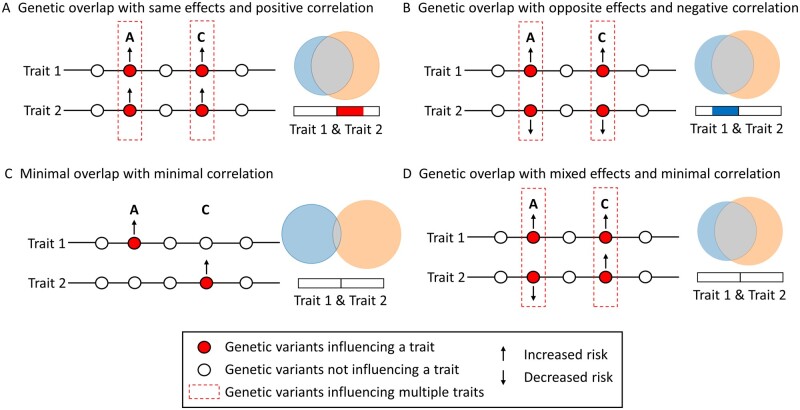
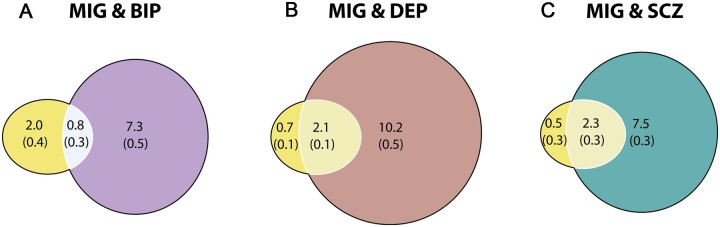
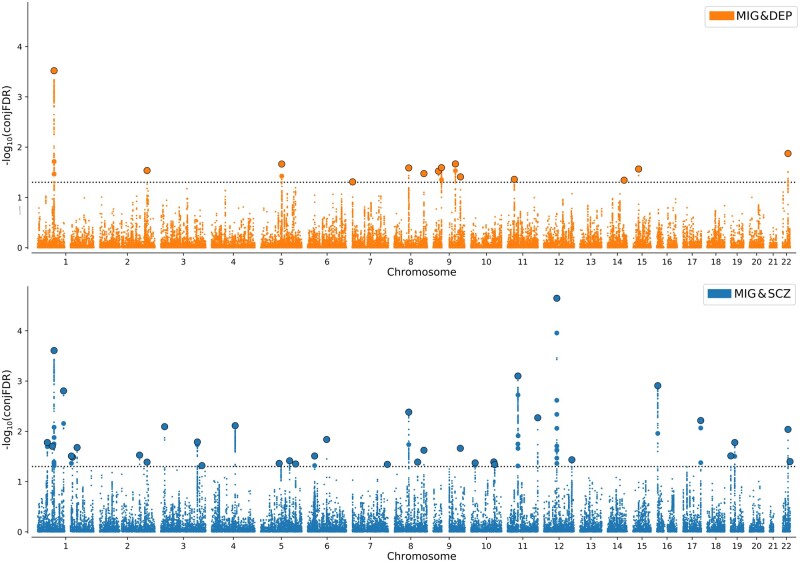
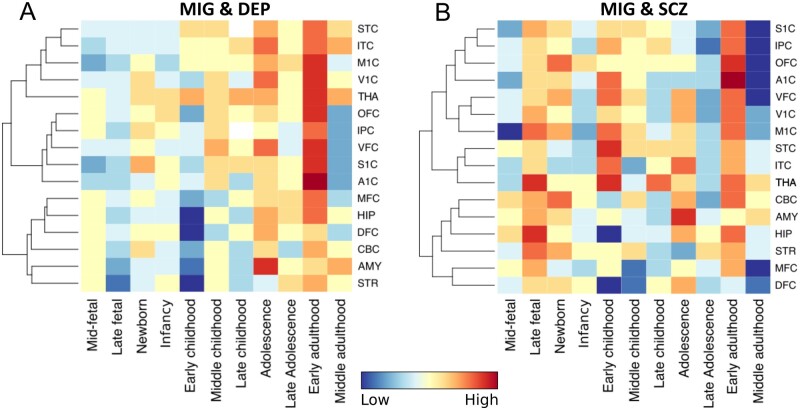
Migraine is three times more prevalent in people with bipolar disorder or depression. The relationship between schizophrenia and migraine is less certain although glutamatergic and serotonergic neurotransmission are implicated in both. A shared genetic basis to migraine and mental disorders has been suggested but previous studies have reported weak or non-significant genetic correlations and five shared risk loci. Using the largest samples to date and novel statistical tools, we aimed to determine the extent to which migraine's polygenic architecture overlaps with bipolar disorder, depression and schizophrenia beyond genetic correlation, and to identify shared genetic loci. Summary statistics from genome-wide association studies were acquired from large-scale consortia for migraine (n cases = 59 674; n controls = 316 078), bipolar disorder (n cases = 20 352; n controls = 31 358), depression (n cases = 170 756; n controls = 328 443) and schizophrenia (n cases = 40 675, n controls = 64 643). We applied the bivariate causal mixture model to estimate the number of disorder-influencing variants shared between migraine and each mental disorder, and the conditional/conjunctional false discovery rate method to identify shared loci. Loci were functionally characterized to provide biological insights. Univariate MiXeR analysis revealed that migraine was substantially less polygenic (2.8 K disorder-influencing variants) compared to mental disorders (8100-12 300 disorder-influencing variants). Bivariate analysis estimated that 800 (SD = 300), 2100 (SD = 100) and 2300 (SD = 300) variants were shared between bipolar disorder, depression and schizophrenia, respectively. There was also extensive overlap with intelligence (1800, SD = 300) and educational attainment (2100, SD = 300) but not height (1000, SD = 100). We next identified 14 loci jointly associated with migraine and depression and 36 loci jointly associated with migraine and schizophrenia, with evidence of consistent genetic effects in independent samples. No loci were associated with migraine and bipolar disorder. Functional annotation mapped 37 and 298 genes to migraine and each of depression and schizophrenia, respectively, including several novel putative migraine genes such as L3MBTL2, CACNB2 and SLC9B1. Gene-set analysis identified several putative gene sets enriched with mapped genes including transmembrane transport in migraine and schizophrenia. Most migraine-influencing variants were predicted to influence depression and schizophrenia, although a minority of mental disorder-influencing variants were shared with migraine due to the difference in polygenicity. Similar overlap with other brain-related phenotypes suggests this represents a pool of 'pleiotropic' variants that influence vulnerability to diverse brain-related disorders and traits. We also identified specific loci shared between migraine and each of depression and schizophrenia, implicating shared molecular mechanisms and highlighting candidate migraine genes for experimental validation.
Keywords: bipolar disorder; depression; genetics; migraine; schizophrenia.
© The Author(s) (2021). Published by Oxford University Press on behalf of the Guarantors of Brain.
Figures
References
-
- Breslau N, Lipton RB, Stewart WF, Schultz LR, Welch KMA.. Comorbidity of migraine and depression: Investigating potential etiology and prognosis. Neurology. 2003;60(8):1308–1312. - PubMed
-
- Minen MT, De Dhaem OB, Van Diest AK, et al. Migraine and its psychiatric comorbidities. J Neurol Neurosurg Psychiatry. 2016;87(7):741–749. - PubMed
-
- Fornaro M, Stubbs B.. A meta-analysis investigating the prevalence and moderators of migraines among people with bipolar disorder. J Affect Disord. 2015;178:88–97. - PubMed
-
- Leo RJ, Singh J.. Migraine headache and bipolar disorder comorbidity: A systematic review of the literature and clinical implications. Scand J Pain. 2016;11(1):136–145. - PubMed
-
- Louter MA, Pelzer N, De Boer I, et al. Prevalence of lifetime depression in a large hemiplegic migraine cohort. Neurology. 2016;87(22):2370–2374. - PubMed
