


Residual respiratory impairment after COVID-19 pneumonia
- PMID: 34273962
- PMCID: PMC8286033
- DOI: 10.1186/s12890-021-01594-4
Residual respiratory impairment after COVID-19 pneumonia
Abstract
Introduction: The novel coronavirus SARS-Cov-2 can infect the respiratory tract causing a spectrum of disease varying from mild to fatal pneumonia, and known as COVID-19. Ongoing clinical research is assessing the potential for long-term respiratory sequelae in these patients. We assessed the respiratory function in a cohort of patients after recovering from SARS-Cov-2 infection, stratified according to PaO2/FiO2 (p/F) values.
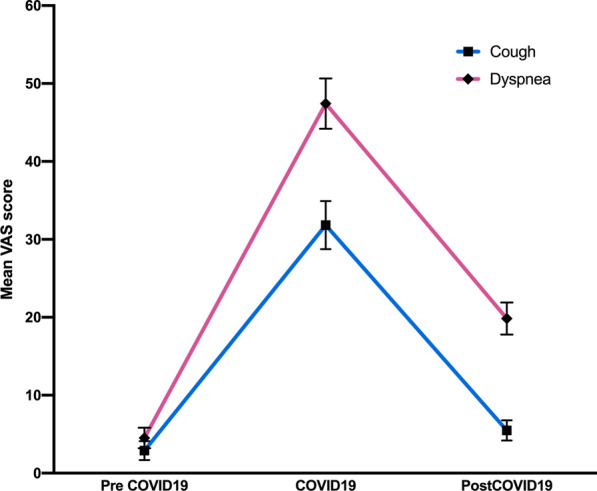
Method: Approximately one month after hospital discharge, 86 COVID-19 patients underwent physical examination, arterial blood gas (ABG) analysis, pulmonary function tests (PFTs), and six-minute walk test (6MWT). Patients were also asked to quantify the severity of dyspnoea and cough before, during, and after hospitalization using a visual analogic scale (VAS). Seventy-six subjects with ABG during hospitalization were stratified in three groups according to their worst p/F values: above 300 (n = 38), between 200 and 300 (n = 30) and below 200 (n = 20).
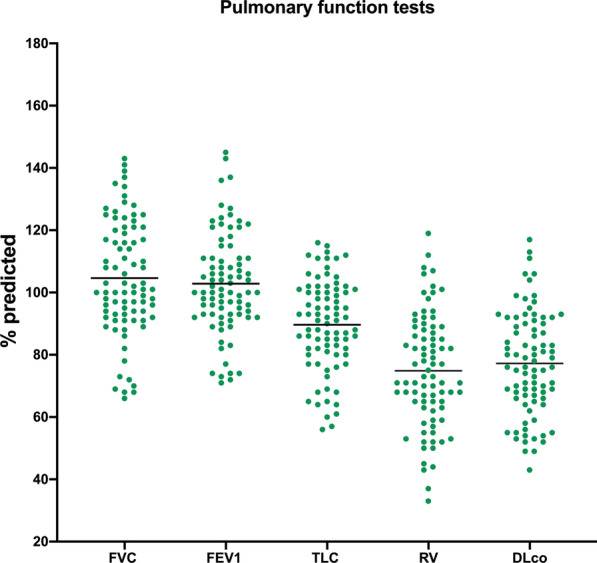
Results: On PFTs, lung volumes were overall preserved yet, mean percent predicted residual volume was slightly reduced (74.8 ± 18.1%). Percent predicted diffusing capacity for carbon monoxide (DLCO) was also mildly reduced (77.2 ± 16.5%). Patients reported residual breathlessness at the time of the visit (VAS 19.8, p < 0.001). Patients with p/F below 200 during hospitalization had lower percent predicted forced vital capacity (p = 0.005), lower percent predicted total lung capacity (p = 0.012), lower DLCO (p < 0.001) and shorter 6MWT distance (p = 0.004) than patients with higher p/F.
Conclusion: Approximately one month after hospital discharge, patients with COVID-19 can have residual respiratory impairment, including lower exercise tolerance. The extent of this impairment seems to correlate with the severity of respiratory failure during hospitalization.
Keywords: 6MWT; ABG; COVID; PFT; cough; dyspnoea.
© 2021. The Author(s).
Conflict of interest statement
Dr. Lombardi has nothing to disclose; Dr. Calabrese has nothing to disclose; Dr. Iovene reports personal fees from Boehringer Ingelheim, Menarini, outside the submitted work; Dr. Pierandrei has nothing to disclose; Dr. Lerede has nothing to disclose; Dr. Varone reports personal fees from Boehringer Ingelheim, Roche, outside the submitted work; Dr. Richeldi reports personal fees from FibroGen, Boehringer Ingelheim, Roche, Biogen, Veracyte, Promedior, outside the submitted work; Dr. Sgalla reports personal fees from Boehringer Ingelheim, outside the submitted work.
Figures
References
-
- WHO. COVID-19 Weekly Epidemiological Update 44. World Heal Organ. 2021;(June):1–3.
MeSH terms
Substances
LinkOut - more resources
Full Text Sources
Medical
Miscellaneous
