


Exploring the relationship between students' learning satisfaction and self-efficacy during the emergency transition to remote learning amid the coronavirus pandemic: A cross-sectional study
- PMID: 34276239
- PMCID: PMC8275635
- DOI: 10.1007/s10639-021-10644-7
Exploring the relationship between students' learning satisfaction and self-efficacy during the emergency transition to remote learning amid the coronavirus pandemic: A cross-sectional study
Abstract
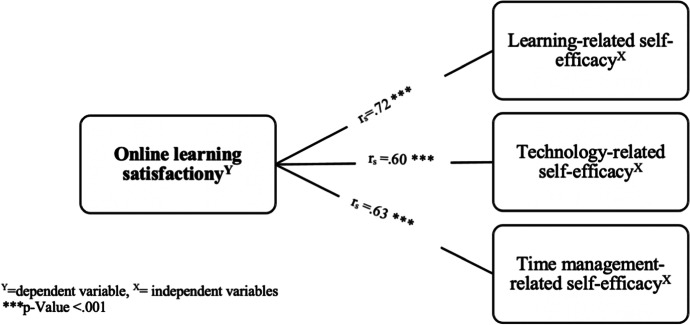
The overarching objective of this study was to assess learning satisfaction among students and to determine whether online-learning self-efficacy was associated with online learning satisfaction during the emergency transition to remote learning. This cross-sectional study involved a survey distributed to 22 Saudi Arabian universities. The survey used in this study consisted of an online learning self-efficacy (OLSE) questionnaire and an electronic learning (e-learning) satisfaction questionnaire. A total of 1,226 respondents voluntarily participated in and completed the survey. Students in medical fields made up 289 (23.6%). A Kruskal-Wallis H test and a chi-square test were used to compare the student's satisfaction based on the educational variables. Spearman's correlation and multiple linear regression analyses were performed to assess the association between self-efficacy and satisfaction. The findings revealed degrees of satisfaction ranging between high satisfaction and dissatisfaction. The majority of students (51%) expressed high satisfaction, and 599 students (49%) reported experiencing a low level of satisfaction with e-learning. A comparison of groups with low and high satisfaction scores revealed a significant difference in the OLSE. High satisfaction was positively correlated with the OLSE domains: time management, technology, and learning. The OLSE regression analysis model significantly predicted satisfaction. It showed that the model, corrected for education level and grade point average of the students, significantly predicted e-learning satisfaction (F = 8.04, R2 = 0.59, p = .004). The study concluded that students' satisfaction with the e-learning experience is influenced by e-learning self-efficacy. The study's findings lead to the practical implications and identify the need to improve the remote learning, time management and technology self-efficacy to enhance students' satisfaction.
Keywords: COVID-19 pandemic; Education; Remote learning; Self-efficacy; Students’ satisfaction; Technology.
© The Author(s) 2021.
Conflict of interest statement
Conflict of interestThe authors declare that the research was conducted in the absence of any commercial or financial relationships that could be construed as a potential conflict of interest.
Figures
References
-
- Akyol Z. Educational communities of inquiry: theoretical framework, research and practice: Theoretical framework, research and practice. IGI Global; 2012.
-
- Al Ghamdi, A. (2017) Influence of lecturer immediacy on students’ learning outcomes: Evidence from a distance education program at a university in Saudi Arabia. International Journal of Information and Education Technology, 7(1), 35. 10.18178/IJIET.2017.7.1.838
-
- Al-Asmari AM, Khan MSR. E-learning in saudi arabia: past, present and future. Near and Middle Eastern Journal of Research in Education. 2014;2014(1):2. doi: 10.5339/nmejre.2014.2. - DOI
-
- Alahmari A. The state of distance education in saudi srabia. Quarterly Review of Distance Education. 2017;18(2):91–101.
-
- Alavi M, Vogel DR. Using information technology to add value to management education. Academy of Management Journal. 1997;40(6):1310–1333. doi: 10.2307/257035. - DOI
LinkOut - more resources
Full Text Sources