


Unraveling the Ethical, Legal, and Social Implications of Neurobiobanking and Stroke Genomic Research in Africa: A Study Protocol of the African Neurobiobank for Precision Stroke Medicine ELSI Project
- PMID: 34276269
- PMCID: PMC8284747
- DOI: 10.1177/1609406920923194
Unraveling the Ethical, Legal, and Social Implications of Neurobiobanking and Stroke Genomic Research in Africa: A Study Protocol of the African Neurobiobank for Precision Stroke Medicine ELSI Project
Abstract
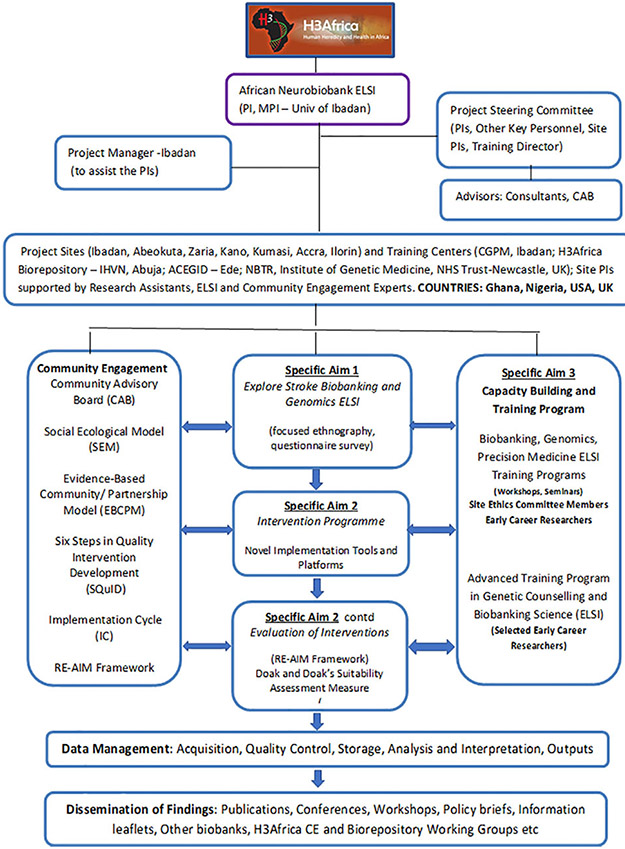
The ethical, legal, and social implications (ELSI) of emerging neurobiobanks and data resources are unclear in an African scientific landscape with unique cultural, linguistic, and belief systems. The overarching goal of the African Neurobiobank for Precision Stroke Medicine-ELSI Project is to identify, examine, and develop novel approaches to address ELSI issues of biobanking and stroke genomic research in sub-Saharan Africa (SSA). To accomplish the goal we will (1) explore knowledge, attitude, perceptions, barriers, and facilitators influencing ELSI issues related to biobanking and stroke genomic research; (2) use information obtained to craft a community intervention program focused on ELSI issues; and (3) build capacity and careers related to genomics and biobanking for effective client/community engagement while enhancing regulatory, governance, and implementation competences in biobanking science in SSA. A community-based participatory research and mixed-methodological approach, focused on various levels of the social ecological model, will be used to identify and examine relevant ELSI issues. Contextual intervention tools, platforms, and practices will be developed to enhance community understanding and participation in stroke biobanking and genomics research activities while facilitating enduring trust, and equitable and fair utilization of biobanking resources for genetic and trans-omics research. A concurrent capacity building program related to genetic counseling and biobanking will be implemented for early career researchers. The huge potential for neurobiobanking and genomics research in Africa to advance precision medicine applicable to stroke and other neurological disorders requires addressing ELSI challenges while building sustainable research, career, and regulatory capacities in trans-omics and biobanking science.
Keywords: Africa; ELSI; biobanking; ethical; genomics; legal; neurobiobanking; precision medicine; social issues; stroke.
Conflict of interest statement
Declaration of Conflicting Interests The author(s) declared no potential conflicts of interest with respect to the research, authorship, and/or publication of this article.
Figures
References
-
- Abimiku A, Mayne ES, Joloba M, Beiswanger CM, Troyer J, & Wideroff L (2017). H3Africa Biorepository Program: Supporting genomics research on African populations by sharing high-quality biospecimens. Biopreservation and Biobanking, 15(2), 99–102. 10.1089/bio.2017.0005 - DOI
-
- Akinyemi RO, Akinwande K, Diala S, Adeleye O, Ajose A, Issa K, Owusu D, Boamah I, Yahaya IS, Jimoh AO, Imoh L, Fakunle G, Akpalu A, Sarfo F, Wahab K, Sanya E, Owolabi L, Obiako R, Osaigbovo G, … Owolabi M (2018). Biobanking in a challenging African environment: Unique experience from the SIREN project. Biopreservation and Biobanking, 16(3), 217–232. 10.1089/bio.2017.0113 - DOI - PMC - PubMed
-
- Akinyemi RO, Owolabi MO, Adebayo PB, Akinyemi JO, Otubogun FM, Uvere E, Adjenijio O, Adeleye O, Aridegbe O , Taiwo FT, Ogun SA, & Ogunniyi A (2015). Task-shifting training improves stroke knowledge among Nigerian non-neurologist health workers. Journal of the Neurological Sciences, 359(1–2), 112–116. 10.1016/j.jns.2015.10.019 - DOI - PMC - PubMed
-
- Akinyemi RO, Owolabi MO, Oyeniyi T, Ovbiagele B, Arnett DK, Tiwari HK, Walker R, Ogunniyi A, Kalaria RN, & the SIREN group of the H3 Africa Consortium. (2016). Neurogenomics in Africa: Perspectives, progress, possibilities and priorities. Journal of the Neurological Sciences, 366, 213–223. 10.1016/j.jns.2016.05.006 - DOI - PMC - PubMed
-
- Akinyemi RO, Salami A, Akinyemi J, Ojagbemi A, Olopade F, Coker M, Farombi T, Nweke M, Arulogun O, Jegede A, Owolabi M, Kalaria RN, & Ogunniyi A (2019). Brain banking in low and middle-income countries: Raison D’etre for the Ibadan brain ageing, dementia and neurodegeneration (IBADAN) brain bank project. Brain Research Bulletin, 145, 136–141. 10.1016/j.brainresbull.2018.08.014 - DOI - PMC - PubMed
Grants and funding
LinkOut - more resources
Full Text Sources
Research Materials