Toll-like Receptor 2 in Autoimmune Inflammation
- PMID: 34277108
- PMCID: PMC8263214
- DOI: 10.4110/in.2021.21.e18
Toll-like Receptor 2 in Autoimmune Inflammation
Abstract
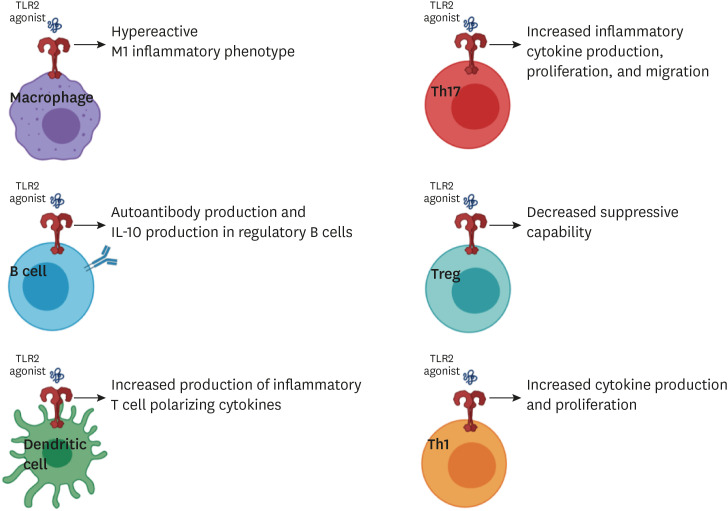
TLR signaling is critical for broad scale immune recognition of pathogens and/or danger molecules. TLRs are particularly important for the activation and the maturation of cells comprising the innate immune response. In recent years it has become apparent that several different TLRs regulate the function of lymphocytes as well, albeit to a lesser degree compared to innate immunity. TLR2 heterodimerizes with either TLR1 or TLR6 to broadly recognize bacterial lipopeptides as well as several danger-associated molecular patterns. In general, TLR2 signaling promotes immune cell activation leading to tissue inflammation, which is advantageous for combating an infection. Conversely, inappropriate or dysfunctional TLR2 signaling leading to an overactive inflammatory response could be detrimental during sterile inflammation and autoimmune disease. This review will highlight and discuss recent research advances linking TLR2 engagement to autoimmune inflammation.
Keywords: Autoimmunity; Experimental autoimmune encephalomyelitis; T Lymphocytes, Regulatory; Th17 Cells; Toll-like receptor; Toll-like receptor 2.
Copyright © 2021. The Korean Association of Immunologists.
Conflict of interest statement
Conflict of Interest: The authors declare no potential conflicts of interest.
Figures
References
-
- Davidson A, Diamond B. Autoimmune diseases. N Engl J Med. 2001;345:340–350. - PubMed
-
- Cooper GS, Stroehla BC. The epidemiology of autoimmune diseases. Autoimmun Rev. 2003;2:119–125. - PubMed
-
- Jadidi-Niaragh F, Mirshafiey A. Th17 cell, the new player of neuroinflammatory process in multiple sclerosis. Scand J Immunol. 2011;74:1–13. - PubMed
-
- Yasuda K, Takeuchi Y, Hirota K. The pathogenicity of Th17 cells in autoimmune diseases. Semin Immunopathol. 2019;41:283–297. - PubMed
Publication types
LinkOut - more resources
Full Text Sources