


Examining the effects of HIV self-testing compared to standard HIV testing services in the general population: A systematic review and meta-analysis
- PMID: 34278282
- PMCID: PMC8271120
- DOI: 10.1016/j.eclinm.2021.100991
Examining the effects of HIV self-testing compared to standard HIV testing services in the general population: A systematic review and meta-analysis
Abstract
Background: We updated a 2017 systematic review and compared the effects of HIV self-testing (HIVST) to standard HIV testing services to understand effective service delivery models among the general population.
Methods: We included randomized controlled trials (RCTs) comparing testing outcomes with HIVST to standard testing in the general population and published between January 1, 2006 and June 4, 2019. Random effects meta-analysis was conducted and pooled risk ratios (RRs) were reported. The certainty of evidence was determined using the GRADE methodology.
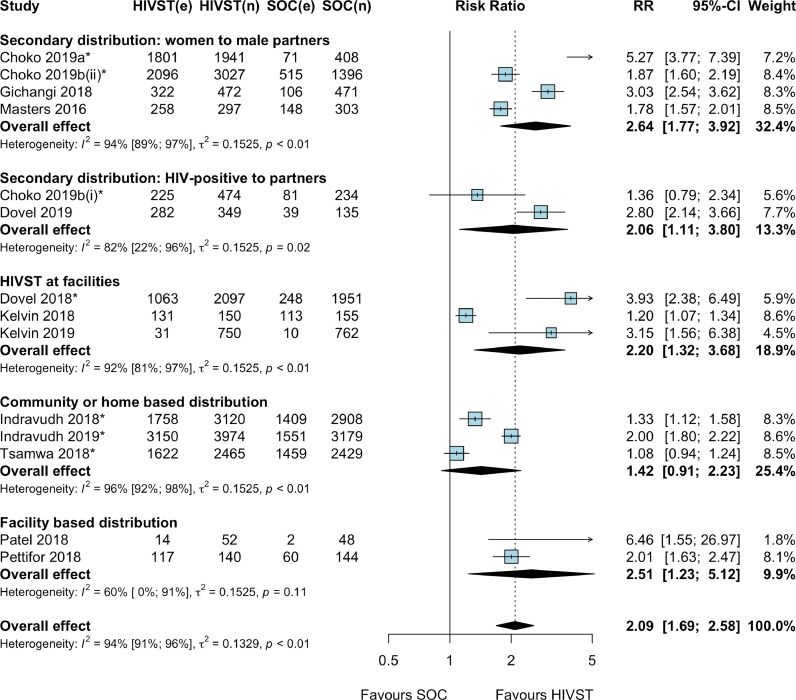
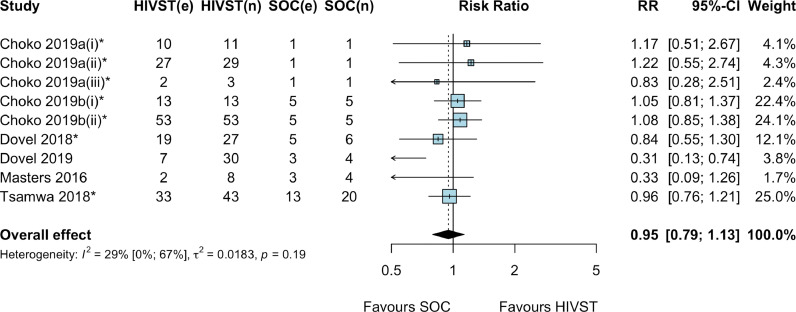
Findings: We identified 14 eligible RCTs, 13 of which were conducted in sub-Saharan Africa. Support provided to self-testers ranged from no/basic support to one-on-one in-person support. HIVST increased testing uptake overall (RR:2.09; 95% confidence interval: 1.69-2.58; p < 0.0001;13 RCTs; moderate certainty evidence) and by service delivery model including facility-based distribution, HIVST use at facilities, secondary distribution to partners, and community-based distribution. The number of persons diagnosed HIV-positive among those tested (RR:0.81, 0.45-1.47; p = 0.50; 8 RCTs; moderate certainty evidence) and number linked to HIV care/treatment among those diagnosed (RR:0.95, 0.79-1.13; p = 0.52; 6 RCTs; moderate certainty evidence) were similar between HIVST and standard testing. Reported harms/adverse events with HIVST were rare and appeared similar to standard testing (RR:2.52: 0.52-12.13; p = 0.25; 4 RCTs; very low certainty evidence).
Interpretation: HIVST appears to be safe and effective among the general population in sub-Saharan Africa with a range of delivery models. It identified and linked additional people with HIV to care. These findings support the wider availability of HIVST to reach those who may not otherwise access testing.
Keywords: HIV self-testing; HIV testing services; Meta-analysis; Systematic Review; general population.
© 2021 The Authors.
Conflict of interest statement
Dr. Corbett reports grants from London School of Hygiene & Tropical Medicine, outside the submitted work. Dr. Geng reports a Viiv Healthcare research grant. Ms. Johnson reports grants from the Bill and Melinda Gates Foundation, Unitaid, and the United States Agency for International Development, during the conduct of the study; grants from the Bill and Melinda Gates Foundation, Unitaid, and the United States Agency for International Development outside the submitted work. Dr. Witzel, Dr. Rodger and Dr. Weatherburn report grants from the National Instituet of Health Research during the conduct of the study. All other authors have nothing to declare.
Figures



References
-
- Joint United Nations Programme on HIV/AIDS; Geneva: 2019. Global AIDS update 2019 — communities at the centre.
-
- World Health Organization; Geneva: 2019. Consolidated guidelines on HIV testing services 2019. - PubMed
-
- World Health Organization; Geneva: 2016. Guidelines on HIV self-testing and partner notification: a supplement to the consolidated guidelines on HIV testing services. - PubMed
-
- Joint United Nations Programme for HIV/AIDS; Geneva: 2017. Ending AIDS: progress towards the 90–90–90 targets.
Grants and funding
LinkOut - more resources
Full Text Sources
