. 2021 Aug:38:101001.
doi: 10.1016/j.eclinm.2021.101001. Epub 2021 Jul 14.

A modelling study investigating short and medium-term challenges for COVID-19 vaccination: From prioritisation to the relaxation of measures

Affiliations

A modelling study investigating short and medium-term challenges for COVID-19 vaccination: From prioritisation to the relaxation of measures

Cécile Tran Kiem et al. EClinicalMedicine. 2021 Aug.

Abstract

Background: The roll-out of COVID-19 vaccines is a multi-faceted challenge whose performance depends on pace of vaccination, vaccine characteristics and heterogeneities in individual risks.

Methods: We developed a mathematical model accounting for the risk of severe disease by age and comorbidity, and transmission dynamics. We compared vaccine prioritisation strategies in the early roll-out stage and quantified the extent to which measures could be relaxed as a function of the vaccine coverage achieved in France.

Findings: Prioritizing at-risk individuals reduces morbi-mortality the most if vaccines only reduce severity, but is of less importance if vaccines also substantially reduce infectivity or susceptibility. Age is the most important factor to consider for prioritization; additionally accounting for comorbidities increases the performance of the campaign in a context of scarce resources. Vaccinating 90% of ≥65 y.o. and 70% of 18-64 y.o. before autumn 2021 with a vaccine that reduces severity by 90% and susceptibility by 80%, we find that control measures reducing transmission rates by 15-27% should be maintained to remain below 1000 daily hospital admissions in France with a highly transmissible variant (basic reproduction number R0 = 4). Assuming 90% of ≥65 y.o. are vaccinated, full relaxation of control measures might be achieved with a vaccine coverage of 89-100% in 18-64 y.o or 60-69% of 0-64 y.o.

Interpretation: Age and comorbidity-based vaccine prioritization strategies could reduce the burden of the disease. Very high vaccination coverage may be required to completely relax control measures. Vaccination of children, if possible, could lower coverage targets necessary to achieve this objective.

Keywords: COVID-19; Comorbidities; Prioritisation; Relaxation of measures; SARS-CoV-2; Vaccination.


Conflict of interest statement

PC reports consulting fees from Sanofi Pasteur for projects outside of the submitted work and unrelated to COVID-19. The other authors declare no competing interests.

Figures
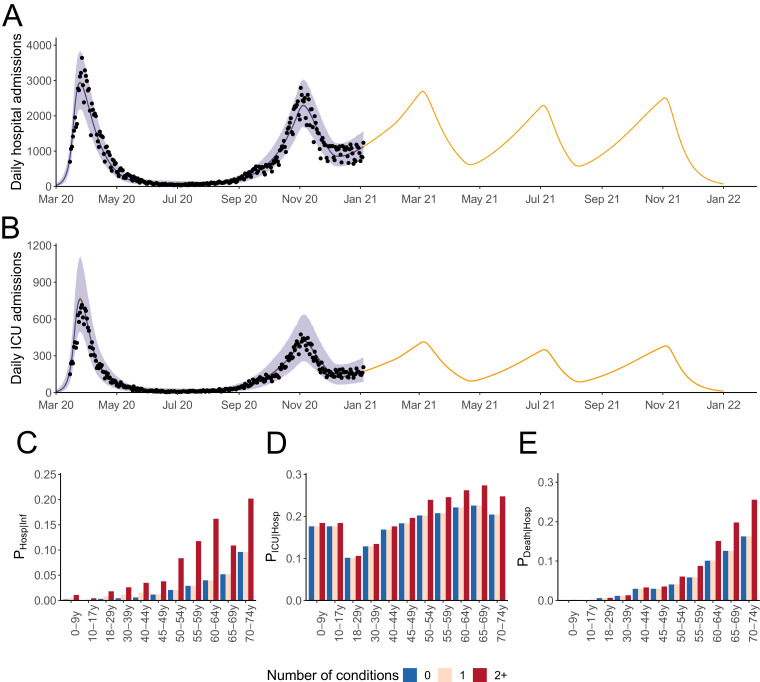
Fig. 1:
Fig. 1
Daily (A) ICU and (B) hospital admissions in metropolitan France in our baseline epidemiological scenario in the absence of vaccination. (C) Probability of hospitalisation given infection, (D) probability of ICU admission given hospitalisation and (E) death given hospitalisation stratified by age group and number of conditions. The shaded areas in (A-B) correspond to 95% credible intervals.
Fig. 2:
Fig. 2
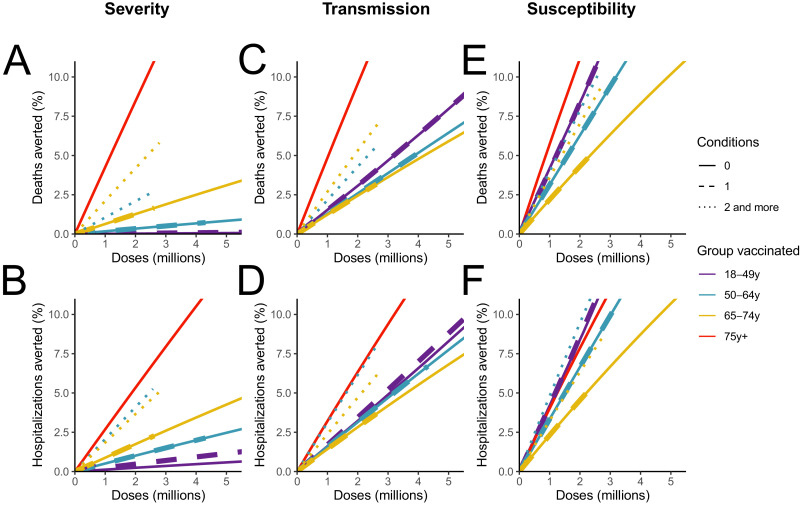
Impact of vaccination strategies targeted at different age and comorbidity groups. (A) Deaths and (B) hospitalisations averted for the vaccine Severity that reduces severity by 90%. (C) Deaths and (D) hospitalisations averted for the vaccine Transmission that reduces severity by 90% and infectivity by 30%. (E) Deaths and (F) hospitalisations averted for the vaccine Susceptibility that reduces severity by 90% and susceptibility by 90%. To increase readability, results are reported for less than 5 million doses administered and less than 10% of deaths or hospitalisations averted.
Fig. 3:
Fig. 3
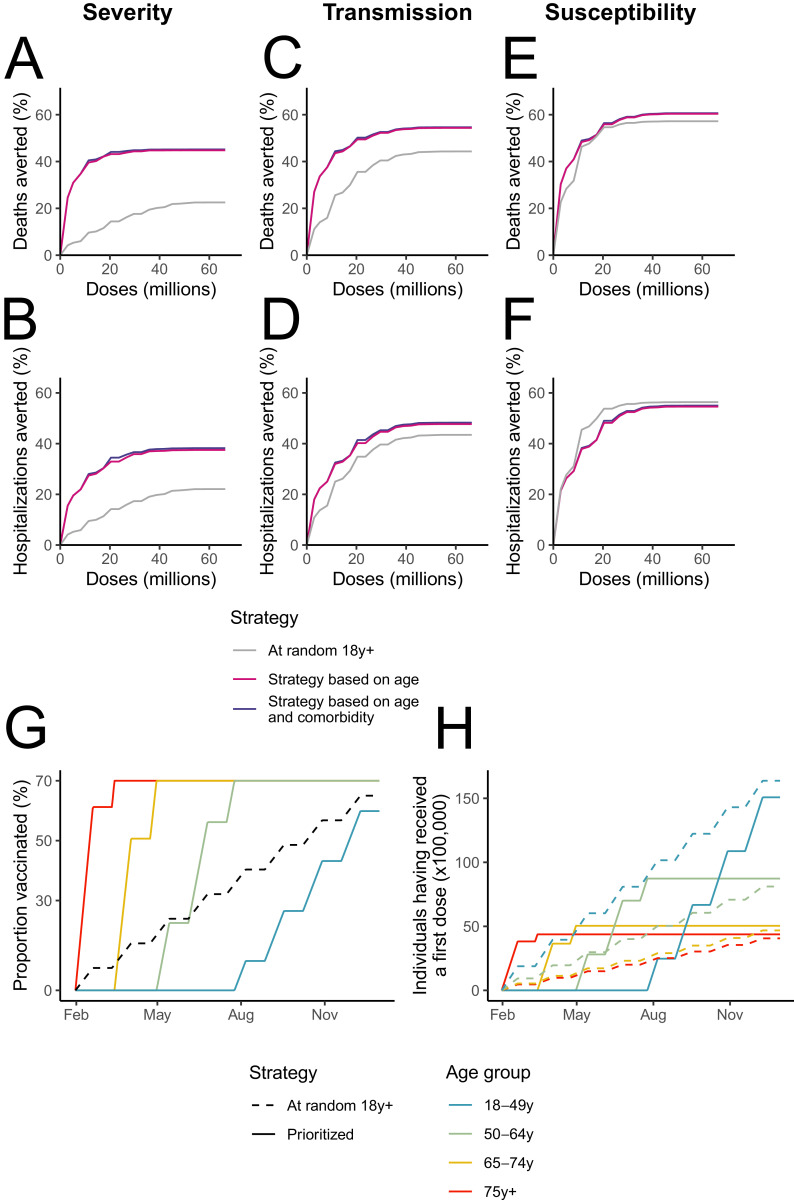
Impact of different vaccine prioritisation strategies. (A) Deaths and (B) hospitalisations averted (A) for the vaccine Severity that reduces severity by 90%. (C) Deaths and (D) hospitalisations averted for the vaccine Transmission that reduces severity by 90% and infectivity by 30%. (E) Deaths and (F) hospitalisations averted for the vaccine Susceptibility that reduces severity by 90% and susceptibility by 90%. (G) Proportion of the population and (H) number of individuals having received a first dose throughout 2021 in the different age groups by prioritisation strategy.
Fig. 4:
Fig. 4
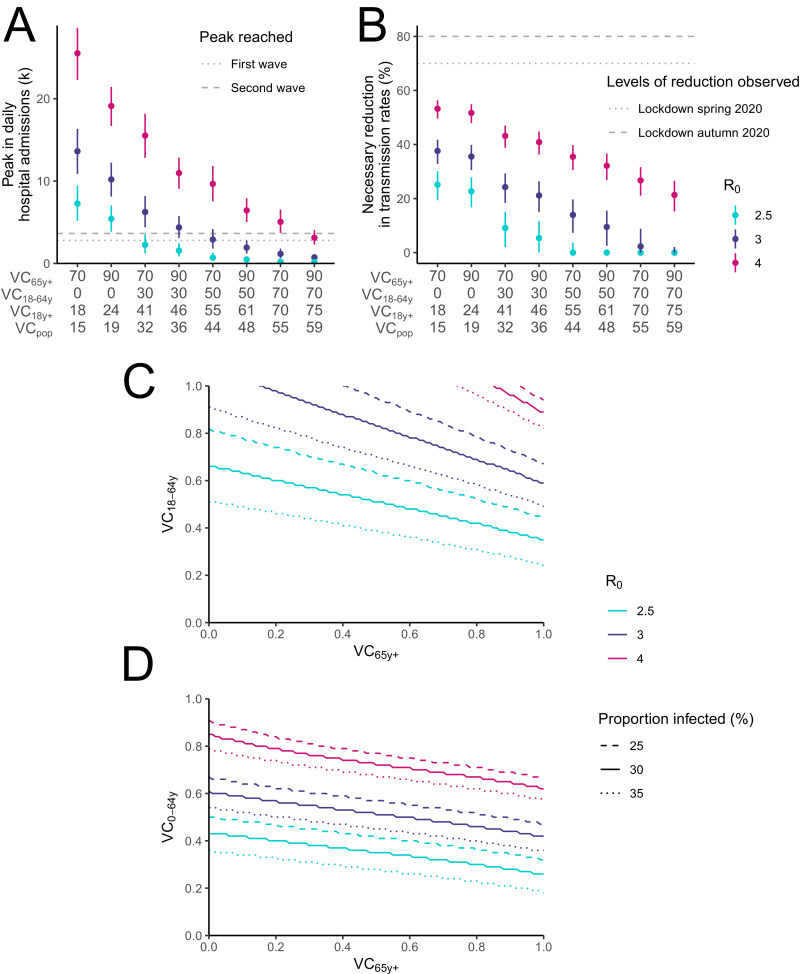
Manageable relaxation of measures by levels of vaccine coverage. (A) Peak in daily hospital admissions for different combinations of vaccine coverages in 18–64 y.o. (VC18–64y) and ≥65 y.o. (VC65y+). (B) Reduction in transmission rates necessary to avoid reaching 1000 daily hospital admissions. (C) Combinations of vaccine coverages in 18–64 y.o. and ≥65 y.o. and in (D) 0–64 y.o. and ≥65 y.o. necessary to avoid reaching 1000 daily hospital admissions. Different values of the basic reproduction number R0 assuming complete relaxation are explored. The reductions computed in (A-B) assume a proportion ever infected in France of 30% (range 25%−35% corresponding to the vertical bars) upon relaxation on September 1st 2021. Results are reported for the vaccine Susceptibility that reduces severity by 90% and susceptibility by 80%. For each combination of vaccine coverage in 18–64 y.o. and ≥65 y.o., we report the corresponding vaccine coverage in those older than 18 y.o. (VC18y+) and in the general population (VCpop). In (C-D), different values for the proportion of people ever infected in France at the date of relaxation of measures are explored.

References

    1. O'Driscoll M., Ribeiro Dos Santos G., Wang L. Age-specific mortality and immunity patterns of SARS-CoV-2. Nature. 2021;590:140–145. - PubMed
    1. Bubar K.M., Reinholt K., Kissler S.M. Model-informed COVID-19 vaccine prioritization strategies by age and serostatus. Science. 2021 doi: 10.1126/science.abe6959. published online Jan 21. - DOI - PMC - PubMed
    1. Matrajt L., Eaton J., Leung T., Brown E.R. Vaccine optimization for COVID-19: who to vaccinate first? Sci Adv. 2020;7 doi: 10.1126/sciadv.abf1374. - DOI - PMC - PubMed
    1. Moore S., Hill E.H., Tildesley M.J., Dyson L., Keeling M.J. Vaccination and non-pharmaceutical interventions for COVID-19: a mathematical modelling study. Lancet Infect Dis. 2021 doi: 10.1016/S1473-3099(21)00143-2. published online March 18. - DOI - PMC - PubMed
    1. Sandmann F.G., Davies N.G., Vassall A., Edmunds W.J., Jit M. The potential health and economic value of SARS-CoV-2 vaccination alongside physical distancing in the UK: a transmission model-based future scenario analysis and economic evaluation. Lancet Infect Dis. 2021 doi: 10.1016/S1473-3099(21)00079-7. published online March 18. - DOI - PMC - PubMed