


Phylogenomics and biogeography of Cunoniaceae (Oxalidales) with complete generic sampling and taxonomic realignments
- PMID: 34278558
- PMCID: PMC8361763
- DOI: 10.1002/ajb2.1688
Phylogenomics and biogeography of Cunoniaceae (Oxalidales) with complete generic sampling and taxonomic realignments
Erratum in
-
Corrigendum.Am J Bot. 2022 Aug;109(8):1326-1327. doi: 10.1002/ajb2.16049. Epub 2022 Aug 26. Am J Bot. 2022. PMID: 36017873 Free PMC article. No abstract available.
Abstract
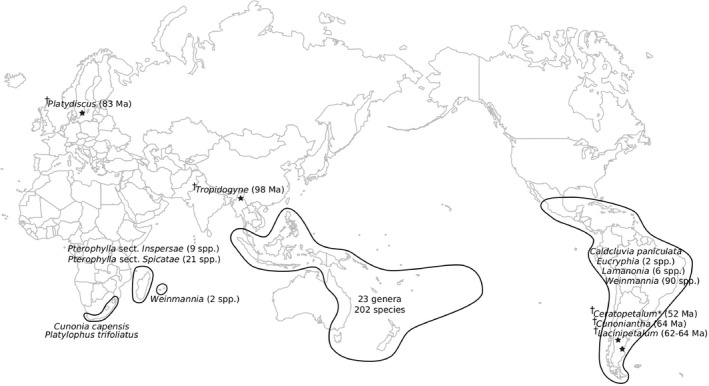
Premise: Cunoniaceae are a family of shrubs and trees with 27 genera and ca. 335 species, mostly confined to tropical and wet temperate zones of the southern hemisphere. There are several known issues regarding generic limits, and the family also displays a number of intriguing long-range disjunctions.
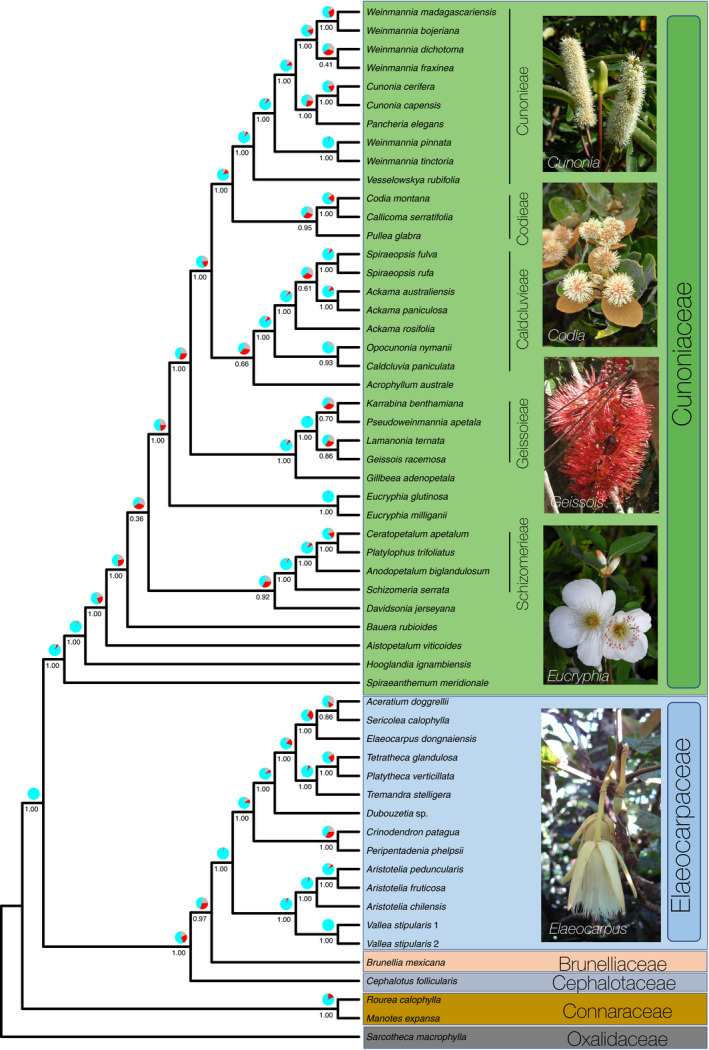
Methods: We performed a phylogenomic study using the universal Angiosperms353 probe set for targeted sequence capture. We sampled 37 species covering all genera in the Cunoniaceae, and those in the three closely related families of the crown Oxalidales (Brunelliaceae, Cephalotaceae, and Elaeocarpaceae). We also performed analyses for molecular dating and ancestral area reconstruction.
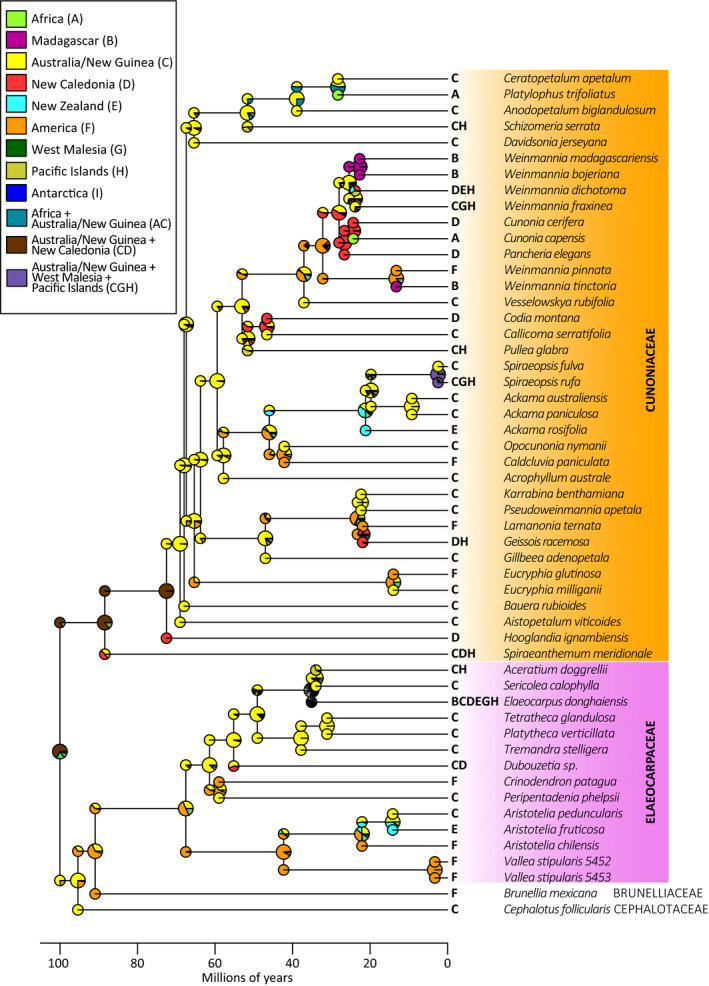
Results: We recovered the topology (Cunoniaceae, (Cephalotaceae, (Brunelliaceae, Elaeocarpaceae))) and a well-resolved genus-level phylogeny of Cunoniaceae with strongly supported clades corresponding to all previously recognized tribes. As previously suspected, the genera Ackama and Weinmannia were recovered as paraphyletic. Australasia was inferred as the likely ancestral area for the family.
Conclusions: The current distribution of Cunoniaceae is best explained by long-distance dispersal with a few possible cases of Australasian-American vicariance events. Extinctions may have been important in determining the mostly Oceanian distribution of this family while some genera in the tribe Cunonieae and in New Caledonia have undergone recent bursts of diversification. New generic diagnoses, 80 new combinations, and one new name are provided for a recircumscribed Ackama (including Spiraeopsis), a much smaller Weinmannia (mostly New World), and a resurrected Pterophylla to accommodate Old World taxa previously in Weinmannia.
Keywords: Caldcluvia; Antarctica; Australia; Gondwana; Madagascar; relicts.
© 2021 The Authors. American Journal of Botany published by Wiley Periodicals LLC on behalf of Botanical Society of America.
Figures
References
-
- Altschul, S. F., Gish W., Miller W., Myers E. W., and Lipman D. J.. 1990. Basic local alignment search tool. Journal of Molecular Biology 215: 403–410. - PubMed
-
- Angiosperm Phylogeny Group . 1998. An ordinal classification for the families of flowering plants. Annals of the Missouri Botanical Garden 85: 531–553.
-
- APG IV [Angiosperm Phylogeny Group IV] . 2016. An update of the Angiosperm Phylogeny Group classification for the orders and families of flowering plants: APG IV. Botanical Journal of the Linnean Society 181: 1–20.
-
- APNI . 2020. Australian plant name index. IBIS database, Centre for Australian National Botanic Gardens, Biodiversity Research, Canberra, Australia. Website: http://www.cpbr.gov.au/cgi‐bin/apni.
-
- Baker, W. J., and Couvreur T. L. P.. 2013. Global biogeography and diversification of palms sheds light on the evolution of tropical lineages. I. Historical biogeography. Journal of Biogeography 40: 274–285.
Publication types
MeSH terms
LinkOut - more resources
Full Text Sources
Research Materials
