


Patient engagement in preclinical laboratory research: A scoping review
- PMID: 34280783
- PMCID: PMC8318845
- DOI: 10.1016/j.ebiom.2021.103484
Patient engagement in preclinical laboratory research: A scoping review
Abstract
Background: 'Patient engagement' involves meaningful collaboration between researchers and 'patient partners' to co-create research. It helps ensure that research being conducted is relevant to its ultimate end-users. Although patient engagement within clinical research has been well documented, the prevalence and effects of patient engagement in translational preclinical laboratory research remain unclear. The aim of this scoping review is to present current patient engagement activities reported in preclinical laboratory research.
Methods: MEDLINE, Embase, and grey literature were systematically searched from inception to April 2021. Studies that described or investigated patient engagement in preclinical laboratory research were included. Patient engagement activities where patients (i.e. patients, family members, caregivers or community members) provided input, or consultation on at least one element of the research process were eligible for inclusion. Study characteristics and outcomes were extracted and organized thematically.
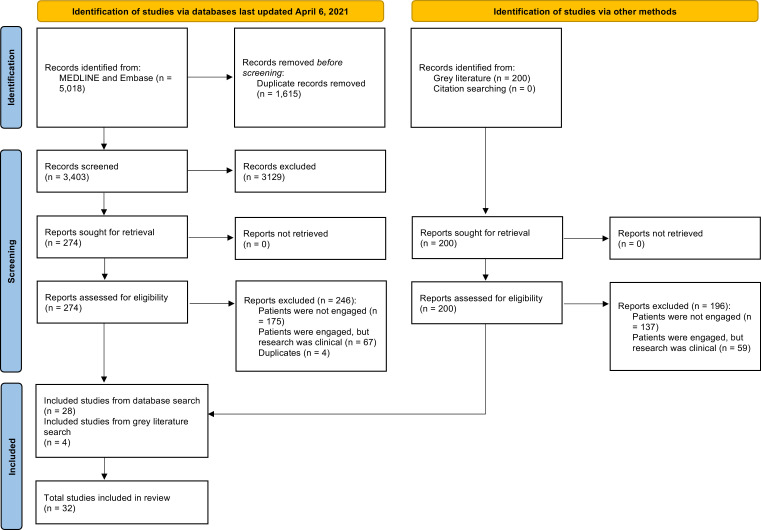
Findings: 32 reports were included (30 primary studies, 1 narrative review, and 1 researcher guide). Most studies engaged patients at the education or priority setting stages (n=26). The most frequently reported benefit of patient engagement was 'providing a mutual learning opportunity'. Reported barriers to patient engagement reflected concerns around 'differences in knowledge and research experience' and how this may challenge communication and limit meaningful collaboration.
Interpretation: Patient engagement is feasible and beneficial for preclinical laboratory research. Future work should focus on assessing the impacts of patient engagement in this area of research.
Funding: None.
Keywords: Basic science; Patient engagement; Preclinical; Scoping review; Translational research.
Copyright © 2021 The Authors. Published by Elsevier B.V. All rights reserved.
Conflict of interest statement
Declaration of Competing Interest All authors have completed the ICMJE uniform disclosure form at www.icmje.org/coi_disclosure.pdf and declare: no support from any organisation for the submitted work; no financial relationships with any organisations that might have an interest in the submitted work in the previous three years; no other relationships or activities that could appear to have influenced the submitted work. DPR reports other relationships and activities from Institute of Musculoskeletal Health and Arthritis (CIHR), personal fees from Janssen, other from Various pharmaceutical companies, other from Clinical Trials Ontario, other from Chronic Pain Network, outside the submitted work; DPR is a scientist by training and lives with rheumatoid arthritis.
Comment in
-
Patient engagement as a crucial asset of preclinical biomedical research.EBioMedicine. 2021 Sep;71:103528. doi: 10.1016/j.ebiom.2021.103528. Epub 2021 Aug 19. EBioMedicine. 2021. PMID: 34419926 Free PMC article. No abstract available.
References
-
- Canadian Institutes of Health Research. Patient Engagement [Internet].[cited 2021 July 6]. Available from: http://www.cihr-irsc.gc.ca/e/45851.html
-
- Canadian Institutes of Health Research. About SPOR [Internet]. [cited 2021 July 6]. Available from: http://www.cihr-irsc.gc.ca/e/51036.html
-
- Duffett L. Patient engagement: what partnering with patient in research is all about. Thromb Res. 2017;150:113–120. - PubMed
Publication types
MeSH terms
LinkOut - more resources
Full Text Sources
Miscellaneous
