. 2021 Aug:70:103490.
doi: 10.1016/j.ebiom.2021.103490. Epub 2021 Jul 17.

Effects of general versus subarachnoid anaesthesia on circadian melatonin rhythm and postoperative delirium in elderly patients undergoing hip fracture surgery: A prospective cohort clinical trial

Affiliations

Effects of general versus subarachnoid anaesthesia on circadian melatonin rhythm and postoperative delirium in elderly patients undergoing hip fracture surgery: A prospective cohort clinical trial

Yanan Song et al. EBioMedicine. 2021 Aug.

Abstract

Background: Circadian rhythm disturbance is common postoperatively in older patients with hip fractures, which may contribute to the development of postoperative delirium (POD). As a reliable biomarker of endogenous circadian rhythms, melatonin regulates the sleep-wake cycle and environmental adaptation, and its secretory rhythm may be modified by anaesthesia and surgery. This study compared the impact of subarachnoid anaesthesia (SA) and general anaesthesia (GA), on the peak of melatonin secretion (primary outcome), the circadian rhythm of melatonin, cortisol and sleep, and the POD incidence (secondary outcome).

Methods: In this prospective cohort observational study, hip fracture surgery patients were enrolled and assigned to receive either SA or GA. Postoperative plasma melatonin and cortisol levels were dynamically measured every six hours on seven time-points, and the circadian rhythm parameters including mesor, amplitude, and acrophase were calculated. Subjective and objective sleep assessments were performed by sleep diaries and sleep trackers, respectively. The Confusion Assessment Method was used twice daily by a specific geriatrician to screen for POD occurrence.

Findings: In a cohort of 138 patients who underwent hip fracture surgery, the circadian rhythm disruption of the patients in the GA group (n=69) was greater than the SA group (n=69). Compared with SA, GA provided the lower peak concentration, mesor, and amplitude of melatonin secretion on postoperative day 1 (p < 0.05). Patients in the GA group experienced higher awakenings, more sleep deprivation, and poor sleep quality on surgery day (p < 0.05). A proportion of 12 patients in the SA group (17.4%) and 24 patients in the GA group (34.8%) experienced POD (p = 0.020).

Interpretation: These results suggest that SA may be superior to GA in elderly patients undergoing hip fracture surgery as SA is associated with less impairment of the melatonin rhythm and sleep patterns, and fewer POD occurrences.

Funding: The study was supported by the National Natural Science Foundation of China (81971012, 81873726, 81901095, 81701052, and 81801070), Key Clinical Projects of Peking University Third Hospital (BYSYZD2019027), and Peking University "Clinical Medicine plus X" Youth Project (PKU2020LCXQ016).

Keywords: Circadian rhythm; general anaesthesia; melatonin; postoperative delirium; subarachnoid anaesthesia.


Conflict of interest statement

Declaration of Competing Interest The authors declare no competing interests.

Figures
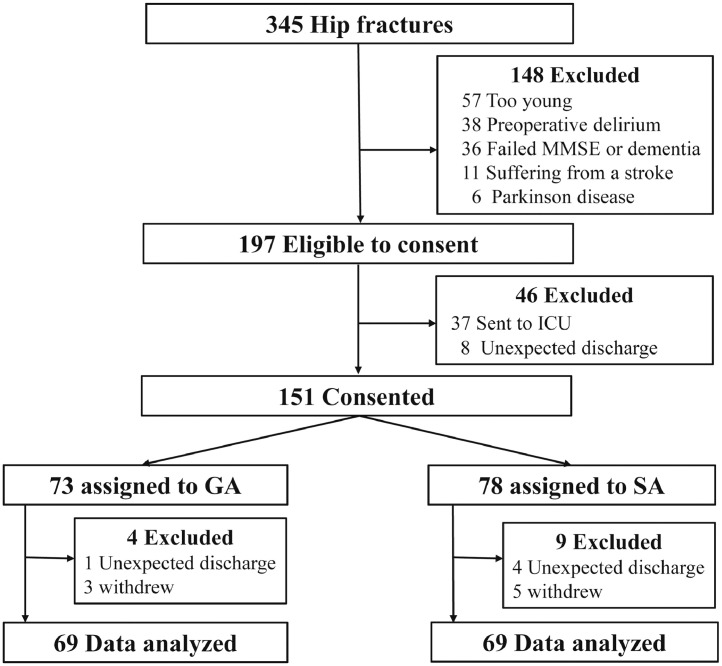
Fig 1
Fig. 1
Study flow chart. MMSE, Mini-Mental State Examination; ICU, intensive care unit; GA, general anaesthesia; SA, subarachnoid anaesthesia.
Fig 2
Fig. 2
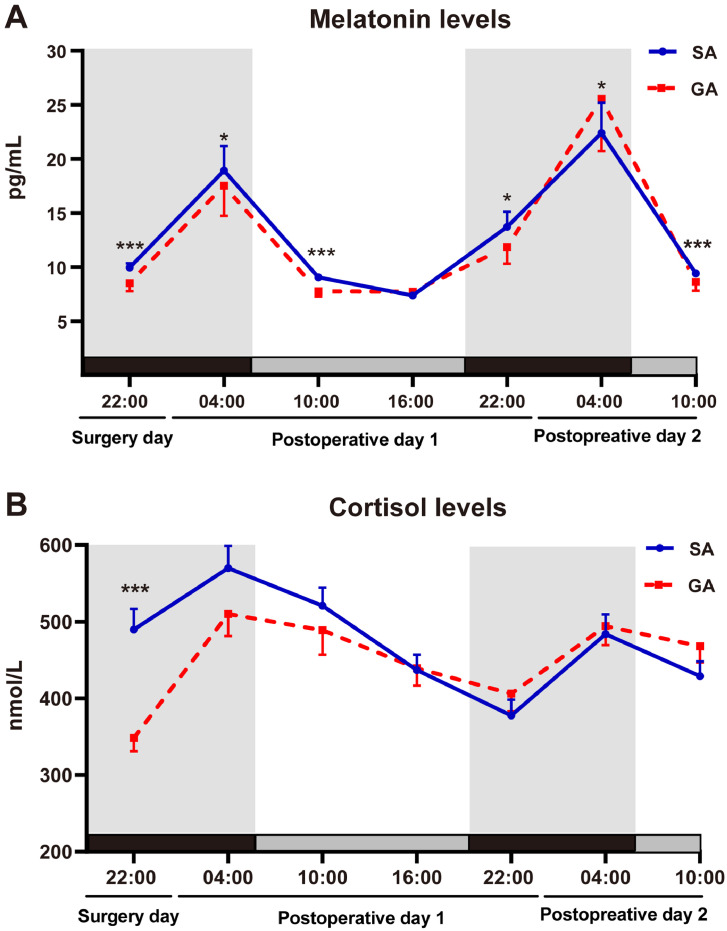
Postoperative plasma concentrations of melatonin and cortisol. Melatonin (A) and cortisol (B) concentration profiles from 69 SA patients (solid curve) and 69 GA patients (broken curve). Data were shown as the mean and SEM. Patients in the GA group displayed significantly lower concentrations of plasma melatonin than the SA group as measured at 22:00 (surgery day), 04:00 (postoperative day 1), 10:00 (postoperative day 1), 22:00 (postoperative day 1), and 10:00 (postoperative day 2) (A). The melatonin level at 04:00 (postoperative day 2) was significantly higher in GA patients than SA patients (A). The plasma cortisol concentration in the GA group was significantly lower at 22:00 on the surgery day (B). Compared to SA group, *p < 0.05, **p < 0.01 and *** p < 0.001 (Benjamini-Hochberg correction). GA, general anaesthesia; SA, subarachnoid anaesthesia.
Fig 3
Fig. 3
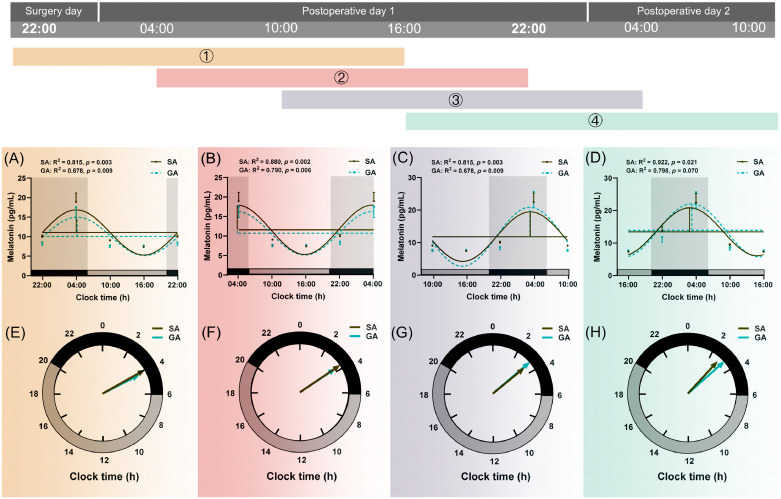
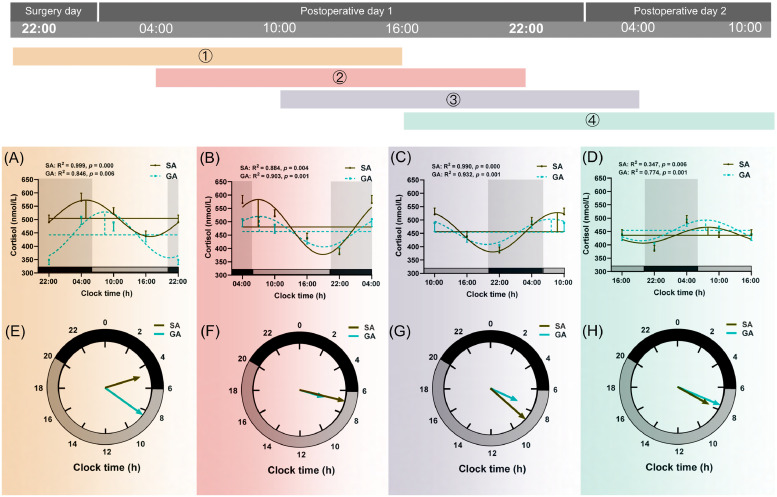
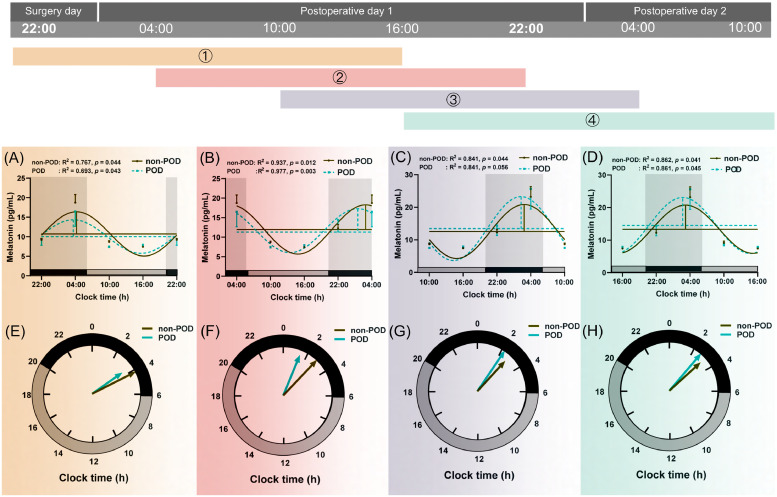
Circadian rhythm of plasma melatonin secretion in SA (n=69) and GA (n=69) group. Data were shown as mean and SEM. Different colours (①,②,③,④) represented different rhythm curves based on four starting time points which successively were at 22:00 (on the surgery day), 4:00, 10:00, and 16:00 (on postoperative day 1). The upper part (Fig. A, B, C, and D) was a cosine curve, and the lower part (Fig. E, F, G, and H) was a continuous clock face from 0:00 to 24:00, as computed by the cosinor method. The last point in each clock was a duplicate of the start point, which was for visualizing periodically. And the data was subsequently smoothed with the cosinor method curve-fitting procedure (GraphPad Prism 8; GraphPad Software, Inc). The acrophase was the phase of the maximal value assumed by the curve, and horizontal and vertical lines represented mesor and amplitude, respectively in figures (A, B, C, and D). The goodness of rhythmicity (R2 and p-value) was shown on the top, and the black bar indicated the night or light-off period (20:00-06:00), and grey bars represented the day or light-on period (06:00-20:00) at the bottom of the lower figures (A, B, C, and D). The amplitude and acrophase of a rhythm were plotted on a continuous clock face from 0:00 to 24:00, and the acrophase indicated by the angle of a vector whose length corresponds to the amplitude (E, F, G, and H). Compared to SA group, *p < 0.05, **p < 0.01 and *** p < 0.001. GA, general anaesthesia; SA, subarachnoid anaesthesia.
Fig 4
Fig. 4
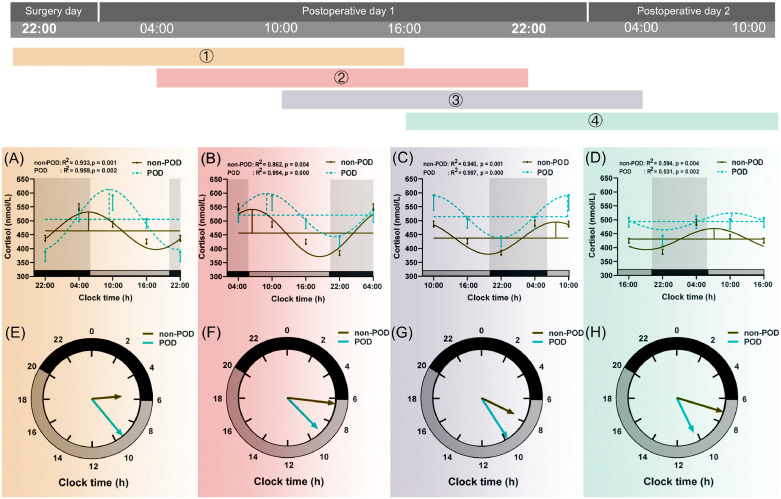
Circadian rhythm of plasma cortisol secretion in SA (n=69) and GA (n=69) group. See above legend shown in Fig. 3.
Fig 5
Fig. 5
Circadian rhythm of plasma melatonin secretion in non-POD (n=102) and POD (n=36) group. See above legend shown in Fig. 3.
Fig 6
Fig. 6
Circadian rhythm of plasma cortisol secretion in non-POD (n=102) and POD (n=36) group. See above legend shown in Fig. 3.
Fig 7
Fig. 7
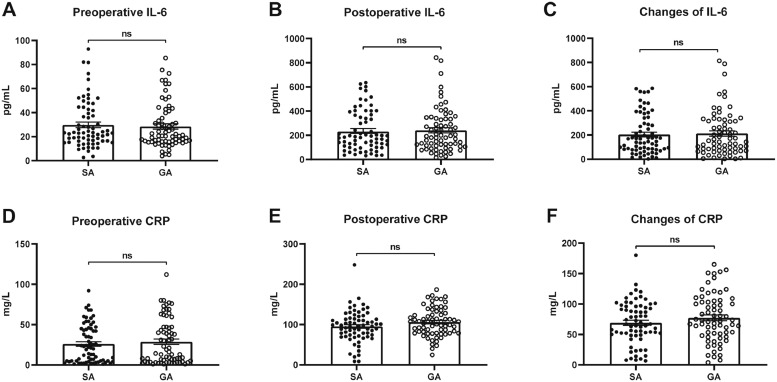
Perioperative plasma levels of inflammatory cytokines. Data were presented as mean and SEM. There was no significant difference between the two groups (n=69, each) in CRP and IL-6 concentration at baseline and on postoperative day 1, and changes of CRP and IL-6 (A–F).

References

    1. Cauley JA, Chalhoub D, Kassem AM, Fuleihan GH. Geographic and ethnic disparities in osteoporotic fractures. Nat Rev Endocrinol. 2014;10(6):338–351. - PubMed
    1. Zhang CG, Feng JN, Wang SF, Gao P, Xu L, Zhu JX. Incidence of and trends in hip fracture among adults in urban China: A nationwide retrospective cohort study. Plos Med. 2020;17(8) - PMC - PubMed
    1. Ravi B, Pincus D, Choi S, Jenkinson R, Wasserstein DN, Redelmeier DA. Association of Duration of Surgery With Postoperative Delirium Among Patients Receiving Hip Fracture Repair. Jama Netw Open. 2019;2(2) - PMC - PubMed
    1. Jin Z, Hu J, Ma D. Postoperative delirium: perioperative assessment, risk reduction, and management. Br J Anaesth. 2020;125(4):492–504. - PubMed
    1. Su X, Wang DX. Improve postoperative sleep: what can we do? Curr Opin Anesthesio. 2018;31(1):83–88. - PMC - PubMed

Publication types