


Prescription Habits Related to Chronic Pathologies of Elderly People in Primary Care in the Western Part of Romania: Current Practices, International Recommendations, and Future Perspectives Regarding the Overuse and Misuse of Medicines
- PMID: 34280980
- PMCID: PMC8297022
- DOI: 10.3390/ijerph18137043
Prescription Habits Related to Chronic Pathologies of Elderly People in Primary Care in the Western Part of Romania: Current Practices, International Recommendations, and Future Perspectives Regarding the Overuse and Misuse of Medicines
Abstract
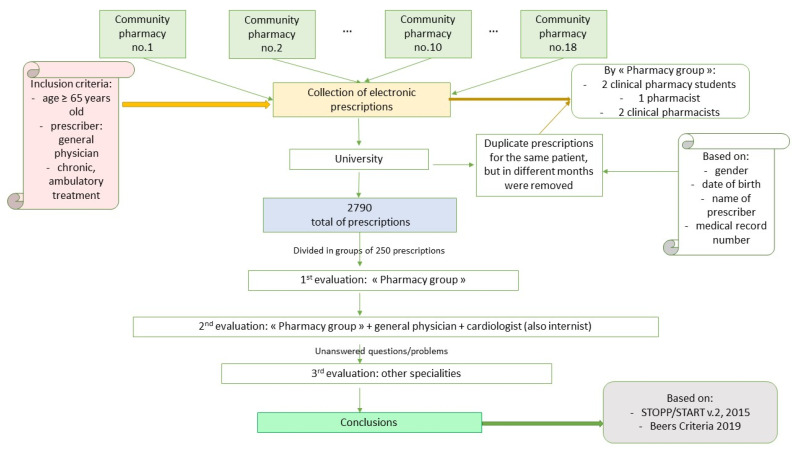
The European Commission's 2019 report regarding the state of health profiles highlighted the fact that Romania is among the countries with the lowest life expectancy in the European Union. Therefore, the objectives of the present study were to assess the current prescription habits of general physicians in Romania related to medicines taken by the elderly population for chronic conditions in both urban and rural setting and to discuss/compare these practices with the current international recommendations for the elderly (American-Beers 2019 criteria and European-STOPP/START v.2, 2015 criteria). A total of 2790 electronic prescriptions for chronic pathologies collected from 18 community pharmacies in the western part of Romania (urban and rural zones) were included. All medicines had been prescribed by general physicians. We identified the following situations of medicine overuse: 15% of the analyzed prescriptions involved the use of nonsteroidal anti-inflammatory drugs (NSAIDs) for >2 weeks, 12% involved the use of a proton-pump inhibitor (PPI) for >8 weeks, theophylline was the bronchodilator used as a monotherapy in 3.17% of chronic obstructive pulmonary disease cases, and zopiclone was the hypnotic drug of choice for 2.31% of cases. Regarding the misuse of medicines, 2.33% of analyzed prescriptions contained an angiotensin-converting enzyme (ACE) inhibitor and an angiotensin II receptor blocker (ARB) for patients with renal failure in addition to vitamin K antagonists (AVKs) and NSAIDs in 0.43% of cases. Prescriptions for COX2 NSAIDs for periods longer than 2 weeks for patients with cardiovascular disorders accounted for 1.33% of prescriptions, and trihexyphenidyl was used as a monotherapy for patients with Parkinson's disease in 0.18% of cases. From the included medical prescriptions, 32.40% (the major percent of 2383 prescriptions) had two potentially inappropriate medications (PIMs). Rural zones were found to be risk factor for PIMs. Decreasing the chronic prescription of NSAIDs and PPIs, discontinuing the use of hypnotic drugs, and avoiding potentially harmful drug-drug associations will have long term beneficial effects for Romanian elderly patients.
Keywords: Beers criteria; STOPP/START; aged people; inappropriate prescribing; medical prescriptions for chronic pathologies; primary health care.
Conflict of interest statement
The authors declare no conflict of interest.
Figures
References
-
- Eurostat 2019 State of Health in the EU. Romania. Country Health Profiles 2019. [(accessed on 20 January 2021)]; Available online: https://www.euro.who.int/__data/assets/pdf_file/0009/419472/Country-Heal....
-
- Eurostat 2017 State of Health in the Eu. Country Health Profiles 2017. [(accessed on 20 January 2021)]; Available online: https://ec.europa.eu/health/sites/health/files/state/docs/chp_romania_en....
-
- European Commission Country Report 2016. [(accessed on 20 January 2021)]; Available online: https://ec.europa.eu/info/sites/info/files/cr_romania_2016_en.pdf.
MeSH terms
Substances
LinkOut - more resources
Full Text Sources
Research Materials
Miscellaneous
