. 2021 Jul 2;18(13):7122.
doi: 10.3390/ijerph18137122.

The Moderating Role of Emotion Regulation in the Recall of Negative Autobiographical Memories

Affiliations

The Moderating Role of Emotion Regulation in the Recall of Negative Autobiographical Memories

Desirée Colombo et al. Int J Environ Res Public Health. .

Abstract

When facing a negative event, people implement different strategies to regulate ongoing emotions. Although the previous literature has suggested that the emotional intensity of a negative episode is associated with the characteristics of the subsequent autobiographical memory, it is still unknown whether emotion regulation (ER) moderates this relationship. In the present study, we provided undergraduate students with a smartphone-based diary to report a negative episode immediately after its occurrence and rate the momentary use of two ER strategies: cognitive reappraisal and rumination. To explore autobiographical memory, two "surprise" recall tasks were performed one week and one month after the event. According to the results, cognitive reappraisal was linked with better memory performances, and a tendency to retrospectively underestimate the negativity of highly intense events was observed only in participants adopting high rates of this strategy. Conversely, intense rumination was found to be associated with less detailed memories of emotionally intense events, as well as with higher emotional involvement with negative episodes over time, regardless of their intensity. Together, our results support the maladaptive role of rumination and the adaptive influence of cognitive reappraisal on autobiographical memory.

Keywords: autobiographical memory; cognitive reappraisal; ecological momentary assessment; emotion regulation; rumination.


Conflict of interest statement

The authors declare no conflict of interest.

Figures
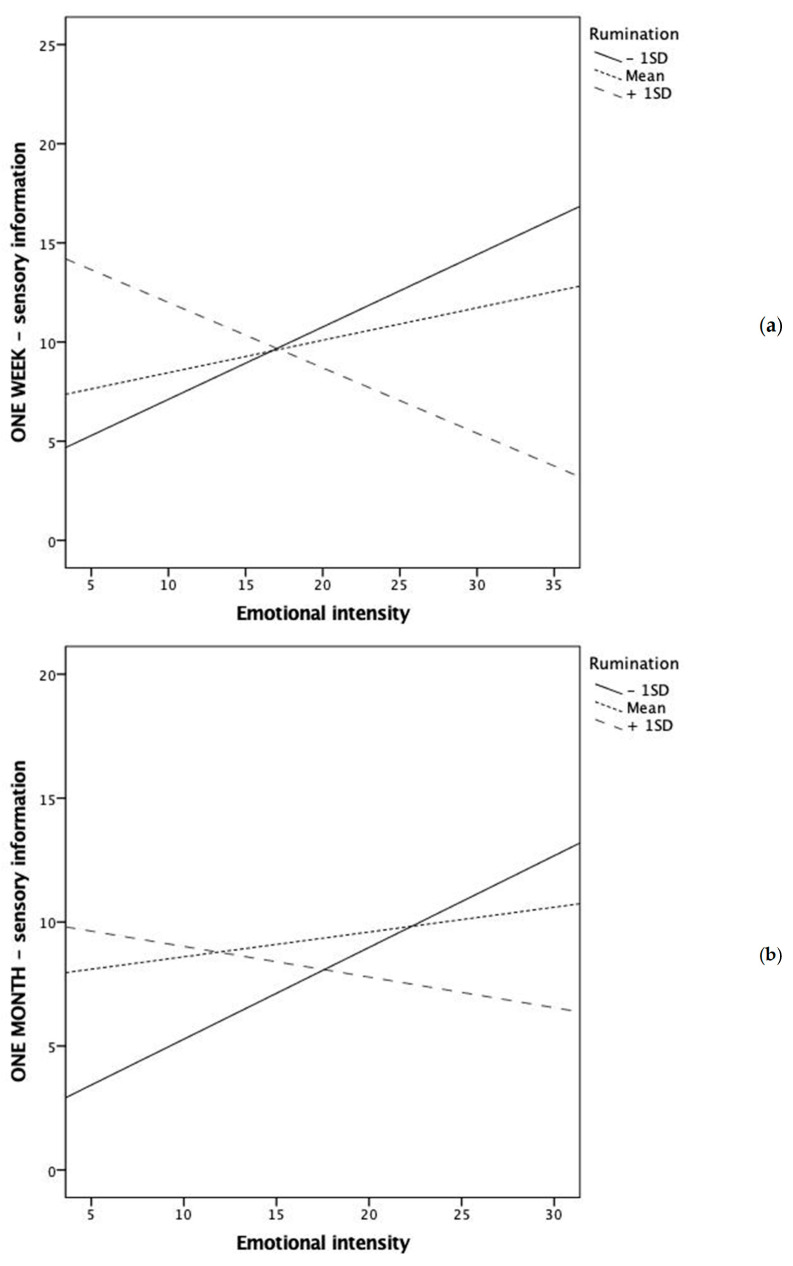
Figure 1
Figure 1
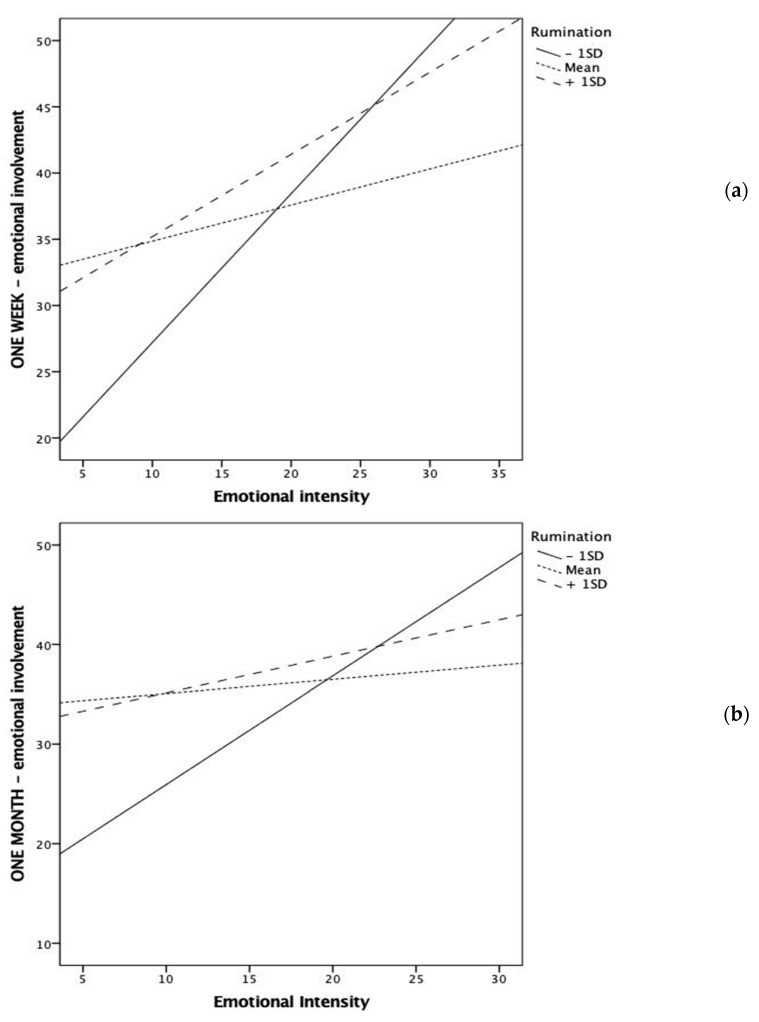
Graphical representation of the significant interaction between rumination and emotional intensity in predicting emotional involvement at one-week (a) and one-month (b) follow-up assessments.
Figure 2
Figure 2
Graphical representation of the significant interaction between rumination and emotional intensity in predicting sensory information at one-week (a) and one-month (b) follow-up assessments.
Figure 3
Figure 3
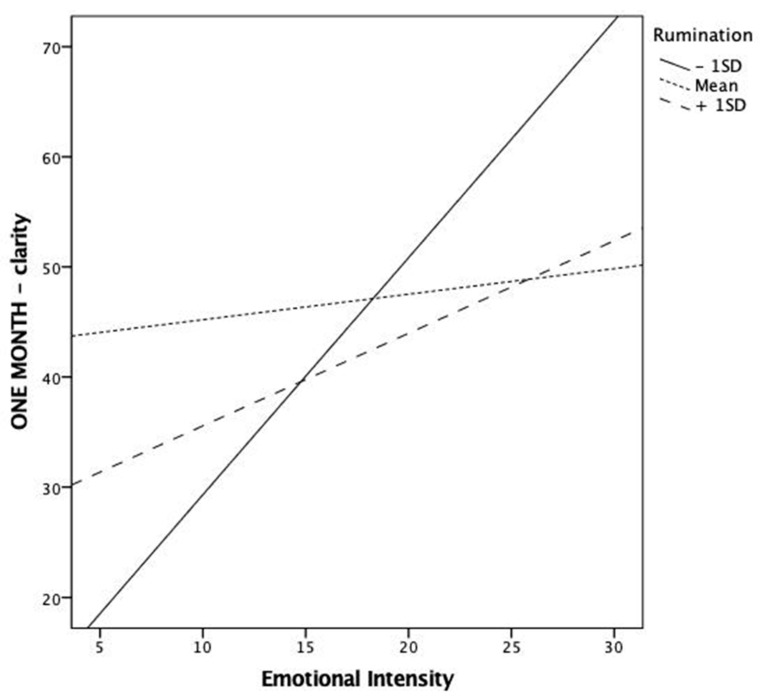
Graphical representation of the significant interaction between rumination and emotional intensity in predicting clarity at a one-month follow-up.
Figure 4
Figure 4
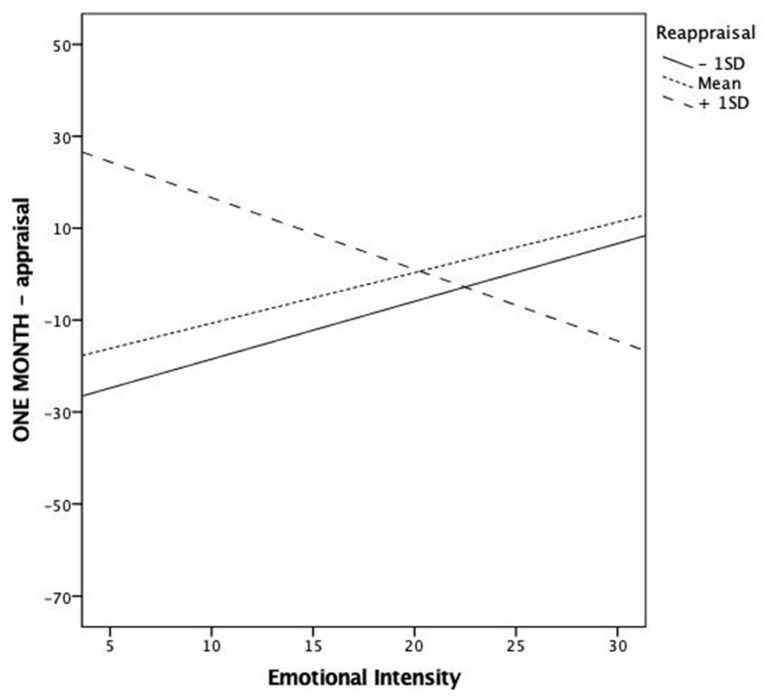
Graphical representation of the significant interaction between cognitive reappraisal and emotional intensity in predicting event appraisal at a one-month follow-up. Note that positive appraisal scores reflect the retrospective overestimation of the negativity of the event, whereas negative values indicate the tendency to retrospectively underestimate it.

References

    1. Liu Y., Fu Q., Fu X. The interaction between cognition and emotion. Chin. Sci. Bull. 2009;54:4102–4116. doi: 10.1007/s11434-009-0632-2. - DOI
    1. Gros C. Cognition and Emotion: Perspectives of a Closing Gap. Cogn. Comput. 2010;2:78–85. doi: 10.1007/s12559-010-9034-7. - DOI
    1. Ochsner K.N., Phelps E. Emerging perspectives on emotion–cognition interactions. Trends Cogn. Sci. 2007;11:317–318. doi: 10.1016/j.tics.2007.06.008. - DOI - PubMed
    1. Holland A.C., Kensinger E.A. Emotion and autobiographical memory. Phys. Life Rev. 2010;7:88–131. doi: 10.1016/j.plrev.2010.01.006. - DOI - PMC - PubMed
    1. Brosch T., Scherer K.R., Grandjean D., Sander D. The impact of emotion on perception, attention, memory, and decision-making. Swiss Med. Wkly. 2013;143:w13786. doi: 10.4414/smw.2013.13786. - DOI - PubMed

Publication types