Combination fixed-dose β agonist and steroid inhaler as required for adults or children with mild asthma: a Cochrane systematic review
- PMID: 34282031
- PMCID: PMC9132861
- DOI: 10.1136/bmjebm-2021-111764
Combination fixed-dose β agonist and steroid inhaler as required for adults or children with mild asthma: a Cochrane systematic review
Abstract
Background: In people with mild asthma poor adherence to regular therapy is common and increases the risk of exacerbations, morbidity and mortality. The use of fixed-dose combination inhalers containing an inhaled corticosteroid (ICS) and a fast-acting β2-agonist (FABA) is established in moderate asthma, but they may also have potential utility in mild asthma.
Objectives: To evaluate the efficacy and safety of single combined FABA/ICS inhaler only used as needed in people with mild asthma.
Design and setting: Cochrane meta-analysis of available trial data.
Participants: Children aged 12+ and adults with mild asthma.
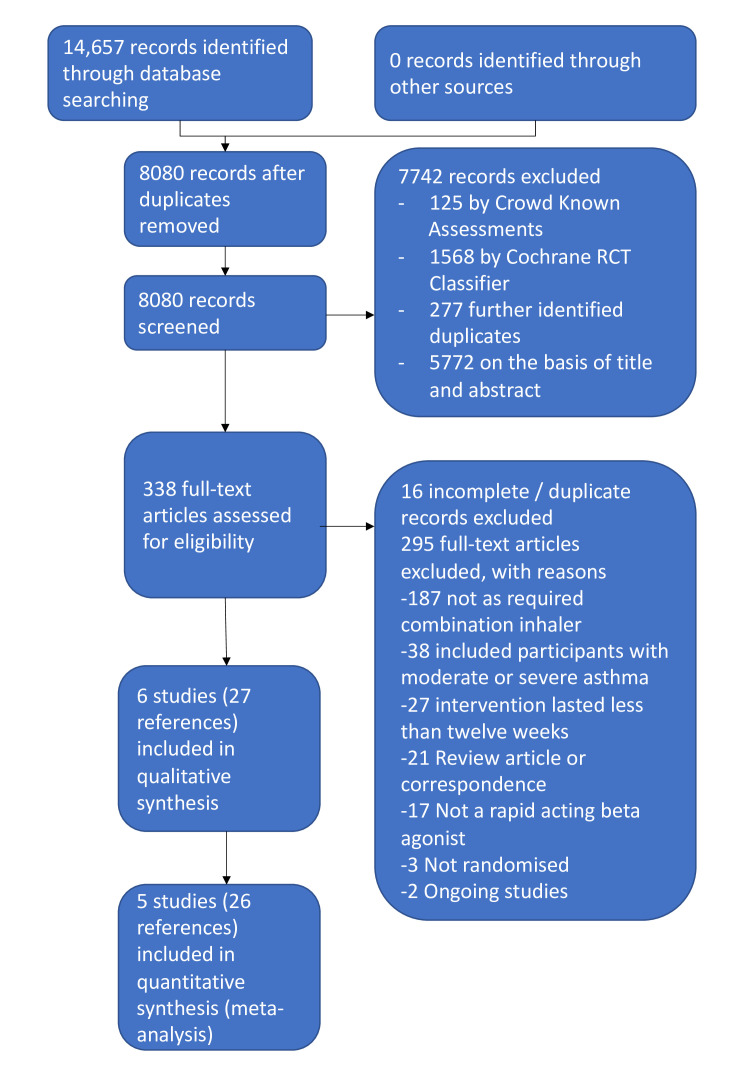
Search methods: We searched the Cochrane Airways Trials Register, Cochrane Central Register of Controlled Trials, MEDLINE and Embase, ClinicalTrials.gov and the WHO trials portal on 19 March 2021.
Interventions: A single fixed-dose FABA/ICS inhaler used as required compared with no treatment, placebo, short-acting beta agonist (SABA) as required, regular ICS with SABA as required, regular fixed-dose combination ICS/long-acting beta agonist (LABA), or regular fixed-dose combination ICS/FABA with as required ICS/FABA.We included randomised controlled trials (RCTs) and cross-over trial. We excluded trials shorter than 12 weeks. We included full texts, abstracts and unpublished data.
Data collection and analysis: We used Cochrane's standard methodological procedures and applied the GRADE approach to assess the evidence.
Main outcome measures: We included six studies from which 9657 participants contributed to the meta-analyses. All used dry powder budesonide and formoterol as the combination inhaler. Two studies included children aged 12+ years and two studies were open-label.
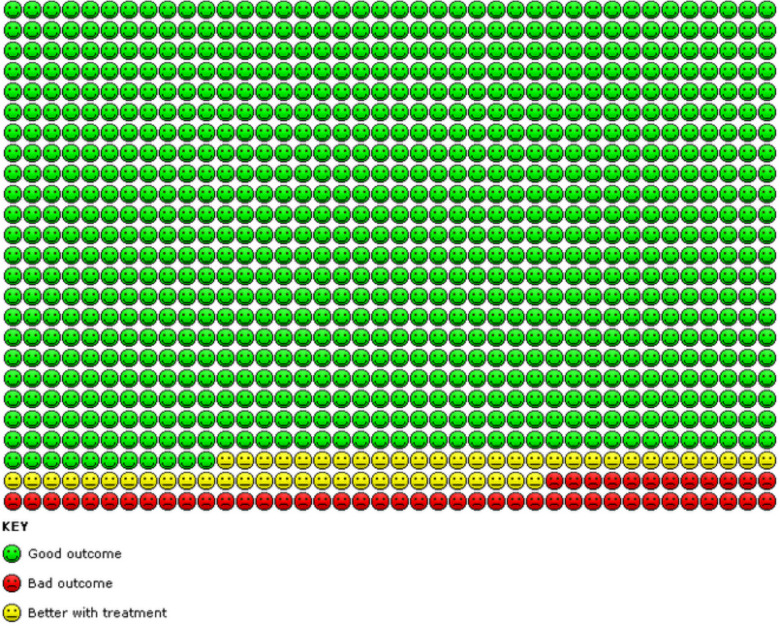
Faba/ics as-required versus faba as-required: Compared with as-required FABA alone, as-required FABA/ICS reduced exacerbations requiring systemic steroids (OR 0.45, 95% CI 0.34 to 0.60, 2 RCTs, 2997 participants, high-certainty evidence), equivalent to 109 people out of 1000 in the FABA alone group experiencing an exacerbation requiring systemic steroids, compared with 52 (95% CI 40 to 68) out of 1000 in the FABA/ICS as-required group. FABA/ICS as required may also reduce the odds of an asthma-related hospital admission or emergency department or urgent care visit (OR 0.35, 95% CI 0.20 to 0.60, 2 RCTs, 2997 participants, low-certainty evidence). Changes in asthma control were small and less than the minimal clinically important difference (MCID). FABA/ICS as required was associated with reductions in fractional exhaled nitric oxide, probably reducing the odds of an adverse event (OR 0.82, 95% CI 0.71 to 0.95) and may reduce total systemic steroid dose (mean difference (MD) -9.90, 95% CI -19.38 to -0.42).
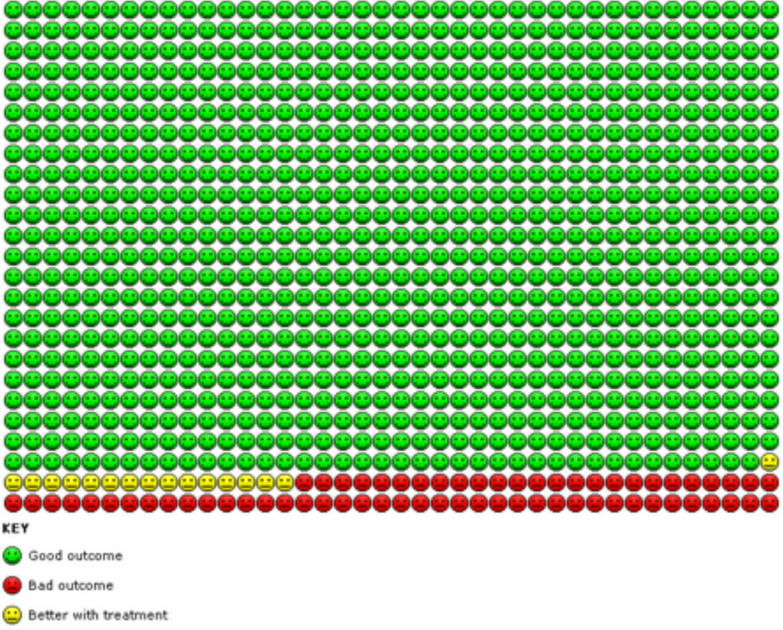
Faba/ics as required versus regular ics plus faba as required: There may be little or no difference in the number of people with asthma exacerbations requiring systemic steroids with FABA/ICS as required compared with regular ICS (OR 0.79, 95% CI 0.59 to 1.07, 4 RCTs, 8065 participants, low-certainty evidence), equivalent to 81 people out of 1000 in the regular ICS plus FABA group experiencing an exacerbation requiring systemic steroids, compared with 65 (95% CI 49 to 86) out of 1000 in the FABA/ICS as-required group. The odds of an asthma-related hospital admission or emergency department or urgent care visit may be reduced in those taking FABA/ICS as required (OR 0.63, 95% CI 0.44 to 0.91, 4 RCTs, 8065 participants, low-certainty evidence). Changes in asthma control were small and less than MCID. Adverse events and total systemic corticosteroid doses were similar between groups. FABA/ICS as required was likely associated with less average daily exposure to ICS than those on regular ICS (MD -154.51 mcg/day, 95% CI -207.94 to -101.09).
Conclusions: FABA/ICS as required is clinically effective in adults and adolescents with mild asthma and reduced exacerbations, hospital admissions or unscheduled healthcare visits and exposure to systemic corticosteroids and probably reduces adverse events compared with FABA as required alone. FABA/ICS as required is as effective as regular ICS and reduced asthma-related hospital admissions or unscheduled healthcare visits, and average exposure to ICS, and is unlikely associated with increased adverse events.
Keywords: asthma; evidence-based practice; primary healthcare; respiratory tract diseases.
© Author(s) (or their employer(s)) 2022. Re-use permitted under CC BY. Published by BMJ.
Conflict of interest statement
Competing interests: IC has been involved in recruitment for a GlaxoSmithKline-sponsored trial of inhaled nemiralisib for COPD, but did not directly receive funding for this. ST reports money for travel from Novartis in 2019 for an educational event. SR is undertaking a PhD supported by an unrestricted research grant from AstraZeneca. He has attended educational events sponsored by AstraZeneca (2019). TSCH has received research funding from the Wellcome Trust, NIHR, the Beit Guardians; has received speaker fees from AstraZeneca, Boehringer Ingelheim; his research team have received funding from Sanofi.
Figures
References
Publication types
MeSH terms
Substances
Grants and funding
LinkOut - more resources
Full Text Sources
Medical
Research Materials