


Outcomes of the One Anastomosis Gastric Bypass with Various Biliopancreatic Limb Lengths: a Retrospective Single-Center Cohort Study
- PMID: 34283379
- PMCID: PMC8458216
- DOI: 10.1007/s11695-021-05555-y
Outcomes of the One Anastomosis Gastric Bypass with Various Biliopancreatic Limb Lengths: a Retrospective Single-Center Cohort Study
Abstract
Introduction: One anastomosis gastric bypass (OAGB) is an effective and safe treatment for morbidly obese patients. Longer biliopancreatic (BP) limb length is suggested to result in better weight loss outcomes, but to date, no data are available for the OAGB to substantiate this. We hypothesized that applying a longer BP-limb length in the higher BMI classes would result in more weight reduction so that the attained BMI would be comparable to patients with a lower BMI, thereby compensating for differences in baseline BMI.
Method: A retrospective cohort study in patients who underwent a primary OAGB at a teaching hospital in the Netherlands between January 2015 and December 2016. BP-limb length was tailored based on preoperative BMI. Patients were divided into three different groups depending on the length of the BP-limb: 150, 180, and 200 cm. Weight loss outcomes after 1 and 3 years and resolution of comorbidities were compared between these groups.
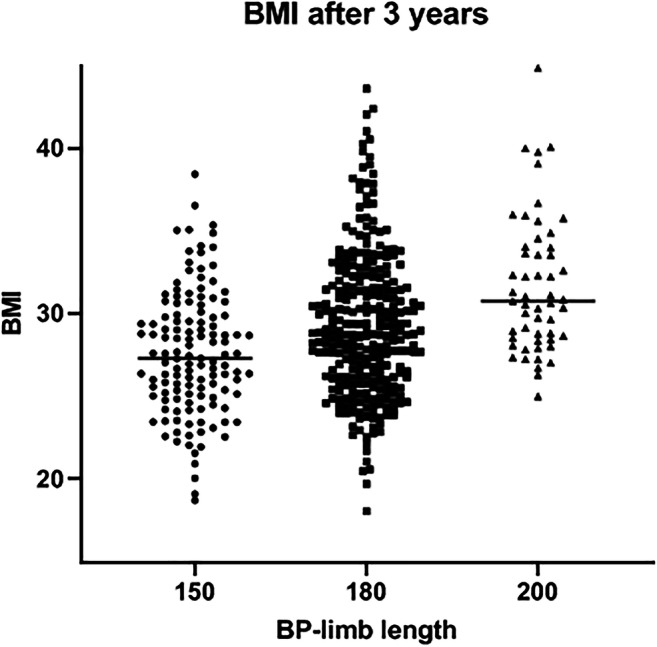
Results: Of the 632 included patients, a BP-limb length of 150 cm was used in 172 (27.2%), 180 cm in 388 (61.4%), and 200 cm in 72 (11.4%) patients. Despite more BMI loss, %EWL was lower and attained BMI remained higher in the groups with longer BP-limb lengths. After adjustment for the confounder preoperative BMI, longer BP-limb lengths were not associated with higher BMI loss. There was no difference in remission rates of comorbidities.
Conclusion: Attained BMI remained higher in spite of tailoring BP-limb length according to baseline BMI with no differences in remission rates of comorbidities.
Keywords: Bariatric surgery; Biliopancreatic limb length; Mini gastric bypass; One anastomosis gastric bypass.
© 2021. The Author(s).
Conflict of interest statement
The authors declare no competing interests.
Figures
References
-
- DeMaria EJ, Pate V, Warthen M, Winegar DA. Baseline data from American society for metabolic and bariatric surgery-designated bariatric surgery centers of excellence using the bariatric outcomes longitudinal database. Surg Obes Relat Dis. 2010;6:347–355. doi: 10.1016/j.soard.2009.11.015. - DOI - PubMed
MeSH terms
LinkOut - more resources
Full Text Sources
Medical
