Review
. 2021 Jul 20;9(1):162.
doi: 10.1186/s40168-021-01093-y.

From gut microbiota to host appetite: gut microbiota-derived metabolites as key regulators

Affiliations
Review

From gut microbiota to host appetite: gut microbiota-derived metabolites as key regulators

Hui Han et al. Microbiome. .

Abstract

Feelings of hunger and satiety are the key determinants for maintaining the life of humans and animals. Disturbed appetite control may disrupt the metabolic health of the host and cause various metabolic disorders. A variety of factors have been implicated in appetite control, including gut microbiota, which develop the intricate interactions to manipulate the metabolic requirements and hedonic feelings. Gut microbial metabolites and components act as appetite-related signaling molecules to regulate appetite-related hormone secretion and the immune system, or act directly on hypothalamic neurons. Herein, we summarize the effects of gut microbiota on host appetite and consider the potential molecular mechanisms. Furthermore, we propose that the manipulation of gut microbiota represents a clinical therapeutic potential for lessening the development and consequence of appetite-related disorders. Video abstract.

Keywords: Appetite; Gut microbiota; Hormone; Immune; Metabolites.


Conflict of interest statement

The authors declare that they have no competing interests.

Figures
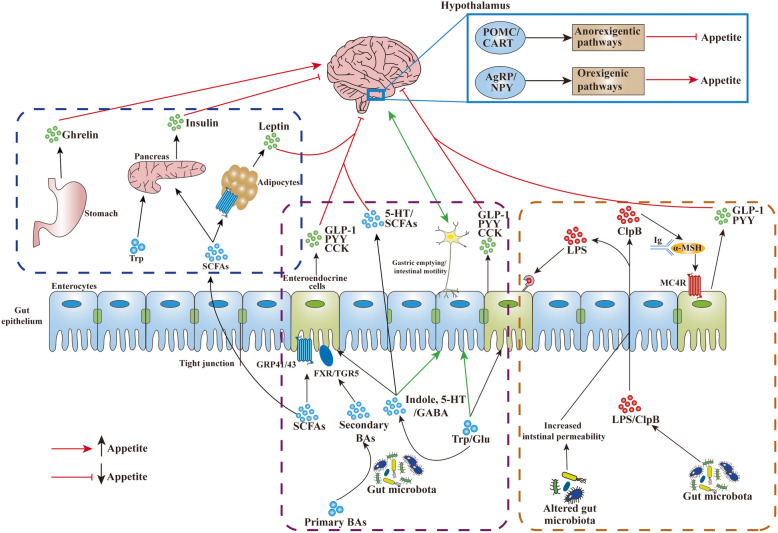
Fig. 1
Fig. 1
Gut microbiota-associated mechanisms involved in host appetite control. Firstly, gut microbial metabolites can stimulate enteroendocrine cells to release anorexigenic hormones (PYY, GLP-1, and CCK) and neurotransmitter (5-HT) and promote the secretion of peripheral hormones (leptin, ghrelin, and insulin). Secondly, Igs are involved in modulating the biological activity of appetite-regulating hormones, such as leptin and ghrelin. In addition, gut microbiota can produce identical protein sequences with appetite-regulating peptides, such as ClpB, that might directly act on anorexigenic neurons or bind to Igs to modulate the secretion of anorexigenic hormones from enteroendocrine L cells
Fig. 2
Fig. 2
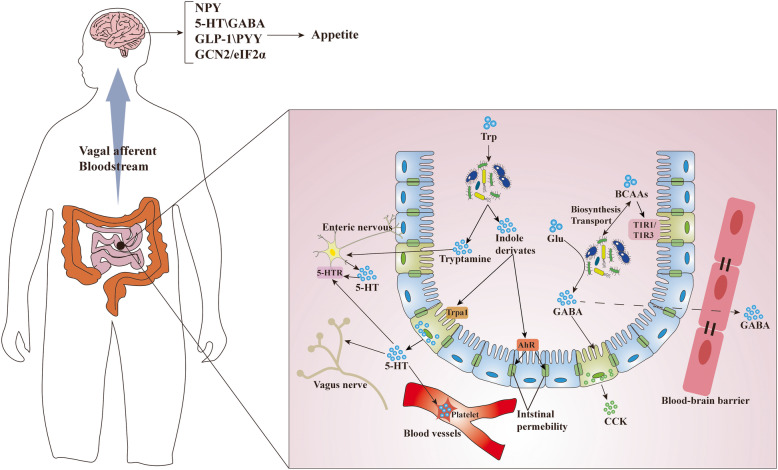
Gut microbial metabolites derived from amino acids influence host appetite control. Microbiota-derived amino acids mediate a variety of effects on appetite control. (1) Trp can be metabolized by commensal bacteria to produce tryptamine that affect the production and secretion of 5-HT, and some indole derivatives that are associated with maintaining intestinal permeability. 5-HT can act as neurotransmitter that conveys signals from the gut to the brain and mediate appetite control. (2) Glu can be metabolized by gut microbiota to produce GABA, which is considered a neurotransmitter to regulate the secretion of appetite-related hormones and intestinal motility. (3) Gut microbiota are involved in the biosynthesis and transport of BCAAs. The imbalance of BCAAs: non-BCAAs ratio can influence the 5-HT production in the hypothalamus. In addition, BCAAs can control appetite through mediating intestinal amino acid receptors and hypothalamic NCG2/eIF2α signaling. The sensory, hormonal, and neural signals are sent to the brain through vagal afferents or bloodstream to regulate appetite
Fig. 3
Fig. 3
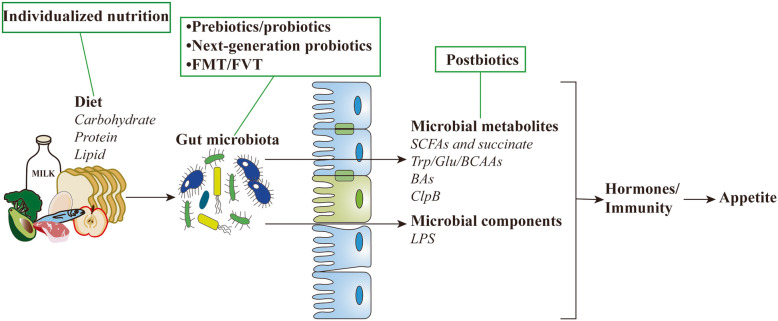
Potential clinical applications related to gut microbiota in appetite-related disorders. Gut microbial composition and metabolites contribute appetite control through altering the production and secretion of appetite-related hormones and influencing the immune system. Modulation of gut microbial composition is feasible via various strategies, including dietary interventions, probiotics, prebiotics, next-generation probiotics, FMT, and FVT. In addition, postbiotics can specifically and precisely change the microbial metabolites

References

    1. Noble EE, Hahn JD, Konanur VR, Hsu TM, Page SJ, Cortella AM, et al. Control of feeding behavior by cerebral ventricular volume transmission of melanin-concentrating hormone. Cell Metab. 2018;28:55–68.e7. doi: 10.1016/j.cmet.2018.05.001. - DOI - PMC - PubMed
    1. Aklan I, Sayar Atasoy N, Yavuz Y, Ates T, Coban I, Koksalar F, et al. NTS catecholamine neurons mediate hypoglycemic hunger via medial hypothalamic feeding pathways. Cell Metab. 2020;31:313–326.e5. doi: 10.1016/j.cmet.2019.11.016. - DOI - PMC - PubMed
    1. Tan HE, Sisti AC, Jin H, Vignovich M, Villavicencio M, Tsang KS, et al. The gut-brain axis mediates sugar preference. Nature. 2020;580:511–516. doi: 10.1038/s41586-020-2199-7. - DOI - PMC - PubMed
    1. Simon JJ, Stopyra MA, Mönning E, Sailer S, Lavandier N, Kihm L, et al. Neuroimaging of hypothalamic mechanisms related to glucose metabolism in anorexia nervosa and obesity. J Clin Invest. 2020;130:4094-103. - PMC - PubMed
    1. Andermann ML, Lowell BB. Toward a wiring diagram understanding of appetite control. Neuron. 2017;95:757–78. - PMC - PubMed