


Measures of physical performance in COVID-19 patients: a mapping review
- PMID: 34284976
- PMCID: PMC8221906
- DOI: 10.1016/j.pulmoe.2021.06.005
Measures of physical performance in COVID-19 patients: a mapping review
Abstract
Background and objective: There is evidence of short- and long-term impairment of physical performance in patients with COVID-19 infection, but a verification of measures of physical impairment in this condition is lacking. We reviewed the measures used to assess physical performance in these patients. Secondary targets were measures of exercise or daily life activities induced symptoms.
Methods: Medline, CINAHL, and Pedro databases were searched from January 2020 to February 2021 for articles in the English language. Two investigators independently conducted the search, screened all titles and/or abstracts based on the inclusion criteria and independently scored the studies. The quality of the studies was evaluated by two reviewers according to the NIH quality assessment tool for observational cohort and cross-sectional studies. Discrepancies were resolved through consensus.
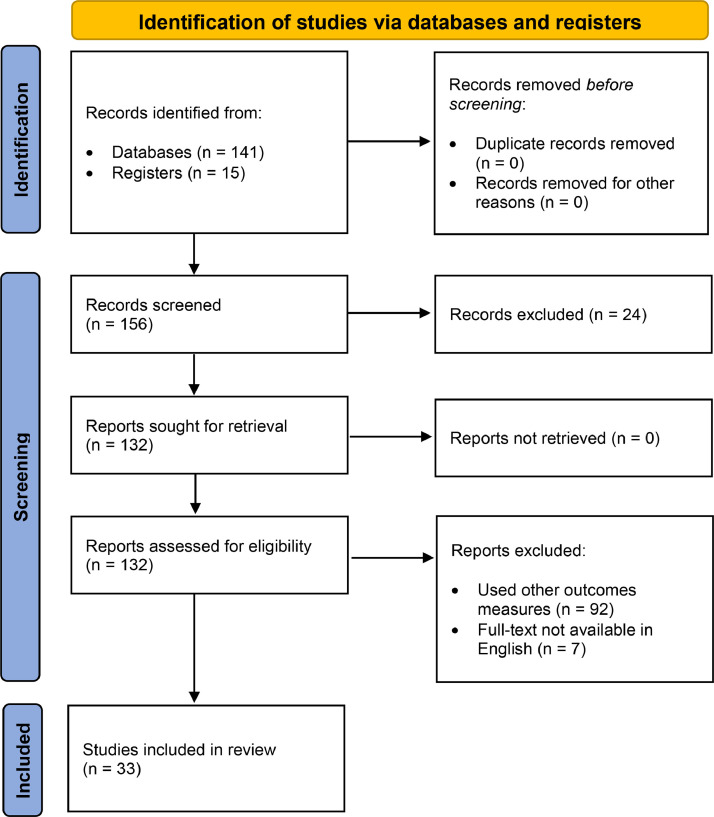
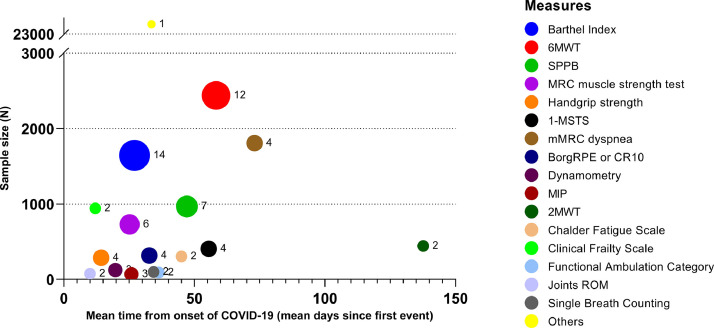
Results: Out of 156 potentially relevant articles, 31 observational studies (8 cross-sectional), 1 randomized controlled trial, and 1 protocol were included. The quality of most of the 31 evaluable studies was judged as low (11 studies) or fair (14 studies). Sample sizes of the studies ranged from 14 to 20,889 patients. among the 28 reported measures, Barthel Index (42.4% of studies), Six-Minute Walking Distance Test (36.4%), Short Physical Performance Battery (21.2%) and 1-Minute Sit-to-Stand (12.1%) were the most used. Fifteen% and 36% of studies reported exercise induced desaturation and dyspnoea when performing the assessments, respectively. Other exercise induced symptoms were fatigue and pain. Studies reported wide ranges of impairment in physical performance as compared to "reference" values (range of mean or median reported values vs "reference values": 11-77 vs 100 points for Barthel Index; 11-22 vs 22-37 repetitions/min for 1m-STS; 0.5-7.9 vs 11.4 ± 1.3 points for SPPB; and 45-223 vs 380-782 m for 6MWT respectively).
Conclusion: This review found that a wide variety of functional status tests have been used, making comparisons difficult between studies. These measures show impairment in physical performance in COVID-19 patients. However, the quality of most of the studies was judged as low or fair.
Keywords: Dyspnoea; Exercise capacity; Exercise induced desaturation; Exercise tests; Functional status; Rehabilitation.
Copyright © 2021 Sociedade Portuguesa de Pneumologia. Published by Elsevier España, S.L.U. All rights reserved.
Conflict of interest statement
Conflicts of interest NA is the Chief Editor of Pulmonology. The other authors declare no potential conflicts of interest with respect to the research, authorship, and/or publication of this article.
Figures
Comment in
-
Functional status in the COVID-19 era: ALERT, ALERT, ALERT!Pulmonology. 2021 Nov-Dec;27(6):481-483. doi: 10.1016/j.pulmoe.2021.08.005. Epub 2021 Sep 14. Pulmonology. 2021. PMID: 34635466 Free PMC article. No abstract available.
References
Publication types
MeSH terms
LinkOut - more resources
Full Text Sources
Medical
