. 2021 Nov;46(12):2121-2131.
doi: 10.1038/s41386-021-01096-1. Epub 2021 Jul 20.

NOP receptor antagonism attenuates reinstatement of alcohol-seeking through modulation of the mesolimbic circuitry in male and female alcohol-preferring rats

Affiliations

NOP receptor antagonism attenuates reinstatement of alcohol-seeking through modulation of the mesolimbic circuitry in male and female alcohol-preferring rats

Anna Maria Borruto et al. Neuropsychopharmacology. 2021 Nov.

Abstract

In patients suffering from alcohol use disorder (AUD), stress and environmental stimuli associated with alcohol availability are important triggers of relapse. Activation of the nociceptin opioid peptide (NOP) receptor by its endogenous ligand Nociceptin/Orphanin FQ (N/OFQ) attenuates alcohol drinking and relapse in rodents, suggesting that NOP agonists may be efficacious in treating AUD. Intriguingly, recent data demonstrated that also blockade of NOP receptor reduced alcohol drinking in rodents. To explore further the potential of NOP antagonism, we investigated its effects on the reinstatement of alcohol-seeking elicited by administration of the α2 antagonist yohimbine (1.25 mg/kg, i.p.) or by environmental conditioning factors in male and female genetically selected alcohol-preferring Marchigian Sardinian (msP) rats. The selective NOP receptor antagonist LY2817412 (0.0, 3.0, 10.0, and 30.0 mg/kg) was first tested following oral (p.o.) administration. We then investigated the effects of LY2817412 (1.0, 3.0, 6.0 μg/μl/rat) microinjected into three candidate mesolimbic brain regions: the ventral tegmental area (VTA), the central nucleus of the amygdala (CeA), and the nucleus accumbens (NAc). We found that relapse to alcohol seeking was generally stronger in female than in male rats and oral administration of LY2817412 reduced yohimbine- and cue-induced reinstatement in both sexes. Following site-specific microinjections, LY2817412 reduced yohimbine-induced reinstatement of alcohol-seeking when administered into the VTA and the CeA, but not in the NAc. Cue-induced reinstatement was suppressed only when LY2817412 was microinjected into the VTA. Infusions of LY2817412 into the VTA and the CeA did not alter saccharin self-administration. These results demonstrate that NOP receptor blockade prevents the reinstatement of alcohol-seeking through modulation of mesolimbic system circuitry, providing further evidence of the therapeutic potential of NOP receptor antagonism in AUD.


Conflict of interest statement

The authors declare no competing interests.

Figures
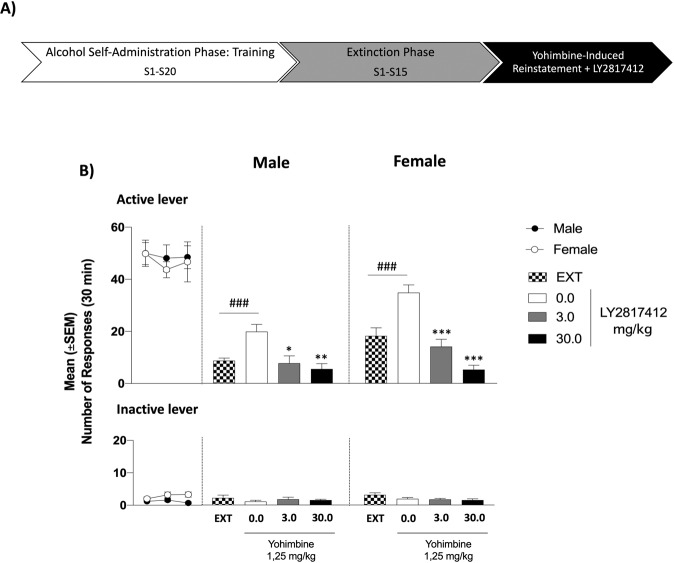
Fig. 1
Fig. 1. Effect of Systemic Administration of LY2817412 on Yohimbine-Induced Reinstatement of Alcohol Seeking in Male and Female msP Rats.
A Schematic representation of the experimental timeline. B Self-administration: black circles (male) and white circles (female) represent mean number of the responses during the last 3 days of alcohol self-administration sessions. No differences were denoted in the number of active or inactive lever presses during this phase. Extinction: mean number of lever presses during the last 3 days of extinction (EXT). Compared to extinction, male (n = 10) and female (n = 10) msP rats treated with yohimbine (1.25 mg/kg; i.p.) and LY2817412 vehicle (0.0) showed a significant reinstatement of responding. Administration of LY2817412 significantly reduced yohimbine-induced reinstatement both in males and females. Previously alcohol paired active and inactive lever presses are presented in the upper and lower panels, respectively. Values represent the mean (±SEM). ###p < 0.001, difference between EXT and rats treated with yohimbine plus LY2817412 vehicle (0.0); *p < 0.05, **p < 0.01, ***p < 0.001, differences between rats treated with yohimbine and LY2817412 vehicle (0.0) and rats treated different doses of the antagonist.
Fig. 2
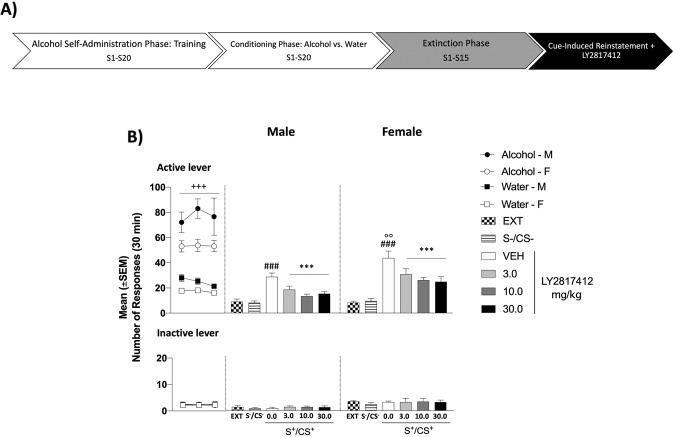
Fig. 2. Effect of Systemic Administration of LY2817412 on Cue-Induced Reinstatement of Alcohol-Seeking in Male and Female msP Rats.
A Schematic representation of the experimental timeline. B Conditioning phase: black circles (male) and white circles (female) represent the responses during the last 3 days of alcohol self-administration sessions; black squares (male) and white squares (female) represents the responses during the last 3 days of water self-administration sessions during the discrimination phases. Analysis of this phase showed a significant time × drugs interaction for the active lever presses. No differences were denoted for the inactive lever. Extinction: mean number of lever presses during the last 3 days of extinction (EXT). Compared to extinction, male (n = 8) and female (n = 10) msP rats showed a significant reinstatement of lever pressing in response to alcohol cues (S+/CS+) but not to water (S/CS). Administration of LY2817412 significantly reduced cue (S+/CS+) induced reinstatement of alcohol seeking. Previously alcohol paired active and inactive lever presses are presented in the upper and lower panels, respectively. Values represent the mean (±SEM). ###p < 0.001, difference between EXT and rats exposed to alcohol paired cues (S+/CS+) treated with LY2817412 vehicle (0.0); °°p < 0.01, difference in the reinstatement between male and female msP rats; ***p < 0.001, difference between rats presented with S+/CS+ and LY2817412 vehicle (0.0) and rats treated different doses of the antagonist.
Fig. 3
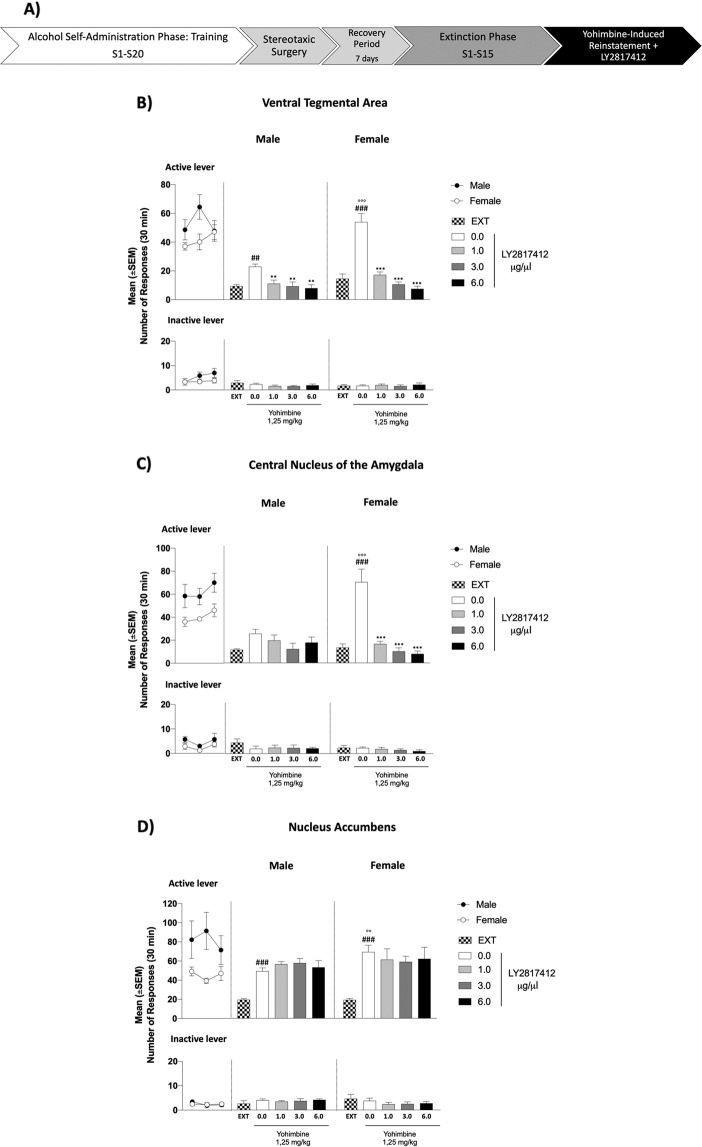
Fig. 3. Effect of Intra-VTA, Intra-CeA and Intra-NAc Administration of LY2817412 on Yohimbine‐Induced Reinstatement of Alcohol Seeking in Male and Female msP rats.
A Schematic representation of the experimental timeline. BD Self-administration: black circles (male) and white circles (female) represent the mean number of responses during the last 3 days of alcohol self-administration sessions. Self‐administration: black (male) and white (female) circle represents the responses during the last 3 days of alcohol self‐administration sessions. No differences were denoted in the number of active or inactive lever presses during this phase in all brain regions. Extinction: mean number of lever presses during the last 3 days of extinction (EXT). B Male (n = 9) and female (n = 7) msP rats were implanted with bilateral cannulas aimed at the VTA. Compared with EXT, yohimbine elicited a significant reinstatement of responding, both in male and in female rats. Intra-VTA administration of LY2817412 reduced the active lever responses elicited by yohimbine treatment in both sexes. C Male (n = 7) and female (n = 7) msP rats were implanted with bilateral cannulas aimed at the CeA. Compared with EXT, yohimbine elicited a significant reinstatement of responding in female but not in male subjects. Intra-CeA administration of LY2817412 reduced the active lever responses elicited by yohimbine treatment only in female rats. D Male (n = 7) and female (n = 8) msP rats were implanted with bilateral cannulas aimed at the NAc. Compared with EXT, yohimbine elicited a significant reinstatement of responding both in male and female msP rats. Values represent the mean (±SEM). ##p < 0.01, ###p < 0.001, difference between EXT and rats treated with yohimbine plus LY2817412 vehicle (0.0); °°p < 0.01, °°°p < 0.001, difference in the reinstatement between male and female msP rats; **p < 0.01, ***p < 0.001, difference between rats treated with yohimbine and LY2817412 vehicle (0.0) and rats treated with different doses of the antagonist.
Fig. 4
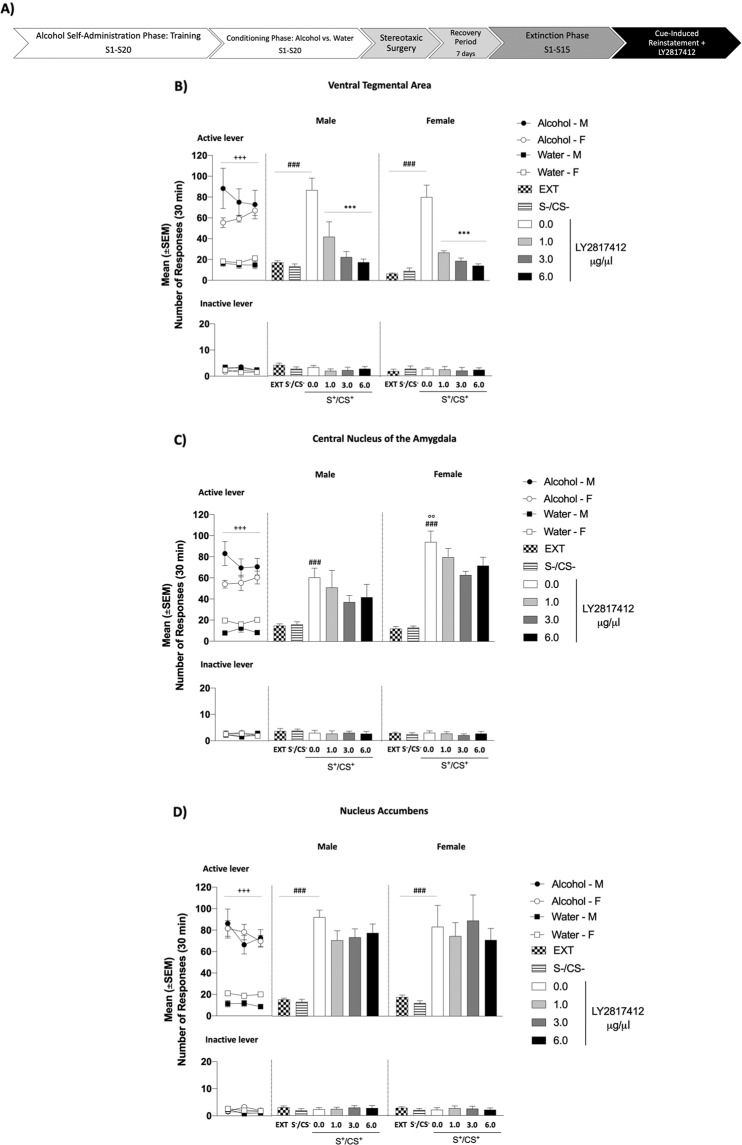
Fig. 4. Effect of Intra-VTA, Intra-CeA and Intra-NAc Administration of LY2817412 on Cue‐Induced Reinstatement of Alcohol Seeking in Male and Female msP rats.
A Schematic representation of the experimental timeline. B–D Conditioning phase: black circles (male) and white circles (female) represent the responses during the last 3 days of alcohol self‐administration; black squares (male) and white squares (female) represent the responses during the last 3 days of water self-administration during the discrimination phases. Analysis of this phase showed a significant time × drugs interaction in all brain regions for the active lever presses. No differences were denoted for the inactive lever. Extinction: mean number of lever presses during the last 3 days of extinction (EXT). B Male (n = 7) and female (n = 7) rats were implanted with bilateral cannulas aimed at the VTA. Compared to EXT, rats exposed to alcohol-predictive of discriminative stimuli (S+/CS+) and treated with LY2817412 vehicle (0.0) reinstated active lever pressing. Intra-VTA administration of the drug attenuated the reinstatement elicited by the alcohol-predictive discriminative stimuli. C Male (n = 7) and female (n = 8) rats were implanted with bilateral cannulas aimed at the CeA. Compared to EXT, rats exposed to alcohol-predictive of discriminative stimuli (S+/CS+) and treated with LY2817412 vehicle (0.0) reinstated active lever pressing. Intra-CeA administration of the NOP antagonist did not prevent the effect of S+/CS+. D Male (n = 8) and female (n = 8) msP rats were implanted with bilateral cannulas aimed at the NAc. Compared to EXT, rats exposed to the alcohol-predictive stimuli (S+/CS+) elicited a significant reinstatement of responding. Intra-NAc administration of the NOP antagonist did not prevent the effect of S+/CS+. Presentation of water paired cues (S/CS) never affected operant responding that in all groups remained at extinction level. Values represent the mean (±SEM). ###p < 0.001, difference between EXT and rats exposed to alcohol paired cues (S+/CS+) treated with LY2817412 vehicle (0.0); °°p < 0.001, difference in the reinstatement between male and female msP rats; ***p < 0.001, difference between rats presented with S+/CS+ and LY2817412 vehicle (0.0) and rats treated different doses of the antagonist.
Fig. 5
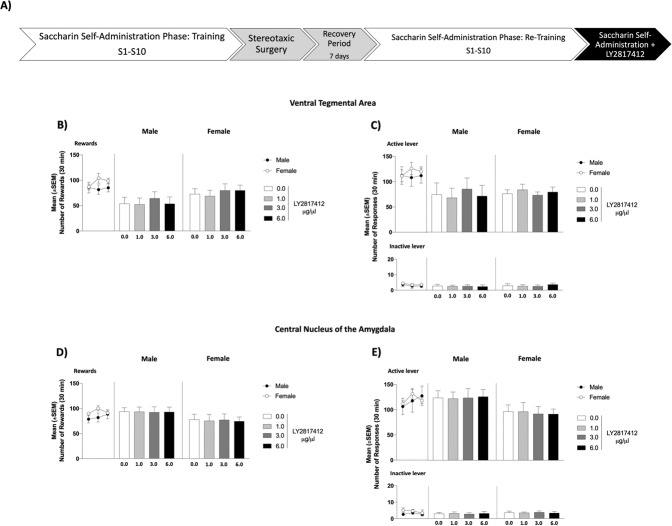
Fig. 5. Effect of Intra-VTA and Intra-CeA Administration of LY2817412 on Saccharin Self-Administration in Male and Female msP rats.
A Schematic representation of the experimental timeline. B–E Black circles (male) and white circles (female) represent the mean number of rewards (B, D), active (C, E upper panel) and inactive (C, E lower panel) levers during the last 3 days of saccharin self‐administration sessions. B, C Male (n = 10) and female (n = 9) msP rats microinjected into the VTA with LY2817412 did not show changes in saccharin reward or in the total number of lever pressing at both the active and inactive levers. D, E Male (n = 10) and female (n = 9) msP rats microinjected into the CeA with LY2817412 did not show changes in saccharin reward or in the total number of lever pressing at both the active and inactive levers. Values represent the mean (±SEM).

References

    1. Koob GF. Neurocircuitry of alcohol addiction: synthesis from animal models. Handb Clin Neurol. 2014;125:33–54. - PubMed
    1. Koob GF, Le Moal M. Plasticity of reward neurocircuitry and the ‘dark side’ of drug addiction. Nat Neurosci. 2005;8:1442–4. - PubMed
    1. Monti PM, Binkoff JA, Abrams DB, Zwick WR, Nirenberg TD, Liepman MR. Reactivity of alcoholics and nonalcoholics to drinking cues. J Abnorm Psychol. 1987;96:122–6. - PubMed
    1. Martin-Fardon R, Weiss F. Modeling relapse in animals. Curr Top Behav Neurosci. 2013;13:403–32. - PMC - PubMed
    1. Cooney NL, Litt MD, Morse PA, Bauer LO, Gaupp L. Alcohol cue reactivity, negative-mood reactivity, and relapse in treated alcoholic men. J Abnorm Psychol. 1997;106:243–50. - PubMed

Publication types