


Step-Up and Step-Down Treatment Approaches for COPD: A Holistic View of Progressive Therapies
- PMID: 34285480
- PMCID: PMC8285922
- DOI: 10.2147/COPD.S275943
Step-Up and Step-Down Treatment Approaches for COPD: A Holistic View of Progressive Therapies
Abstract
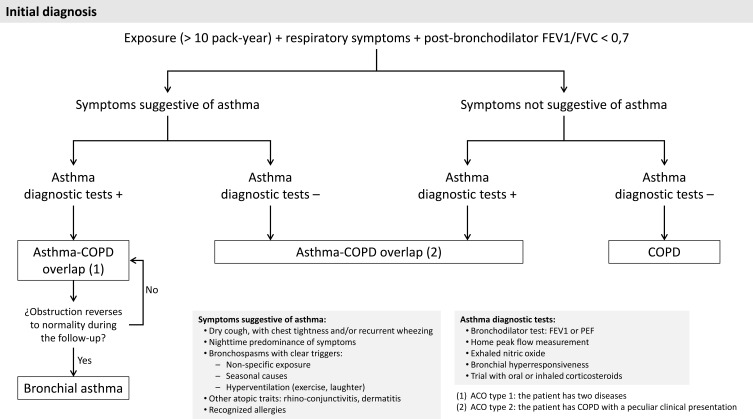
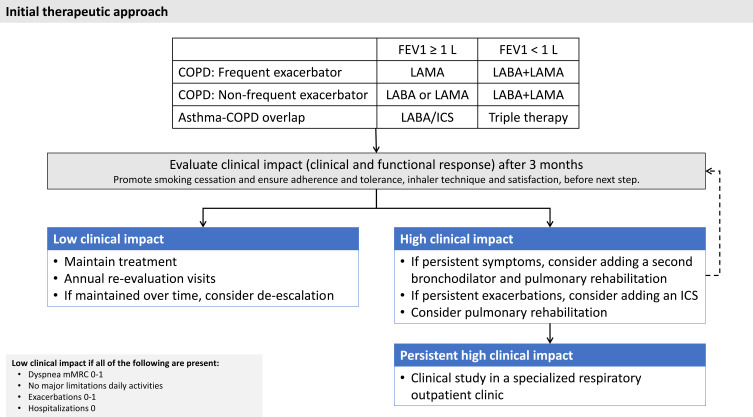
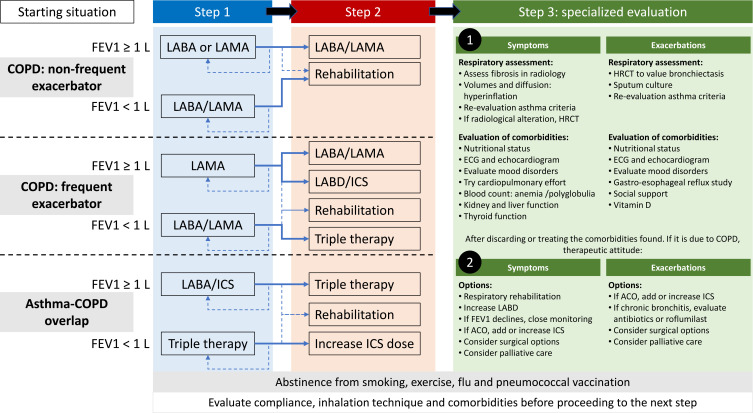
Recent advances in inhaled drugs and a clearer definition of the disease have made the task of managing COPD more complex. Different proposals have been put forward which combine all the available treatments and the different clinical presentations in an effort to select the best therapeutic options for each clinical context. As COPD is a chronic progressive disease, the escalation of therapy has traditionally been considered the most natural way to tackle it. However, the notion of COPD as a constantly progressing disease has recently been challenged and, in specific areas, this points to the possibility of a de-escalation in treatment. In this context, the clinician requires simple, specific recommendations to guide these changes in treatment in their daily clinical practice. To accomplish this, the first step must be a correct evaluation and an accurate initial preliminary diagnosis of the patient's condition. Thereafter, the first escalation in therapy must be introduced with caution as the disease progresses, since clinical trials are not designed with clinical decision-making in mind. During this escalation, three possibilities are open to change the current treatment for a different one within the same family, to increase non-pharmacological interventions or to increase the pharmacological therapies. Beyond that point, a patient with persistent symptoms represents a complex clinical scenario which requires a specialized approach, including the evaluation of different respiratory and non-respiratory comorbidities. Unfortunately, there are few de-escalation studies available, and these are mainly observational in nature. The debate on de-escalation in pharmacological treatment, therefore, involves two main discussion points: the withdrawal of bronchodilators and the withdrawal of inhaled steroids. Altogether, the scheme for modifying treatment must be more personalized than just adding molecules, and the therapeutic response and its conditioning factors should be evaluated at each step before proceeding further.
Keywords: COPD; escalation of treatment; pharmacological therapies; precision medicine.
© 2021 López-Campos et al.
Conflict of interest statement
JLLC has received grants, honoraria during the last 3 years for lecturing, scientific advice, participation in clinical studies or writing for publications for (alphabetical order): AstraZeneca, Boehringer Ingelheim, Chiesi, CSL Behring, Esteve, Ferrer, Gebro, GlaxoSmithKline, Grifols, Menarini, Novartis, Rovi, and Teva. The other authors declare no conflicts of interest.
Figures
Similar articles
-
Chronic obstructive pulmonary disease - diagnosis and management of stable disease; a personalized approach to care, using the treatable traits concept based on clinical phenotypes. Position paper of the Czech Pneumological and Phthisiological Society.Biomed Pap Med Fac Univ Palacky Olomouc Czech Repub. 2020 Dec;164(4):325-356. doi: 10.5507/bp.2020.056. Biomed Pap Med Fac Univ Palacky Olomouc Czech Repub. 2020. PMID: 33325455
-
What is in the guidelines about the pharmacological treatment of chronic obstructive pulmonary disease?Expert Rev Respir Med. 2013 Apr;7(2 Suppl):43-51. doi: 10.1586/ers.13.17. Expert Rev Respir Med. 2013. PMID: 23551023 Review.
-
Escalation and De-escalation of Therapy in COPD: Myths, Realities and Perspectives.Drugs. 2015 Sep;75(14):1575-85. doi: 10.1007/s40265-015-0450-6. Drugs. 2015. PMID: 26316169
-
Factors influencing treatment escalation from long-acting muscarinic antagonist monotherapy to triple therapy in patients with COPD: a retrospective THIN-database analysis.Int J Chron Obstruct Pulmon Dis. 2018 Mar 5;13:781-792. doi: 10.2147/COPD.S153655. eCollection 2018. Int J Chron Obstruct Pulmon Dis. 2018. PMID: 29551894 Free PMC article.
-
LAMA/LABA vs ICS/LABA in the treatment of COPD in Japan based on the disease phenotypes.Int J Chron Obstruct Pulmon Dis. 2015 Jun 10;10:1093-102. doi: 10.2147/COPD.S72858. eCollection 2015. Int J Chron Obstruct Pulmon Dis. 2015. PMID: 26089659 Free PMC article. Review.
Cited by
-
Alpha-1 Antitrypsin Deficiency and Bronchial Asthma: Current Challenges.Biomolecules. 2025 Jun 3;15(6):807. doi: 10.3390/biom15060807. Biomolecules. 2025. PMID: 40563447 Free PMC article. Review.
-
Exploring Current Concepts and Challenges in the Identification and Management of Early-Stage COPD.J Clin Med. 2023 Aug 14;12(16):5293. doi: 10.3390/jcm12165293. J Clin Med. 2023. PMID: 37629335 Free PMC article. Review.
References
-
- Cabrera Lopez C, Gomez Saenz JT, Molina Paris J, Trigueros Carrero JA, Lopez-Campos JL. Enabling a community approach to respiratory diseases: the HACER COPD project. Arch Bronconeumol. 2020. - PubMed
-
- Halpin DMG, Criner GJ, Papi A, et al. Global initiative for the diagnosis, management, and prevention of chronic obstructive lung disease. The 2020 GOLD science committee report on COVID-19 and chronic obstructive pulmonary disease. Am J Respir Crit Care Med. 2021;203(1):24–36. doi:10.1164/rccm.202009-3533SO - DOI - PMC - PubMed
Publication types
MeSH terms
Substances
LinkOut - more resources
Full Text Sources
Medical
Research Materials
