


Sex differences in sensory processing in children with autism spectrum disorder
- PMID: 34288517
- PMCID: PMC9290069
- DOI: 10.1002/aur.2580
Sex differences in sensory processing in children with autism spectrum disorder
Abstract
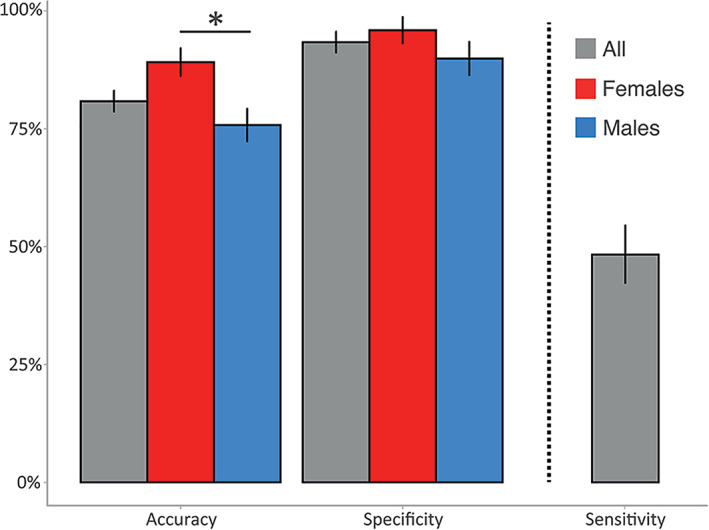
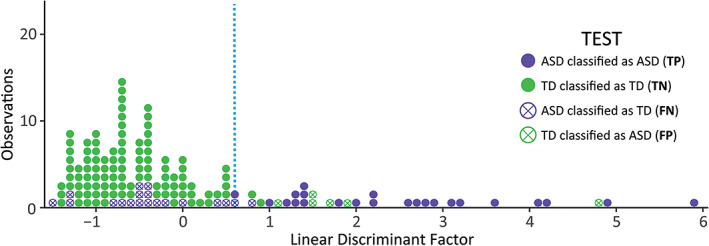
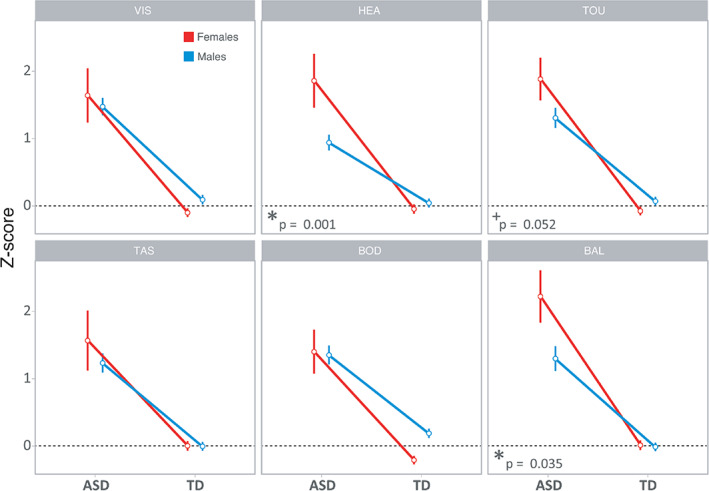
Despite the high prevalence of sensory processing difficulties in children with autism spectrum disorder (ASD), little research has focused on the sex differences in sensory processing. Furthermore, there is a lack of knowledge on the female-specific symptoms of ASD, contributing to later referral, diagnosis and intervention. In this study, we examined the sex differences in sensory processing symptoms in large cohorts of ASD children (N = 168; 26 females, 142 males) and typically developing (TD) children (N = 439; 209 females, 230 males). For this, we translated the sensory processing measure (SPM) and SPM - Preschool (SPM-P) Home Forms to French. The SPM/SPM-P are parent/caregiver questionnaires that assess typical behavioral responses to sensory stimuli. Overall, our results showed that the magnitude of the differences in sensory processing between males and females is larger in ASD children relative to TD children, with females showing more severe symptoms in Hearing, as well as Balance and Motion subscales. Additionally, linear discriminant analysis showed that the SPM/SPM-P are good at discriminating TD children from ASD, children with higher accuracy rates for females than for males. These findings are discussed in light of the heterogeneity of sensory processing difficulties present in ASD. Overall, our results suggest that there seem to be female-specific profiles in sensory processing difficulties in ASD. Implications of findings concerning sex differences in sensory processing and their potential for improving identification and diagnosis of ASD females are discussed. LAY SUMMARY: The present study examined sex differences in behavioral responses to sensory stimuli in children with autism spectrum disorder (ASD), and typically developing (TD) children. While there is a small trend for TD males to show more sensory processing atypicalities, female ASD children show significantly more atypical responses compared to their male counterparts. This has important implications for characterizing female autism profiles, and ultimately improving the chance for earlier detection, diagnosis and treatment.
Keywords: autism spectrum disorder (ASD); child development; sensory processing; sensory processing measure (SPM); sex differences.
© 2021 The Authors. Autism Research published by International Society for Autism Research and Wiley Periodicals LLC.
Conflict of interest statement
The authors declare that they have no conflict of interest.
Figures
References
-
- Ahmad, N. M. , Kadar, M. , Chai, S. C. , Mohd Rasdi, H. F. , Razab, R. , & Dzalani Harun, N. A. (2020). Adaptation, validation and reliability testing of sensory processing measure home form Malay version for children with autism. Jurnal Sains Kesihatan Malaysia, 18(01), 37–45. 10.17576/jskm-2020-1801-06 - DOI
-
- American Psychiatric Association . (2013). Diagnostic and statistical manual of mental disorders: DSM‐5 (5th ed.). American Psychiatric Association.
-
- Ausderau, K. K. , Furlong, M. , Sideris, J. , Bulluck, J. , Little, L. M. , Watson, L. R. , Boyd, B. A. , Belger, A. , Dickie, V. A. , & Baranek, G. T. (2014). Sensory subtypes in children with autism spectrum disorder: Latent profile transition analysis using a national survey of sensory features. Journal of Child Psychology and Psychiatry, 55(8), 935–944. 10.1111/jcpp.12219 - DOI - PMC - PubMed
