. 2021 Aug;11(8):e02124.
doi: 10.1002/brb3.2124. Epub 2021 Jul 21.

Neural mechanisms underlying the Rubber Hand Illusion: A systematic review of related neurophysiological studies

Affiliations

Neural mechanisms underlying the Rubber Hand Illusion: A systematic review of related neurophysiological studies

Stefan Golaszewski et al. Brain Behav. 2021 Aug.

Abstract

Introduction: Many researchers took advantage of the well-established rubber hand illusion (RHI) paradigm to explore the link between the sense of body ownership and the different brain structures and networks. Here, we aimed to review the studies that have investigated this phenomenon by means of neurophysiological techniques.

Methods: The MEDLINE, accessed by Pubmed and EMBASE electronic databases, was searched using the medical subject headings: "Rubber hand illusion" AND "Transcranial magnetic stimulation (TMS)" OR "Evoked potentials (EP)" OR "Event related potentials (ERP)" OR "Electroencephalography (EEG)".

Results: Transcranial magnetic stimulation studies revealed a significant excitability drop in primary motor cortex hand circuits accompanying the disembodiment of the real hand during the RHI experience and that the perceived ownership over the rubber hand is associated with normal parietal-motor communication. Moreover, TMS provided causal evidence that the extrastriate body area is involved in the RHI and subsequently in body representation, while neuromodulation of ventral premotor area and the inferior parietal lobe did not result in an enhancement of embodiment. EP and ERP studies suggest that pre-existing body representations may affect larger stages of tactile processing and support predictive coding models of the functional architecture of multisensory integration in bodily perceptual experience. High-frequency oscillations on EEG play a role in the integrative processing of stimuli across modalities, and EEG activity in γ band activity in the parietal area reflects the visuotactile integration process. EEG studies also revealed that RHI is associated with the neural circuits underlying motor control and that premotor areas play a crucial role in mediating illusory body ownership.

Conclusion: Neurophysiological studies shed new light on our understanding of the different aspects that contribute to the formation of a coherent self-awareness in humans.

Keywords: electroencephalography; event-related potentials; evoked potentials; rubber hand illusion; transcranial magnetic stimulation.


Conflict of interest statement

None of the authors have potential conflicts of interest to be disclosed.

Figures
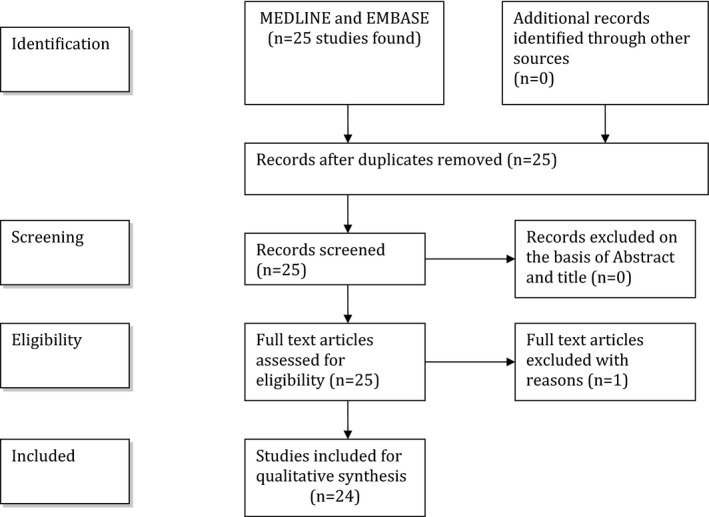
FIGURE 1
FIGURE 1
Flowchart showing the selection/inclusion process
FIGURE 2
FIGURE 2
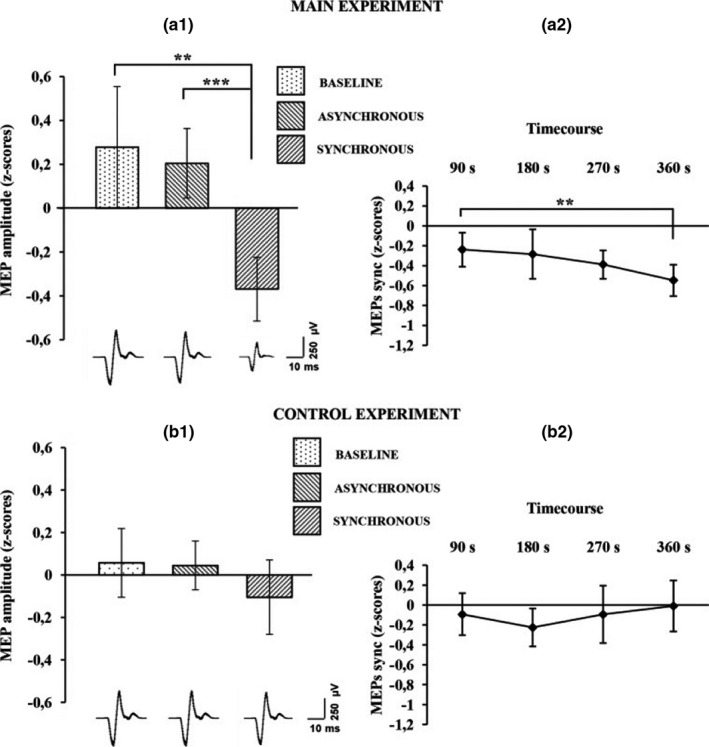
Average motor‐evoked potential (MEP) amplitude variation in the first‐dorsal interosseus (FDI) muscle recorded across all subjects is plotted in a1, for the main experiment, and in b1 for the control experiments. Histograms represent the peak‐to‐peak MEP mean amplitude (normalized) ±95% CI in the baseline, asynchronous, and synchronous conditions, respectively. Significant levels: **p < .005; ***p < .0001. Average MEP amplitude profile recorded across all subjects in the synchronous condition are plotted in a2 for the main experiment and in b2 for the control experiment; points represent the peak‐to‐peak MEP mean amplitude (normalized), ±95% CI, at four time points after induction of the illusion (90, 180, 270 and 360 s); significance level: **p < .005. Examples of average raw MEPs recorded from two representative subjects (for the main and control experiments) in the baseline (main: 609 µVolt; control: 619 µVolt), asynchronous (main: 771 µVolt; control: 601 µVolt), and synchronous (main:150 µVolt; control: 583 µVolt) conditions. Reproduced with permission from Della Gatta et al. (2016)
FIGURE 3
FIGURE 3
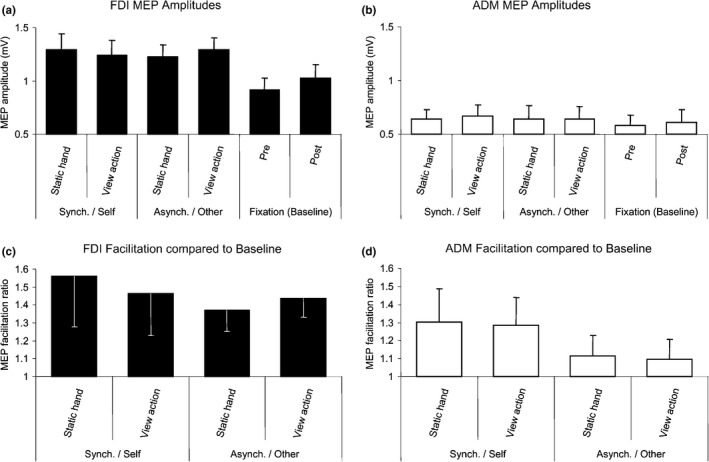
Mean + Standard Error, SE, Cortical Excitability of FDI and ADM after Action Observation or during Viewing of a Static Hand in Each Ownership Condition (a and b) Average MEP size in each condition. (c and d) Facilitation ratios in the experimental blocks relative to averaged baseline blocks
FIGURE 4
FIGURE 4
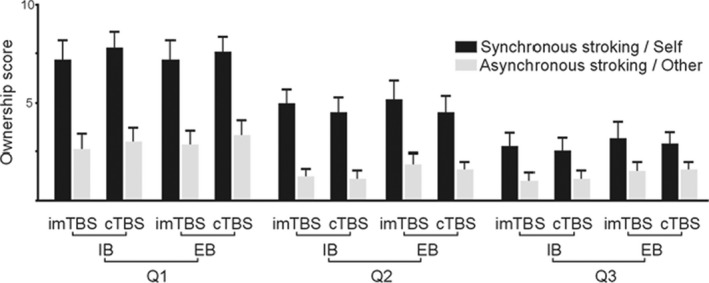
Means and standard errors of the RHI questionnaire assessing the ownership of the observed hand in the different experimental conditions: The conditions were the following: TBS (cTBS and imTBS), BLOCK (IB and EB) and STROKING (Synchronous/Self and Asynchronous/Other). Legend: TBS = theta burst stimulation; cTBS = continuous theta burst stimulation; imTBS = intermediate theta burst stimulation; IB = Induction Block; EB = Experimental Block. Reproduced with permission from Ticini et al. (2018)
FIGURE 5
FIGURE 5
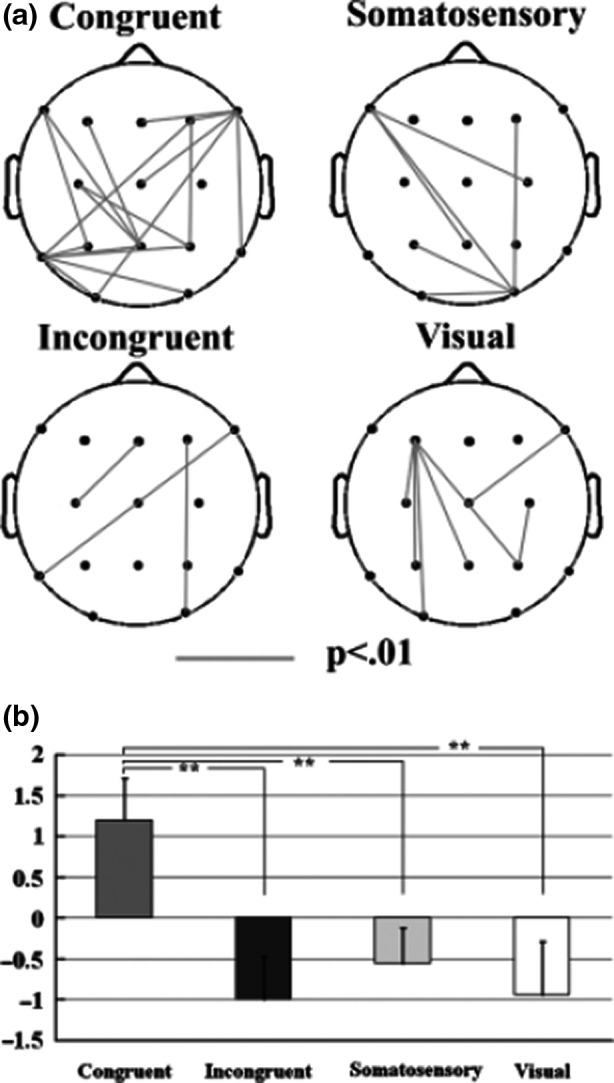
A: The phase synchrony between electrode sites for the congruent and incongruent conditions. The lines denote the significant synchrony between connected electrodes (p<.01). B: The bar graph for the averaged phase‐locking values across all pairs of electrodes. **p<.001. bar graph

References

    1. Asai, T., Mao, Z., Sugimori, E., & Tanno, Y. (2011). Rubber hand illusion, empathy, and schizotypal experiences in terms of self‐other representations. Consciousness and Cognition, 20(4), 1744–1750. 10.1016/j.concog.2011.02.005 - DOI - PubMed
    1. Avanzino, L., Bassolino, M., Pozzo, T., & Bove, M. (2011). Use‐dependent hemispheric balance. Journal of Neuroscience, 31(9), 423–3428. 10.1523/JNEUROSCI.4893-10.2011 - DOI - PMC - PubMed
    1. Botvinick, M., & Cohen, J. (1998). Rubber hands ‘feel’ touch that eyes see. Nature, 391(6669), 756. 10.1038/35784 - DOI - PubMed
    1. Burin, D., Garbarini, F., Bruno, V., Fossataro, C., Destefanis, C., Berti, A., & Pia, L. (2017). Movements and body ownership: Evidence from the rubber hand illusion after mechanical limb immobilization. Neuropsychologia, 107, 41–47. 10.1016/j.neuropsychologia.2017.11.004 - DOI - PubMed
    1. Burin, D., Livelli, A., Garbarini, F., Fossataro, C., Folegatti, A., Gindri, P., & Pia, L. (2015). Are movements necessary for the sense of body ownership? Evidence from the rubber hand illusion in pure hemiplegic patients. Public Library of Science ONE, 10(3), e0117155. 10.1371/journal.pone.0117155 - DOI - PMC - PubMed

Publication types

LinkOut - more resources