A Simple Reverse Transcriptase PCR Melting-Temperature Assay To Rapidly Screen for Widely Circulating SARS-CoV-2 Variants
- PMID: 34288729
- PMCID: PMC8451443
- DOI: 10.1128/JCM.00845-21
A Simple Reverse Transcriptase PCR Melting-Temperature Assay To Rapidly Screen for Widely Circulating SARS-CoV-2 Variants
Abstract
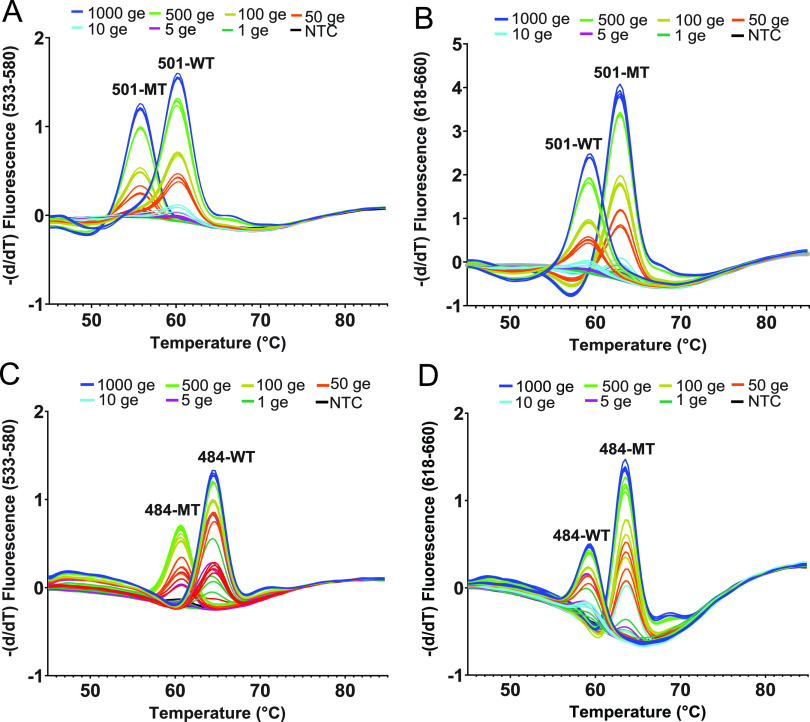
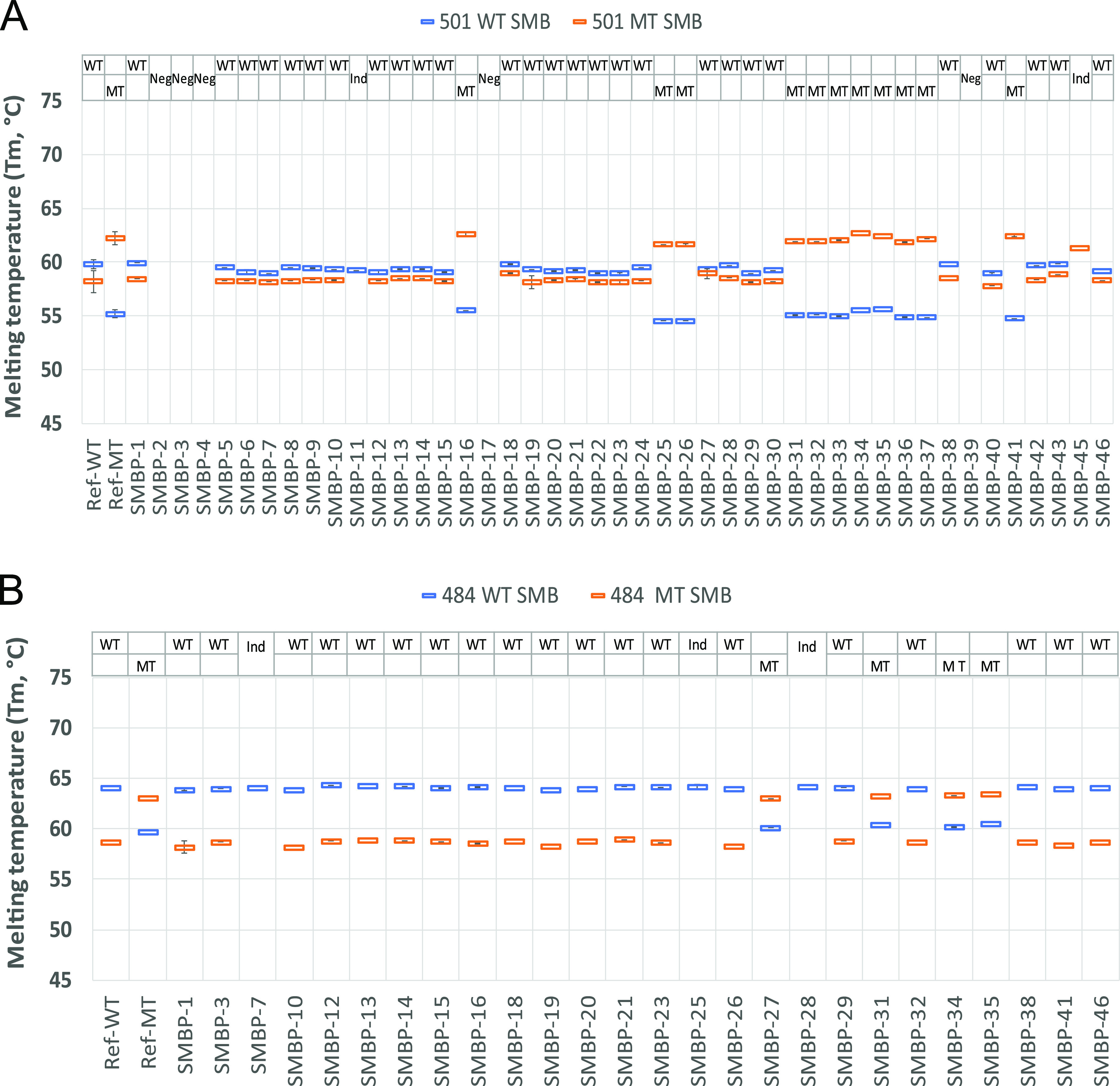
The increased transmission of SARS-CoV-2 variants of concern (VOC), which originated in the United Kingdom (B.1.1.7/alpha), South Africa (B1.351/beta), Brazil (P.1/gamma), the United States (B.1.427/429 or epsilon), and India (B.1.617.2/delta), requires a vigorous public health response, including real-time strain surveillance on a global scale. Although genome sequencing is the gold standard for identifying these VOCs, it is time-consuming and expensive. Here, we describe a simple, rapid, and high-throughput reverse transcriptase PCR (RT-PCR) melting-temperature (Tm) screening assay that identifies the first three major VOCs. RT-PCR primers and four sloppy molecular beacon (SMB) probes were designed to amplify and detect the SARS-CoV-2 N501Y (A23063T) and E484K (G23012A) mutations and their corresponding wild-type sequences. After RT-PCR, the VOCs were identified by a characteristic Tm of each SMB. Assay optimization and testing was performed with RNA from SARS-CoV-2 USA WA1/2020 (wild type [WT]), B.1.1.7, and B.1.351 variant strains. The assay was then validated using clinical samples. The limit of detection for both the WT and variants was 4 and 10 genomic copies/reaction for the 501- and 484-codon assays, respectively. The assay was 100% sensitive and 100% specific for identifying the N501Y and E484K mutations in cultured virus and in clinical samples, as confirmed by Sanger sequencing. We have developed an RT-PCR melt screening test for the major VOCs that can be used to rapidly screen large numbers of patient samples, providing an early warning for the emergence of these variants and a simple way to track their spread.
Keywords: E484K; N501Y; SARS-CoV-2; melting temperature; screening test; sloppy molecular beacon; variants.
Figures
Update of
-
A Simple RT-PCR Melting temperature Assay to Rapidly Screen for Widely Circulating SARS-CoV-2 Variants.medRxiv [Preprint]. 2021 Apr 8:2021.03.05.21252709. doi: 10.1101/2021.03.05.21252709. medRxiv. 2021. Update in: J Clin Microbiol. 2021 Sep 20;59(10):e0084521. doi: 10.1128/JCM.00845-21. PMID: 33758892 Free PMC article. Updated. Preprint.
References
-
- Galloway SE, Paul P, MacCannell DR, Johansson MA, Brooks JT, MacNeil A, Slayton RB, Tong S, Silk BJ, Armstrong GL, Biggerstaff M, Dugan VG. 2021. Emergence of SARS-CoV-2 B.1.1.7 lineage–United States, December 29, 2020–January 12, 2021. MMWR Morb Mortal Wkly Rep 70:95–99. doi: 10.15585/mmwr.mm7003e2. - DOI - PMC - PubMed
-
- Santos JC, Passos GA. 2021. The high infectivity of SARS-CoV-2 B.1.1.7 is associated with increased interaction force between Spike-ACE2 caused by the viral N501Y mutation. bioRxiv doi: 10.1101/2020.12.29.424708. - DOI
Publication types
MeSH terms
Grants and funding
LinkOut - more resources
Full Text Sources
Other Literature Sources
Medical
Miscellaneous