Physical activity, sedentary behaviour and incidence of obstructive sleep apnoea in three prospective US cohorts
- PMID: 34289976
- PMCID: PMC8933852
- DOI: 10.1183/13993003.00606-2021
Physical activity, sedentary behaviour and incidence of obstructive sleep apnoea in three prospective US cohorts
Abstract
Background: Reduced physical activity and increased sedentary behaviour may independently contribute to the development of obstructive sleep apnoea (OSA) through increased adiposity, inflammation, insulin resistance and body fluid retention. However, epidemiological evidence remains sparse and is primarily limited to cross-sectional studies.
Methods: We prospectively followed 50 332 women from the Nurses' Health Study (2002-2012), 68 265 women from the Nurses' Health Study II (1995-2013) and 19 320 men from the Health Professionals Follow-up Study (1996-2012). Recreational physical activity (quantified by metabolic equivalent of task (MET)-h per week) and sitting time spent watching TV and at work/away from home were assessed by questionnaires every 2-4 years. Physician-diagnosed OSA was identified by validated self-report. Cox models were used to estimate hazard ratios (HRs) and 95% confidence intervals for OSA incidence associated with physical activity and sedentary behaviour.
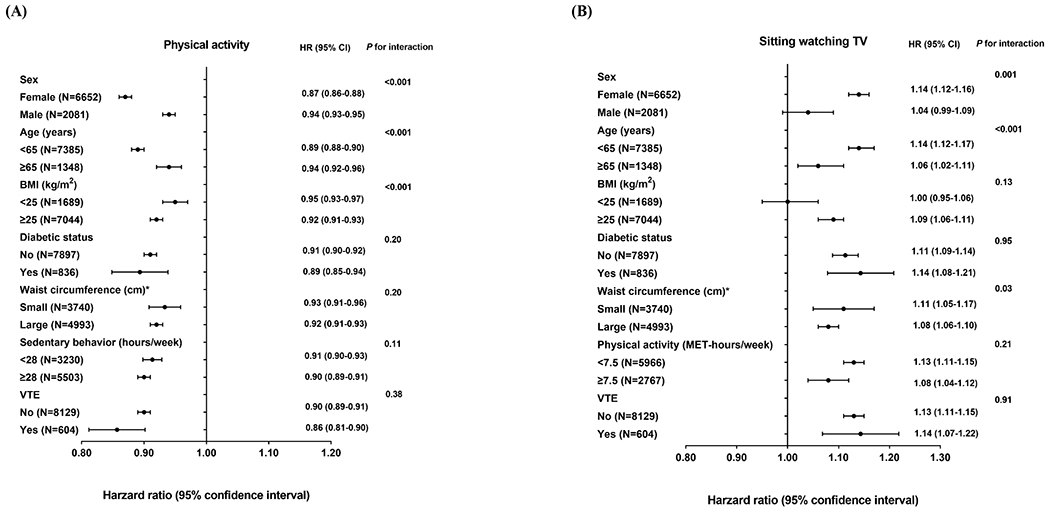
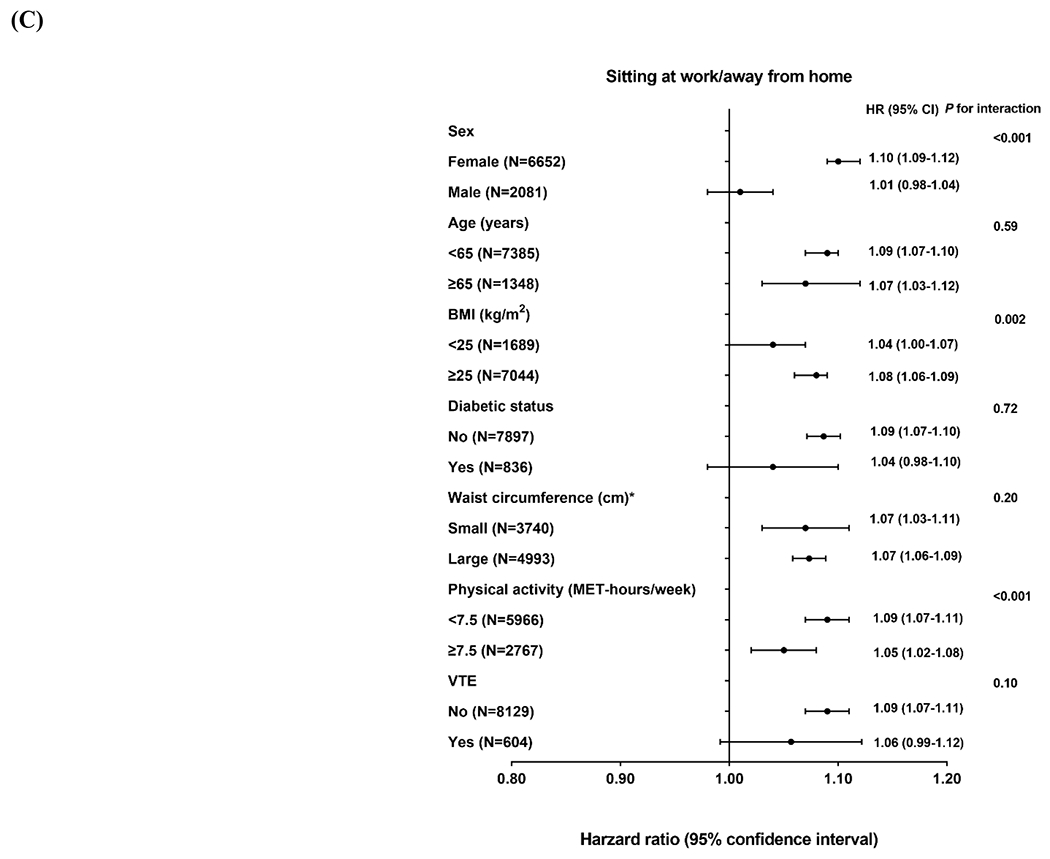
Results: During 2 004 663 person-years of follow-up, we documented 8733 incident OSA cases. After adjusting for potential confounders, the pooled HR for OSA comparing participants with ≥36.0 versus <6.0 MET-h per week of physical activity was 0.46 (95% CI 0.43-0.50; ptrend<0.001). Compared with participants spending <4.0 h per week sitting watching TV, the multivariable-adjusted HR was 1.78 (95% CI 1.60-1.98) for participants spending ≥28.0 h per week (ptrend<0.001). The comparable HR was 1.49 (95% CI 1.38-1.62) for sitting hours at work/away from home (ptrend<0.001). With additional adjustment for several metabolic factors, including body mass index and waist circumference, the associations with physical activity and sitting hours at work/away from home were attenuated but remained significant (ptrend<0.001), whereas the association with sitting hours watching TV was no longer statistically significant (ptrend=0.18).
Conclusions: Higher levels of physical activity and fewer sedentary hours were associated with lower OSA incidence. The potential mediating role of metabolic factors in the association between sedentary behaviour and OSA incidence may depend on the type of sedentary behaviour. Our results suggest that promoting an active lifestyle may reduce OSA incidence.
Copyright ©The authors 2022. For reproduction rights and permissions contact permissions@ersnet.org.
Conflict of interest statement
Conflict of interest: Y. Liu has nothing to disclose. Conflict of interest: L. Yang has nothing to disclose. Conflict of interest: M.J. Stampfer has nothing to disclose. Conflict of interest: S. Redline has nothing to disclose. Conflict of interest: S.S. Tworoger has nothing to disclose. Conflict of interest: T. Huang has nothing to disclose.
Figures
References
-
- Yaggi HK, Concato J, Kernan WN, Lichtman JH, Brass LM, Mohsenin V. Obstructive sleep apnea as a risk factor for stroke and death. N Engl J Med 2005: 353(19): 2034–2041. - PubMed
-
- Kendzerska T, Gershon AS, Hawker G, Tomlinson G, Leung RS. Obstructive sleep apnea and incident diabetes. A historical cohort study. Am J Respir Crit Care Med 2014: 190(2): 218–225. - PubMed
-
- Gottlieb DJ, Yenokyan G, Newman AB, O’Connor GT, Punjabi NM, Quan SF, Redline S, Resnick HE, Tong EK, Diener-West M, Shahar E. Prospective study of obstructive sleep apnea and incident coronary heart disease and heart failure: the sleep heart health study. Circulation 2010: 122(4): 352–360. - PMC - PubMed
Publication types
MeSH terms
Grants and funding
LinkOut - more resources
Full Text Sources
Medical
Miscellaneous