Local IP3 receptor-mediated Ca2+ signals compound to direct blood flow in brain capillaries
- PMID: 34290098
- PMCID: PMC8294755
- DOI: 10.1126/sciadv.abh0101
Local IP3 receptor-mediated Ca2+ signals compound to direct blood flow in brain capillaries
Abstract
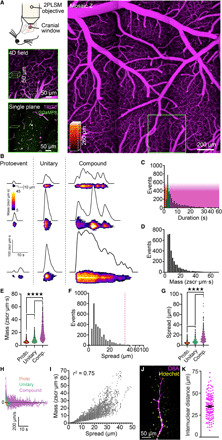
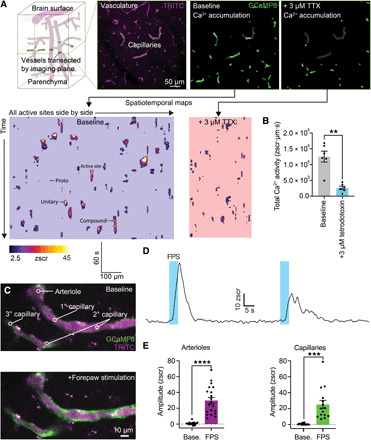
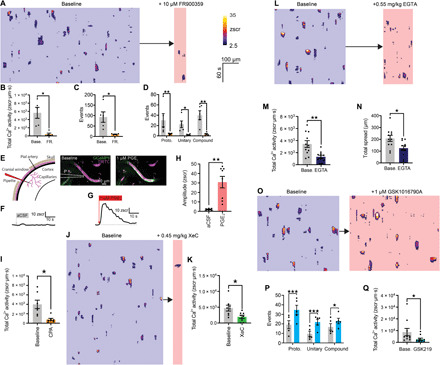
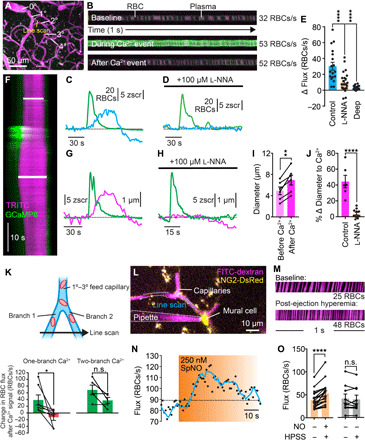
Healthy brain function depends on the finely tuned spatial and temporal delivery of blood-borne nutrients to active neurons via the vast, dense capillary network. Here, using in vivo imaging in anesthetized mice, we reveal that brain capillary endothelial cells control blood flow through a hierarchy of IP3 receptor-mediated Ca2+ events, ranging from small, subsecond protoevents, reflecting Ca2+ release through a small number of channels, to high-amplitude, sustained (up to ~1 min) compound events mediated by large clusters of channels. These frequent (~5000 events/s per microliter of cortex) Ca2+ signals are driven by neuronal activity, which engages Gq protein-coupled receptor signaling, and are enhanced by Ca2+ entry through TRPV4 channels. The resulting Ca2+-dependent synthesis of nitric oxide increases local blood flow selectively through affected capillary branches, providing a mechanism for high-resolution control of blood flow to small clusters of neurons.
Copyright © 2021 The Authors, some rights reserved; exclusive licensee American Association for the Advancement of Science. No claim to original U.S. Government Works. Distributed under a Creative Commons Attribution NonCommercial License 4.0 (CC BY-NC).
Figures
References
-
- Palmer R., Ferrige A., Moncada S., Nitric oxide release accounts for the biological activity of endothelium-derived relaxing factor. Nature 327, 524–526 (1987). - PubMed
-
- Ledoux J., Taylor M. S., Bonev A. D., Hannah R. M., Solodushko V., Shui B., Tallini Y., Kotlikoff M. I., Nelson M. T., Functional architecture of inositol 1, 4, 5-trisphosphate signaling in restricted spaces of myoendothelial projections. Proc. Natl. Acad. Sci. U.S.A. 105, 9627–9632 (2008). - PMC - PubMed
Grants and funding
- R01 HL121706/HL/NHLBI NIH HHS/United States
- P20 GM135007/GM/NIGMS NIH HHS/United States
- P01 HL095488/HL/NHLBI NIH HHS/United States
- DP2 NS121347/NS/NINDS NIH HHS/United States
- R35 HL140027/HL/NHLBI NIH HHS/United States
- 17POST33650030/AHA/American Heart Association-American Stroke Association/United States
- 20CDA35310097 - OSAMA HARRAZ/AHA/American Heart Association-American Stroke Association/United States
- R37 DK053832/DK/NIDDK NIH HHS/United States
- P20 GM103644/GM/NIGMS NIH HHS/United States
- R01 AG066645/AG/NIA NIH HHS/United States
- R01 HL131181/HL/NHLBI NIH HHS/United States
- R24 HL120847/HL/NHLBI NIH HHS/United States
- P30 CA062203/CA/NCI NIH HHS/United States
- R01 NS110656/NS/NINDS NIH HHS/United States
LinkOut - more resources
Full Text Sources
Miscellaneous