


Mode of delivery of Cognitive Behavioral Therapy for Insomnia: a randomized controlled non-inferiority trial of digital and face-to-face therapy
- PMID: 34291808
- PMCID: PMC8664599
- DOI: 10.1093/sleep/zsab185
Mode of delivery of Cognitive Behavioral Therapy for Insomnia: a randomized controlled non-inferiority trial of digital and face-to-face therapy
Abstract
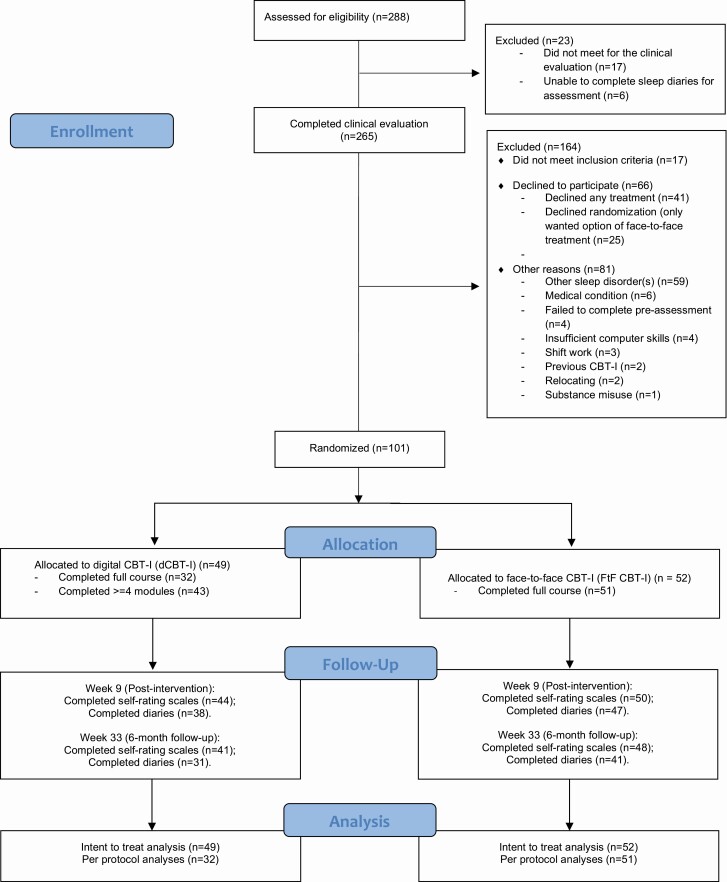
Study objectives: Digital Cognitive Behavioral Therapy for Insomnia (dCBT-I) has demonstrated efficacy in reducing insomnia severity in self-referred and community samples. It is unknown, however, how dCBT-I compares to individual face-to-face (FtF) CBT-I for individuals referred to clinical secondary services. We undertook a randomized controlled trial to test whether fully automated dCBT-I is non-inferior to individual FtF CBT-I in reducing insomnia severity.
Methods: Eligible participants were adult patients with a diagnosis of insomnia disorder recruited from a sleep clinic provided via public mental health services in Norway. The Insomnia Severity Index (ISI) was the primary outcome measure. The non-inferiority margin was defined a priori as 2.0 points on the ISI at week 33.
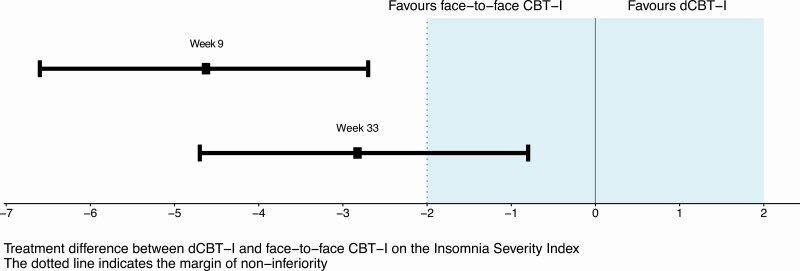
Results: Individuals were randomized to FtF CBT-I (n = 52) or dCBT-I (n = 49); mean baseline ISI scores were 18.4 (SD 3.7) and 19.4 (SD 4.1), respectively. At week 33, the mean scores were 8.9 (SD 6.0) and 12.3 (SD 6.9), respectively. There was a significant time effect for both interventions (p < 0.001); and the mean difference in ISI at week 33 was -2.8 (95% CI: -4.8 to -0.8; p = 0.007, Cohen's d = 0.7), and -4.6 at week 9 (95% CI -6.6 to -2.7; p < 0.001), Cohen's d = 1.2.
Conclusions: At the primary endpoint at week 33, the 95% CI of the estimated treatment difference included the non-inferiority margin and was wholly to the left of zero. Thus, this result is inconclusive regarding the possible inferiority or non-inferiority of dCBT-I over FtF CBT-I, but dCBT-I performed significantly worse than FtF CBT-I. At week 9, dCBT-I was inferior to FtF CBT-I as the 95% CI was fully outside the non-inferiority margin. These findings highlight the need for more clinical research to clarify the optimal application, dissemination, and implementation of dCBT-I. Clinicaltrials.gov: NCT02044263: Cognitive Behavioral Therapy for Insomnia Delivered by a Therapist or on the Internet: a Randomized Controlled Non-inferiority Trial.
Keywords: Cognitive Behavioral Therapy for Insomnia; digital; face-to-face; insomnia disorder; non-inferiority; randomized controlled trial.
© Sleep Research Society 2021. Published by Oxford University Press on behalf of the Sleep Research Society.
Figures
References
-
- Pallesen S, et al. A 10-year trend of insomnia prevalence in the adult Norwegian population. Sleep Med. 2014;15(2):173–179. - PubMed
-
- American Psychiatric Association. Diagnostic and Statistical Manual of Mental Disorders: DSM-5. 5th ed.Washington, DC: American Psychiatric Association; 2013.
-
- Riemann D, et al. European guideline for the diagnosis and treatment of insomnia. J Sleep Res. 2017;26(6):675–700. - PubMed
-
- Morin CM. Cognitive behavioral therapy for chronic insomnia: state of the science versus current clinical practices. Ann Intern Med. 2015;163(3):236–237. - PubMed
