Association Between Visual Field Damage and Gait Dysfunction in Patients With Glaucoma
- PMID: 34292297
- PMCID: PMC8299359
- DOI: 10.1001/jamaophthalmol.2021.2617
Association Between Visual Field Damage and Gait Dysfunction in Patients With Glaucoma
Abstract
Importance: Gait dysfunction is common in older people with visual impairment and is a major cause of falls.
Objective: To compare 3-year longitudinal changes in gait measures across the spectrum of baseline visual field (VF) damage in glaucoma.
Design, setting, and participants: A post hoc analysis was designed on September 1, 2018, following a prospective cohort study, which enrolled older adults with glaucoma or suspected glaucoma from September 2013 to March 2015 and followed up for up to 3 years. Baseline VF damage was defined by integrated VF (IVF) sensitivity and categorized as normal/mild (IVF >28 dB), moderate (IVF, 23-28 dB), and severe (IVF, <23 dB). Each participant walked on an electronic walkway back and forth twice at normal pace each study year. Linear mixed-effects models evaluated longitudinal change in gait outcomes (1) stratified within each VF severity category and (2) across the range of IVF sensitivity. Analysis took place from October 2019 to October 2020.
Main outcomes and measures: Three-year changes in 7 gait assessments under usual-pace walking, including base support and its coefficient of variation, stride length and its coefficient of variation, stride velocity and its coefficient of variation, and cadence.
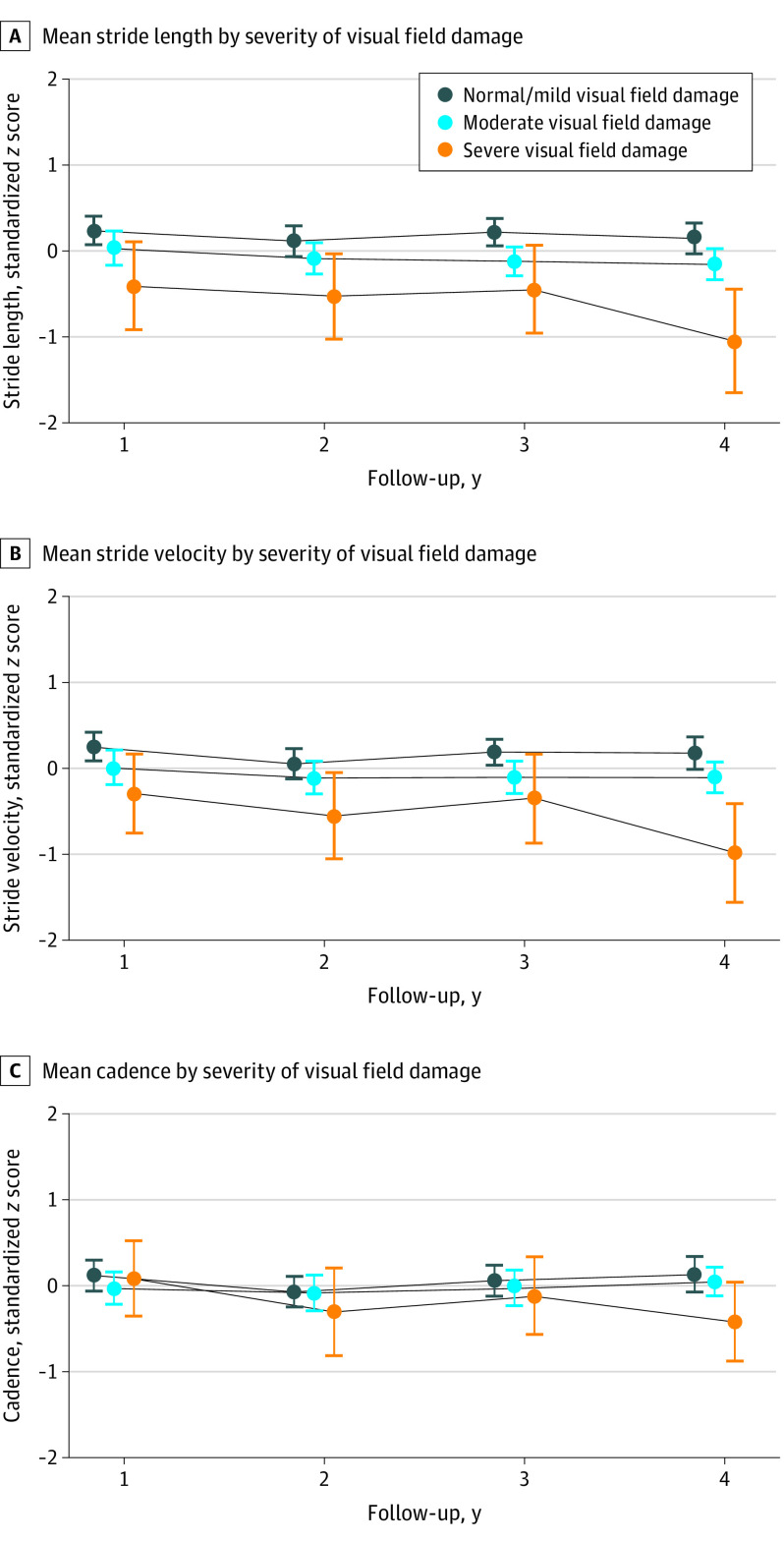
Results: Of 241 participants, the mean (SD) age was 70.8 (7.7) years, 116 (48.2%) were women, and 70 (29.0%) were African American. When comparing longitudinal gait changes over 3 years across the spectrum of IVF sensitivity, each 5-unit (dB) decrement was associated with more rapid declines in stride velocity (-0.05 z score unit/y; 95% CI, -0.09 to -0.01; P = .01) and cadence (-0.07 z score unit/y; 95% CI, -0.10 to -0.03; P < .001). When evaluating gait changes within each glaucoma severity group, shorter stride length was associated with persons with normal/mild (-0.06 z score unit/y; 95% CI, -0.10 to -0.03; P = .001), moderate (-0.08 z score unit/y; 95% CI, -0.12 to -0.04; P < .001), and severe VF damage (-0.16 z score unit/y; 95% CI, -0.24 to -0.07; P < .001), while stride velocity (-0.18 z score unit; 95% CI, -0.28 to -0.07; P = .002) and slower cadence (-0.15 z score unit; 95% CI, -0.25 to -0.04; P = .006) were associated with those with severe VF damage.
Conclusions and relevance: At worse levels of baseline VF damage, patients with glaucoma in this study demonstrated an exacerbated decline in walking speeds (ie, stride velocity and cadence), indicating that mobility speeds decrease faster over time in older adults with glaucoma.
Conflict of interest statement
Figures
Comment in
-
Severe Glaucoma Associated With Changes in Gait Over Time.JAMA Ophthalmol. 2021 Oct 1;139(10):1060-1061. doi: 10.1001/jamaophthalmol.2021.2621. JAMA Ophthalmol. 2021. PMID: 34292307 No abstract available.
References
Publication types
MeSH terms
Grants and funding
LinkOut - more resources
Full Text Sources
Medical
Miscellaneous