Aiming for a bull's-eye: Targeting antifungals to fungi with dectin-decorated liposomes
- PMID: 34293050
- PMCID: PMC8297870
- DOI: 10.1371/journal.ppat.1009699
Aiming for a bull's-eye: Targeting antifungals to fungi with dectin-decorated liposomes
Abstract
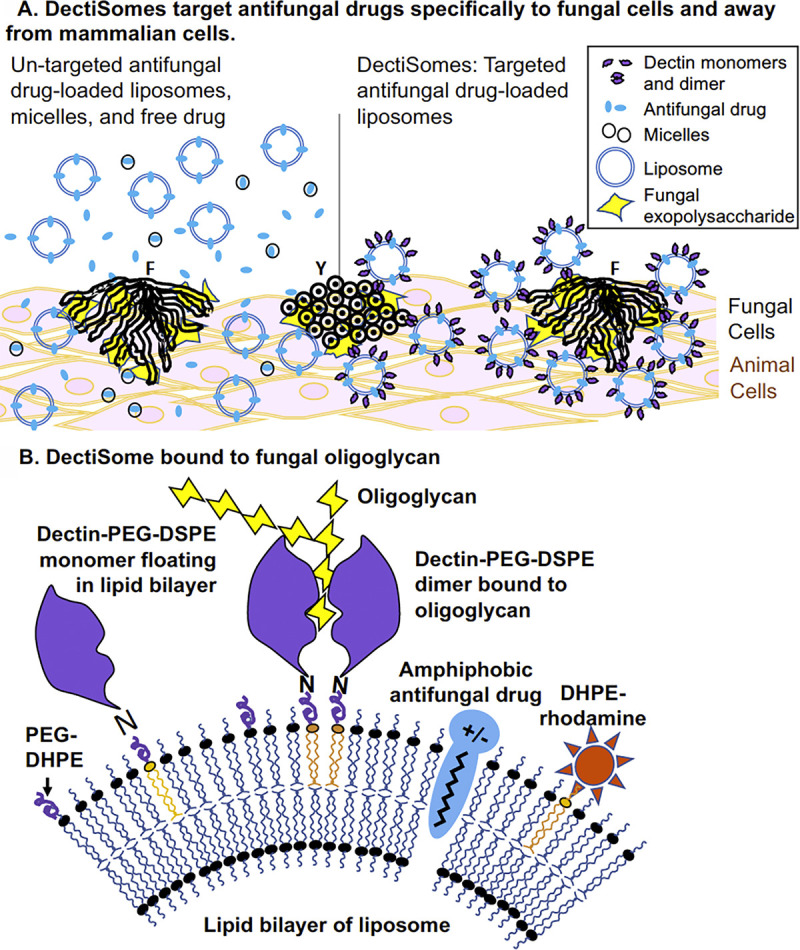
Globally, there are several million individuals with life-threatening invasive fungal diseases such as candidiasis, aspergillosis, cryptococcosis, Pneumocystis pneumonia (PCP), and mucormycosis. The mortality rate for these diseases generally exceeds 40%. Annual medical costs to treat these invasive fungal diseases in the United States exceed several billion dollars. In addition to AIDS patients, the risks of invasive mycoses are increasingly found in immune-impaired individuals or in immunosuppressed patients following stem cell or organ transplant or implantation of medical devices. Current antifungal drug therapies are not meeting the challenge, because (1) at safe doses, they do not provide sufficient fungal clearance to prevent reemergence of infection; (2) most become toxic with extended use; (3) drug-resistant fungal isolates are emerging; and (4) only one new class of antifungal drugs has been approved for clinical use in the last 2 decades. DectiSomes represent a novel design of drug delivery to drastically increase drug efficacy. Antifungals packaged in liposomes are targeted specifically to where the pathogen is, through binding to the fungal cell walls or exopolysaccharide matrices using the carbohydrate recognition domains of pathogen receptors. Relative to untargeted liposomal drug, DectiSomes show order of magnitude increases in the binding to and killing of Candida albicans, Cryptococcus neoformans, and Aspergillus fumigatus in vitro and similarly improved efficacy in mouse models of pulmonary aspergillosis. DectiSomes have the potential to usher in a new antifungal drug treatment paradigm.
Conflict of interest statement
I have read the journal’s policy and the authors of this manuscript have the following competing interests: The authors have applied for a patent (62/913,489, WO/2020/146514) on this technology.
Figures
References
-
- Prakash H, Chakrabarti A. Global Epidemiology of Mucormycosis. J Fungi (Basel). 2019;5(1). Epub 2019/03/25. doi: 10.3390/jof5010026 ; PubMed Central PMCID: PMC6462913. Available from: https://www.ncbi.nlm.nih.gov/pubmed/30901907 - DOI - PMC - PubMed
-
- Bongomin F, Gago S, Oladele R, Denning D. Global and Multi-National Prevalence of Fungal Diseases-Estimate Precision. J Fungi (Basel). 2017;3(4):1–29. Epub 2018/01/27. doi: 10.3390/jof3040057 ; PubMed Central PMCID: PMC5753159. Available from: https://www.ncbi.nlm.nih.gov/pubmed/29371573 - DOI - PMC - PubMed
-
- Benedict K, Jackson B, Chiller T, Beer K. Estimation of Direct Healthcare Costs of Fungal Diseases in the United States. Clin Infect Dis. 2019;68(11):1791–7. Epub 2018/09/12. doi: 10.1093/cid/ciy776 ; PubMed Central PMCID: PMC6409199. Available from: https://www.ncbi.nlm.nih.gov/pubmed/30204844 - DOI - PMC - PubMed
-
- Armstrong-James D, Meintjes G, Brown G. A neglected epidemic: fungal infections in HIV/AIDS. Trends Microbiol. 2014;22(3):120–7. 10.1016/j.tim.2014.01.001. Available from: https://www.sciencedirect.com/science/article/pii/S0966842X1400002X - DOI - PubMed
-
- O’Connor L, Van Anh D, Chau T, Chau N, Huong L, Wolbers M, et al.. Antifungal susceptibility does not correlate with fungal clearance or survival in AIDS-associated cryptococcal meningitis. Clin Infect Dis. 2020. Epub 2020/10/15. doi: 10.1093/cid/ciaa1544 . Available from: https://www.ncbi.nlm.nih.gov/pubmed/33051650 - DOI - PMC - PubMed
Publication types
MeSH terms
Substances
Grants and funding
LinkOut - more resources
Full Text Sources
Medical