


Relationship of proprioception, cutaneous sensitivity, and muscle strength with the balance control among older adults
- PMID: 34293496
- PMCID: PMC8500852
- DOI: 10.1016/j.jshs.2021.07.005
Relationship of proprioception, cutaneous sensitivity, and muscle strength with the balance control among older adults
Abstract
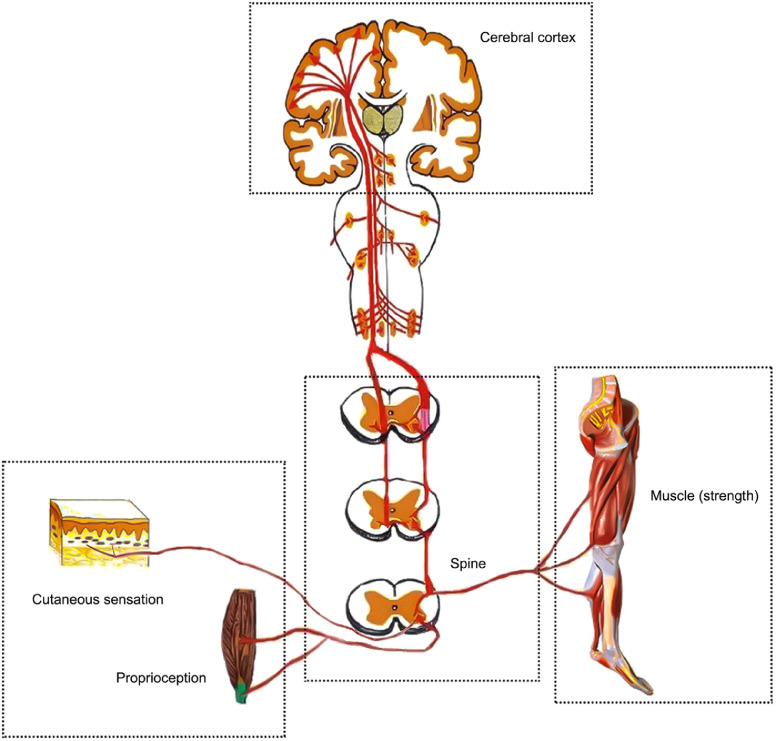
Background: Balance impairment is one of the strongest risk factors for falls. Proprioception, cutaneous sensitivity, and muscle strength are 3 important contributors to balance control in older adults. The relationship that dynamic and static balance control has to proprioception, cutaneous sensitivity, and muscle strength is still unclear. This study was performed to investigate the relationship these contributors have to dynamic and static balance control.
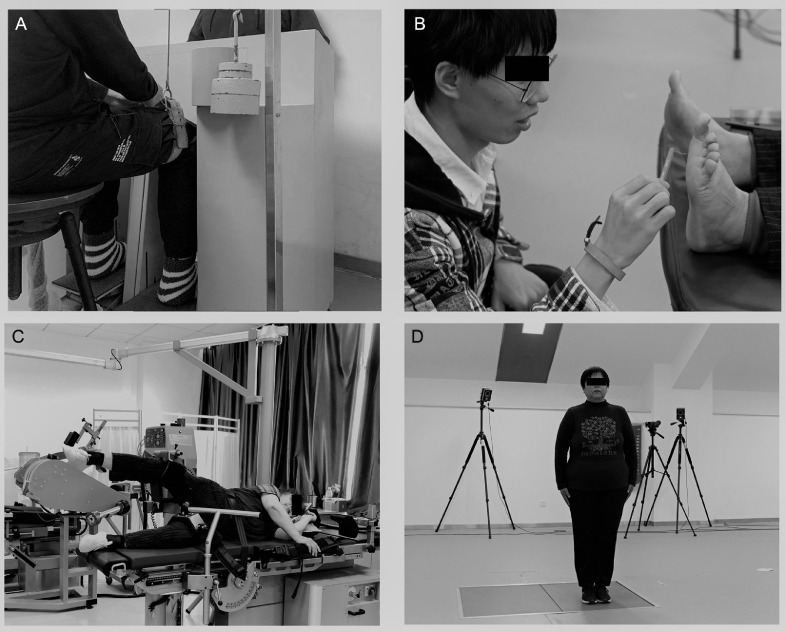
Methods: A total of 164 older adults (female = 89, left dominant = 15, age: 73.5 ± 7.8 years, height: 161.6 ± 7.1 cm, weight: 63.7 ± 8.9 kg, mean ± SD) participated in this study. It tested the proprioception of their knee flexion/extension and ankle dorsi/plantarflexion, along with cutaneous sensitivity at the great toe, first and fifth metatarsals, arch, and heel, and the muscle strength of their ankle dorsi/plantarflexion and hip abduction. The Berg Balance Scale (BBS) and the root mean square (RMS) of the center of pressure (CoP) were collected as indications of dynamic and static balance control. A partial correlation was used to determine the relationship between the measured outcomes variables (BBS and CoP-RMS) and the proprioception, cutaneous sensitivity, and muscle strength variables.
Results: Proprioception of ankle plantarflexion (r = -0.306, p = 0.002) and dorsiflexion (r = -0.217, p = 0.030), and muscle strength of ankle plantarflexion (r = 0.275, p = 0.004), dorsiflexion (r = 0.369, p < 0.001), and hip abduction (r = 0.342, p < 0.001) were weakly to moderately correlated with BBS. Proprioception of ankle dorsiflexion (r = 0.218, p = 0.020) and cutaneous sensitivity at the great toe (r = 0.231, p = 0.041) and arch (r = 0.285, p = 0.002) were weakly correlated with CoP-RMS in the anteroposterior direction. Proprioception of ankle dorsiflexion (r = 0.220, p = 0.035), knee flexion (r = 0.308, p = 0.001) and extension (r = 0.193, p = 0.040), and cutaneous sensitivity at the arch (r = 0.206, p = 0.028) were weakly to moderately correlated with CoP-RMS in the mediolateral direction.
Conclusion: There is a weak-to-moderate relationship between proprioception and dynamic and static balance control, a weak relationship between cutaneous sensitivity and static balance control, and a weak-to-moderate relationship between muscle strength and dynamic balance control.
Keywords: Body stability; Dynamic balance; Kinesthesia; Plantar sensation; Postural control.
Copyright © 2021. Production and hosting by Elsevier B.V.
Figures
References
-
- Antonio PJ, Perry SD. Quantifying stair gait stability in young and older adults, with modifications to insole hardness. Gait Posture. 2014;40:429–434. - PubMed
-
- Muir SW, Berg K, Chesworth B, Klar N, Speechley M. Balance impairment as a risk factor for falls in community-dwelling older adults who are high functioning: A prospective study. Phys Ther. 2010;90:338–347. - PubMed
-
- Zhao YL, Alderden J, Lind BK, Kim H. A comprehensive assessment of risk factors for falls in community-dwelling older adults. J Gerontol Nurs. 2018;44:40–48. - PubMed
-
- Ambrose AF, Paul G, Hausdorff JM. Risk factors for falls among older adults: A review of the literature. Maturitas. 2013;75:51–61. - PubMed
-
- Berg KO, Wood-Dauphinee SL, Williams JI, Maki B. Measuring balance in the elderly: Validation of an instrument. Can J Public Health. 1992;83(Suppl. 2):S7–11. - PubMed
Publication types
MeSH terms
LinkOut - more resources
Full Text Sources
Medical
