Review
. 2021 Jul 22;14(1):114.
doi: 10.1186/s13045-021-01125-y.

Metabolic landscapes in sarcomas

Affiliations
Review

Metabolic landscapes in sarcomas

Richard Miallot et al. J Hematol Oncol. .

Abstract

Metabolic rewiring offers novel therapeutic opportunities in cancer. Until recently, there was scant information regarding soft tissue sarcomas, due to their heterogeneous tissue origin, histological definition and underlying genetic history. Novel large-scale genomic and metabolomics approaches are now helping stratify their physiopathology. In this review, we show how various genetic alterations skew activation pathways and orient metabolic rewiring in sarcomas. We provide an update on the contribution of newly described mechanisms of metabolic regulation. We underscore mechanisms that are relevant to sarcomagenesis or shared with other cancers. We then discuss how diverse metabolic landscapes condition the tumor microenvironment, anti-sarcoma immune responses and prognosis. Finally, we review current attempts to control sarcoma growth using metabolite-targeting drugs.

Keywords: Metabolism; Metabolite-targeted therapies; Metabolomics; Microenvironment; Sarcoma; Transcriptomics.


Conflict of interest statement

The authors declare that they have no competing interests.

Figures
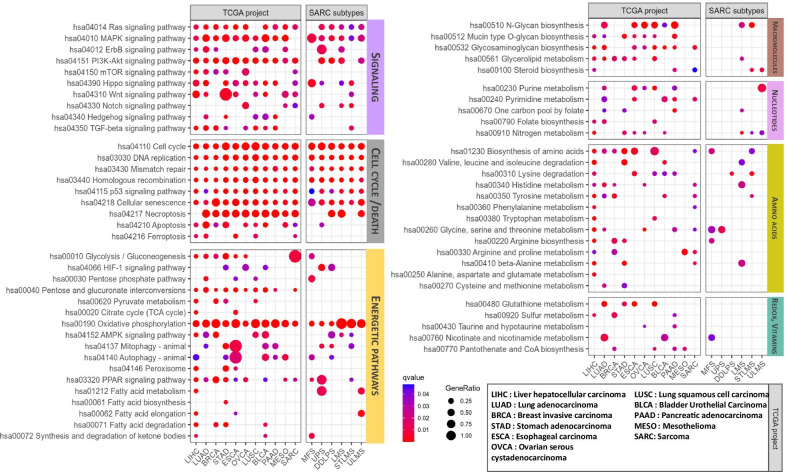
Fig. 1
Fig. 1
Analysis of the TCGA transcriptomic database. Dotplots showing functional enrichment for co-expression modules found in various cancer types and predominant sarcoma subtypes. Htseq raw counts were retrieved from TCGA using GDCquery [22] and VST-normalized [23]. For each dataset, the unsigned co-expression network was produced using WGCNA with automatic pick for soft-thresholding powers. Genes in each module were queried for functional enrichment against Reactome Pathway Database [24] using clusterProfiler [25]. p values were adjusted using Benjamini–Hochberg procedure. For each dataset-pathway pair, the p value corresponds to the lowest one from all the co-expression modules. A subset of the significant (q-value < 0.05) pathways was manually annotated into functional groups for display in the figure. Dots highlight significant pathway-dataset pairs
Fig. 2
Fig. 2
Oncogenic and tumor suppressor pathways altered in STS. (A) This figure highlights mutations that alter regulations of PI3K/AKT/mTOR and MAP kinase pathways in sarcoma. Colored triangles associate sarcoma subtypes (listed on the bottom right corner) with the corresponding genes alterations, either expression or loss, on the scheme. Expression or regulations of tumor suppressor genes is altered (p53, PTEN) concomitantly with increased expression of oncogenes driving malignant transformation (increase Anabolism, Warburg effect). (B) Panel B focuses on cell cycle alterations at the level of the p53 and RB1 tumor suppressor genes notably
Fig. 3
Fig. 3
Metabolic consequences of STS-associated molecular alterations. This scheme integrates sarcoma genetic alterations affecting tumor suppressor genes (green background) or oncogenes (black background) in the tumor metabolic network. These alterations enhance enzymatic reactions in favor of anabolic pathways by increasing the glycolytic flux (pink) and branched pathways, notably nucleotide (yellow), fatty acids (orange) and DNA/RNA synthesis at the cost of dampens mitochondrial function and TCA cycle proper functioning
Fig. 4
Fig. 4
Integrated view of cues and pathways amenable to pharmacological modulation in STS. This diagram places the different existing therapies in sarcoma according to their therapeutic targets. Panel (A) stratify therapeutic option according to main cellular pathways and table B index the current clinical trial and biomarker available in sarcoma disease

References

    1. Lye KL, Nordin N, Vidyadaran S, Thilakavathy K. Mesenchymal stem cells: from stem cells to sarcomas. Cell Biol Int. 2016;40:610–618. doi: 10.1002/cbin.10603. - DOI - PubMed
    1. Xiao W, Mohseny AB, Hogendoorn PCW, Cleton-Jansen A-M. Mesenchymal stem cell transformation and sarcoma genesis. Clin Sarcoma Res. 2013;3:10. doi: 10.1186/2045-3329-3-10. - DOI - PMC - PubMed
    1. Burningham Z, Hashibe M, Spector L, Schiffman JD. The epidemiology of sarcoma. Clin Sarcoma Res. 2012;2:14. doi: 10.1186/2045-3329-2-14. - DOI - PMC - PubMed
    1. Italiano A, Di Mauro I, Rapp J, Pierron G, Auger N, Alberti L, et al. Clinical effect of molecular methods in sarcoma diagnosis (GENSARC): a prospective, multicentre, observational study. Lancet Oncol. 2016;17:532–538. doi: 10.1016/S1470-2045(15)00583-5. - DOI - PubMed
    1. Skubitz KM, Skubitz AP, Xu WW, Luo X, Lagarde P, Coindre J-M, et al. Gene expression identifies heterogeneity of metastatic behavior among high-grade non-translocation associated soft tissue sarcomas. J Transl Med. 2014;12:176. doi: 10.1186/1479-5876-12-176. - DOI - PMC - PubMed

Publication types
